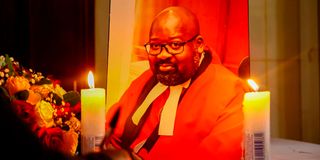
Many in the legal fraternity were surprised and saddened that Justice David Majanja, a High Court Judge, passed on earlier this week. Justice Majanja has been described by many since his demise as warm, friendly and brilliant and other descriptions which may appear as normal platitudes in Africa for the departed.
Like many others, I tried to reflect on the life of Justice Majanja and what it means to me and to the legal profession in Kenya. I had the privilege to have been the late Judge’s contemporary (albeit in different years) at the University of Nairobi, then colleagues at the bar, followed by a stint when he was advising counsel and acted when I instructed him in some cases for my employer. Finally, when he was appointed a Judge about a decade ago, I found myself on a number of occasions appearing before him as counsel representing my employer and client and even on an occasion as a witness in a case he presided over in the commercial courts in Milimani.
Put differently, I may say that I found the honour of living all sides of the law with Justice Majanja from a student to a litigant before him when he became a Judge. That is the extent of my benefit from his life in the law – and loss in his demise. In all these spheres, he inspired many greatly and gave hope in the essence of law and its place in ensuring fairness and justice.
There is no doubt in my mind, and shared by many who knew him that David Majanja was a person of stellar intellectual abilities as seen in the professional stations he occupied, But the unique quality for this was that Justice Majanja did not take to the law in an ideological manner. Even in law school, he refrained from the tendency to have a strict line of personal jurisprudence that most students fell blindly into. He would often say that he leant towards positivist legal thought in terms of approach to the exercise of power, that is the need to ensure that power is restrained strictly to the corners of written law.
But the historical school of law, that propelled home-grown law on matters that related to the social aspects of life also appealed to him. Yet, human rights consciousness was honed by the natural school of law to the effect that law may be law but could be so baggage-ridden as to justify blind adherence. When he became a Judge, this latter school was echoed in the way he approached decisions by courts form outside Kenya. Majanja as a Judge, was cautious to prevent what is known in law as legal obscurantism, that is blind and unquestioning application of legal principles or statutory provisions.
In all these strands of my experiences with him, Justice Majanja by character reveled in industry. He was just a diligent worker. As Advocate or Judge, he went to court every time with the distinguished quality of having a unique command of the facts, documentation and even the law applicable to the case in a manner that was not always matched by fellow or opposing counsel and even occasionally with the other judges whenever he sat in a case as a member of a multiple judge panel hearing a case. The efficiency with which he delivered rulings and judgments after hearing a case is exemplary in that he rarely adjourned a judgment date on the ground that the Judgment was not ready.
His joining the Judiciary from private legal practice at a relatively young age in or about 2012 was one which many known to him questioned as the proper career move for him. His answer to this writer in particular was that the new constitutional dispensation needed a Judiciary that could give it life within the Judiciary no less than from the bar in advocacy. But beyond his words, the answer to this question was given to the country by his conduct: The acuity with which he took to his duties as Judge in the form of the efficiency, the lucid and fluent writing of his judgments erased any doubts as to whether this was ever the right choice for both Judge and litigant and the country at large. Whether as a student, as Advocate or as a Judge, one thread, a golden one I add, was that Justice Majanja did esteem the law, but that he loved justice more.
In his view, the rule of law matters to the extent that it was applied correctly and fairly into the lives of the citizen. He exhibited this in many of his judgments whether in the commercial division of the high courts, in criminal appeals, and in the civil divisions, all, of which he served in in many high court stations in Kenya.
Two cases in which he sat as Judge reveal this. In the first case. Justice Majanja ruled that by failing to consider a party’s further submissions, the Arbitrator had denied that party the right to fairness and justice in a fundamental sense as a matter of justice not just as required by the constitution. He then set aside the Arbitrators award on that account in words that resonated with his belief that procedural fairness as an aspect of law is not negotiable in exercising of judicial or any administrative functions.
The second case shows a core component of Justice Majanja that his neat mind transcended to other aspects of his life. He liked the law to be neat too, meaning it had to be fair plain and easy. By this is meant, that it had to be fair. In the case which challenged the constitutionality of the Finance Bill 2023. In that case, Justice Majanja led a three-judge panel of the High court to the unanimous finding that that the introduction of the housing levy through amendment of the Employment Act lacked a comprehensive legal framework in violation of the Constitution.
But in addition to his intellect, integrity and industry, Justice Majanja was human and humane. Whether as a student, as Advocate or on the bench, his comportment and humanity in the way he treated opposing views or counsel was always true to the oath to act justly. He was particularly helpful as a Judge whenever a litigant was unrepresented and made sure that the pace of trial did not go over the litigant in a manner that tilted the scales of justice.
This would be evident during proceedings by ensuring that the legal processes and concepts were translated to the litigants in language all the way to the same simplicity in the rulings and judgments after that hearing. It is this tapestry of intellect, integrity and industry founded on humane gentility that is my loss and I suppose, of the Judiciary, his friends, and colleagues. Rest in peace, Justice David Shikomera Majanja.