Bridging the global trust deficit requires a fairer world order
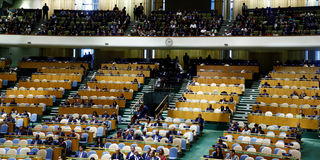
Delegates at the General Assembly hall during the 81st United Nations General Assembly (UNGA) at UN headquarters in New York City, US, September 24, 2026.

When the embers of the Second World War were still burning, 50 nations gathered in San Francisco in 1945 to build a new international order. Africa had only a handful of representatives, a continent largely under colonial rule.
The United Nations Charter that emerged enshrined sovereign equality, cooperation and collective security, and for eight decades it has held the international community together through wars and crises.
Yet the institutions built to sustain cooperation have not evolved to reflect the world they serve.


The Bretton Woods institutions, established in 1944, carry the same imbalance. Africa’s limited role in their founding left a legacy of unequal influence over global economic governance. Today, Africa’s 54 countries hold less than 10 per cent of voting power in key international financial institutions. This shapes access to affordable finance, debt sustainability and development, and raises a fundamental question: how can institutions command trust when those most affected by their decisions have the least influence over them?
In 1955, leaders from Asia and Africa met in Bandung, Indonesia, and argued that an international order cannot be legitimate if it excludes much of humanity. Their principles of sovereign equality, mutual respect and cooperation without domination shaped the Non-Aligned Movement and an enduring call for a fairer world.
That call is more urgent today. Strategic competition is intensifying, economies are fragmenting and confidence in international institutions is under strain. Kenya’s position is clear: global trust must be earned through fairness, representation, accountability and results.
Representation is essential to legitimacy
The Security Council remains the starkest example of the gap between 1945 and today. Africa, home to more than 1.4 billion people, has no permanent seat. This is not a question of prestige; it goes to the legitimacy and effectiveness of decisions on international peace and security. Reform must give Africa meaningful, permanent representation.
The World Trade Organization and the financial institutions pose similar challenges. Developing countries must compete in markets shaped by subsidies, standards and financing that often favour established economies. Formal equality means little without the resources or influence to negotiate on equal terms.
A credible system must give developing economies a fair chance to industrialise, diversify exports and join global value chains, under rules that are transparent, predictable and consistently applied.
BRICS is a signal, not a substitute
The rise of BRICS and other platforms reflects a desire for greater voice in finance, trade and development. It should not be read as a rejection of multilateralism, but as dissatisfaction with institutions slow to adapt. The answer is not to replace one club with another, but to make existing institutions more inclusive and effective.
Kenya’s foreign policy values diversified partnerships across traditional partners, emerging economies and regional organisations. Countries need not agree on everything to cooperate on climate change, pandemics, insecurity and economic instability.
Trust must translate into results
Regional integration offers lessons. The East African Community has advanced trade and mobility, yet non-tariff barriers and uneven implementation persist. The African Continental Free Trade Area promises wider markets and opportunity for young entrepreneurs. Both show that trust grows when governments honour commitments and citizens see tangible benefits.
Peace and security demand the same consistency. Conflicts in eastern Democratic Republic of the Congo and Sudan require sustained diplomacy, credible mediation and coordinated humanitarian action. African-led peace initiatives deserve meaningful political support and predictable financing.
Climate and health will also test the system’s credibility. Africa contributes little to historical emissions yet faces severe climate risks, so climate finance, adaptation support and technology transfer must be accessible, predictable and adequate. COVID-19 exposed the cost of unequal access to medical products; regional health manufacturing, research and surveillance are essential to collective preparedness. For Africa’s young people, trust must also mean education, technology, affordable finance and decent work.
Shared responsibility
Rebuilding trust requires responsibility from all. Governments must respect international law, honour commitments and settle disputes peacefully. Established powers must recognise that reform strengthens, rather than diminishes, multilateral legitimacy. Developing countries must strengthen governance, deepen regional cooperation and pursue reform through sustained engagement.
As Kenya prepares to advance the Nairobi Dialogues on Global Trust, the task is to turn principles into measurable commitments. The priorities are clear: a fairer financial architecture offering affordable finance and meaningful representation; Security Council reform, including permanent African representation; and a system whose rules apply consistently to all. These are not demands for special treatment. They are the foundations of a system every nation can trust.
The choice is not between the Global North and South, or between established institutions and emerging powers. It is between a fragmented order shaped by suspicion and renewed multilateralism grounded in fairness.
Trust will be rebuilt when institutions reflect the world they serve, commitments are honoured and cooperation delivers for all.
Follow our WhatsApp channel for breaking news updates and more stories like this.
The writer is the Principal Secretary, State Department for Foreign Affairs