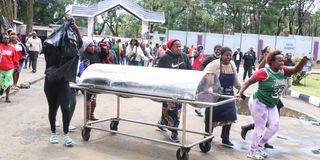
In the past year, Kenya has witnessed a deeply troubling pattern: children leaving home healthy, only to die while in boarding school, many after reportedly developing fever, shivering, or symptoms later linked to acute infections such as malaria.
When news broke that Brenda Akinyi of Njoro Girls High School in Nakuru County had died from cerebral malaria, families were horrified.
When we learnt through Emmanuel Kirimi’s autopsy report that the Form One student of Kilungu Boys High School in Makueni County had died from infection, we were troubled. And we are left asking a hard, uncomfortable question: Are Kenya’s boarding schools medically prepared to keep children safe?
Anyone who has raised a child in Kenya knows how quickly a simple fever can deteriorate and become complicated progressing to convulsions and even loss of consciousness.
We know from clinical best practices that any child presenting with fever, especially above 37.5 degrees C should be evaluated immediately. Other red flags like lethargy, difficult breathing or decreased alertness should trigger expedited evaluation.
The frightening thought that we are starting to see in these cases, however, is that schools simply may not have trained individuals on site to help make these lifesaving decisions in time.
In too many settings, the first responder to a sick child is not a nurse or clinical officer. It may be a matron. A teacher. A well-meaning but overstretched staff member operating beyond their clinical competence. The intention may be good, but good intentions do not replace trained medical judgment.
Unfortunately, many parents assume that once a child is admitted into a boarding institution, there are clear medical protocols, trained health personnel, and rapid referral systems in place. Across the country, that assumption may not always hold. The gap between illness onset and decisive medical action is where preventable tragedies can occur.
When children are sick, they should not be pushed through the school day as usual. Each boarding school ought to have a well-established stay home when sick policy.
Students who are running a fever, vomiting, or too sick to engage in normal school activities should not be in class. They should be isolated and monitored in a supervised medical area until they are able to return to class or sent home.
Schools should strive to normalise children coming forward with illnesses early on, instead of inadvertently praising those who silently suffer through it.
At the very least, children should be fever free for 24 hours (without the aid of fever-reducing medicine). They should be able to eat and drink well, and show obvious signs of clinical improvement before resuming normal school activities. Anything less than this could lead to relapse of symptoms and/or the spread of infection.
Every boarding school is, in reality, a small residential community. Like any community housing large numbers of children, it must have the capacity to recognise, sort, and escalate illness quickly. This is the essence of triage. Internal triage protocols must be written, visible, and regularly practised. Schools need clear internal guidance that helps staff quickly identify which symptoms require immediate clinical review, which children can be safely observed in the infirmary, and when referral to a hospital must occur without delay.
There must also be clarity on who is authorised to make medical escalation decisions and what procedures apply during night hours when many serious illnesses worsen. Without structured triage systems, schools risk dangerous delays, not necessarily out of negligence, but out of uncertainty and lack of clinical capacity.
But maybe the best litmus question of readiness is this: What medically happens at night if a child becomes sick ? Ideally, schools need clearly documented protocols that allow for quick clinical assessment, urgent transfer if red flags are identified, reliable overnight security and medical contact numbers, trusted emergency transportation and defined timelines for escalating care and contacting parents if a child becomes severely ill.
The Teachers Service Commission, Ministry of Health, and Ministry of Education working jointly with county governments, must commit to conducting national audits. The first audit is that of mortalities. All student deaths in boarding schools over at least the last three years must be audited. Kenya deserves answers backed by facts.
Questions such as: What were the presenting symptoms? How long had the student been ill while in school? What care was sought? When was referral made? Could any delay have been avoided?
Transparency on this scale is the only way to stop normalising deaths that could have been prevented. The second audit Kenya requires is a nationwide assessment of school health preparedness. This audit must determine whether schools actually have competent health personnel in place, as well as a functional triage system, nighttime response capability, referral linkages with neighbouring health facilities, and guaranteed emergency transport.
Every parent shares a single hope when they send their child away to school. If something happens to my child while they are at school, someone will know they are in danger and get help before it is too late.
Schools need qualified staffing, basic triage and treatment protocols, and functional referral systems for when a student needs further care. If these things are not in place, they should be identified and remedied.