Premium
Let’s stay course with NSSF deductions
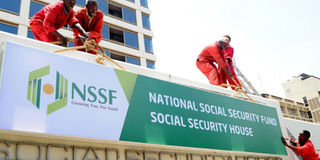
Workers erecting a sign at NSSF's Social Security House offices in Nairobi.
What you need to know:
- It took almost half a century for NSSF to be converted from a provident to a pension fund.
- NSSF and its organs need to do more to engage workers in creating greater ownership.
Workers are staring at another incremental phase of National Social Security Fund (NSSF) deductions, much to their chagrin.
At independence, the government, in trying to address the pressing needs of its citizens, identified three key issues—poverty, ignorance and disease. Establishment of a national provident fund and a health insurance fund were among the policy prescriptions outlined.
It took almost half a century for NSSF to be converted from a provident to a pension fund. Even after its conversion, full implementation had been stalled by litigious opposition. Workers made a monthly contribution of Sh200 and ended up getting one-off benefits from the fund. Those who did not have alternative pension plans retired in penury.
The 2013 law and its regulations outlined how the new deductions would be staggered over a period of five years. Given that workers had existing financial commitments, this approach was the most acceptable as it gave workers a breather between each increment.
Formidable retirement nest egg
The importance of allowing these deductions to run their course cannot be gainsaid. Every worker needs to build a formidable retirement nest egg that will replace their income at old age. This can only happen if—together with prudent investment of funds —a war chest of savings is put away for their eventual retirement.
Focus has largely been laid on the impact on workers’ payslips at the expense of their overall retirement strategy. NSSF and its organs need to do more to engage workers in creating greater ownership. Smoothening out of the contracting-out option of Tier II contributions to other retirement schemes will also go a long way in pacifying conflicts.
Retiring without a good fallback income will force workers to rely on other social protection initiatives such as government social pensions and traditional forms of social security. But with a fiscal space that lacks headroom and the erosion of our traditional social security mechanisms, a majority of retiring workers will be left to their own devices if the NSSF deductions remain low.
The writer is a social protection specialist based in Nairobi