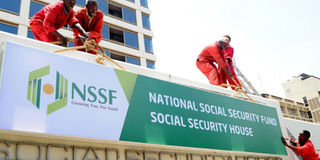
Research shows that 39 per cent of Kenyans who retire die within two years. That single statistic should sit at the centre of any conversation about the National Social Security Fund (NSSF), not at the margins.
It tells us something brutal, our current retirement system does not just fail to protect life after work it may be helping to shorten it.
When a worker has saved only Sh200 a month, the link between poverty in old age, stress, poor health and early death is not theoretical; it is lived reality.
This is why the Court of Appeal’s decision to revert NSSF to the old Sh200 flat contribution is so troubling. For the last two years, Kenyans have been contributing 12 per cent of pensionable income under the 2013 NSSF Act.
In that short period, NSSF’s savings doubled, matching what had been accumulated from independence to the date the Act took effect.
That is what a serious, earnings‑based system can do. By striking down the Act without a transition window, the court has effectively dismantled the only reform that had begun to move Kenya toward meaningful retirement security.
The regional and global benchmarks make this even clearer. Uganda takes about 15 per cent of salary into its NSSF.
Tanzania is around 20 per cent through its main pension schemes. These are not perfect systems, but they are built on the idea that retirement income must be linked to what people earn.
Singapore, with a life expectancy of about 84 years, mandates contributions of up to 37 per cent through its Central Provident Fund. Kenya, with life expectancy around 64 years, is still asking most workers to rely on Sh200 a month. We should not be surprised that so many retirees do not live long enough to enjoy their old age.
The courts have a duty to uphold the Constitution, including proper law‑making processes. But they also operate within a society whose survival depends on more than technical correctness.
In other jurisdictions, apex courts have recognised this tension and used their powers to suspend declarations of invalidity where immediate cancellation of a law would harm millions.
South Africa’s Constitutional Court, for example, has suspended invalidity in social grant and procurement cases to avoid interrupting payments to vulnerable citizens while Parliament fixes defects.
The principle is simple: protect rights and process, but do not collapse systems that keep people alive.
Kenya’s Supreme Court has similar tools. It can look beyond narrow legal flaws and ask; “What happens to real people if this decision takes effect immediately?” In cases touching on public finance and national policy, it has already shown a willingness to consider public interest and national stability when shaping remedies.
That same logic should apply here. An appeal on the NSSF issue should not only argue about procedure, but it should also ask the Supreme Court to consider practicality and public interest to recognise that retirement income is a matter of life and death for hundreds of thousands of Kenyans.
The court could, for instance, uphold concerns about how the 2013 Act was passed, but suspend the invalidity for a defined period.
That would keep the 12 per cent contribution regime in place while giving Parliament time to cure the defects through proper consultation and legislation. Such an approach would avoid “throwing the baby out with the bath water”, we keep the gains in savings and adequacy, while fixing the constitutional plumbing.
From here, the path forward is clear, even if it is politically uncomfortable. Kenya needs a new, watertight NSSF law that keeps contributions earnings‑based, protects low‑income workers through thresholds and phasing, and locks in strong governance so that every shilling is safe and well‑invested.
It needs a multi‑pillar system that combines a basic social pension for the poorest, a mandatory earnings‑related scheme for all workers, and voluntary savings on top. And it needs courts that, while firm on the Constitution, are also alive to the human cost of their remedies.
We cannot keep pretending that Sh200 a month is “better than nothing” when we know that 39 per cent of our retirees are dying within two years.
Mr Omollo, the managing partner of Bon&Drew Associates, is a council member of ICPAK and a governance consultant.
That is not a statistic, it is an indictment. The next round of litigation should not just be about who was right on process. It should be about whether Kenya is willing to design a retirement system that lets its people live long enough and well enough to enjoy the years after work.
The author is the managing partner of Bon&Drew Associates and a council member of ICPAK. Also a governance consultant.