The decision to securitise a portion of the Road Maintenance Levy has caused a profound human and economic impact on the lives of Kenyans across the country.
By unlocking Sh175 billion to settle long-standing pending bills, the government has not only revived over 580 stalled road projects but also breathed new life into communities, businesses, and livelihoods that had been left in limbo.
A total of Sh65 billion has already been disbursed, and resumption of construction has taken place in earnest, with strict timelines set for the contractors. By mid-next month, 80 per cent of pending road bills will have been settled, post-market losses will be reduced, and access to markets will be assured.
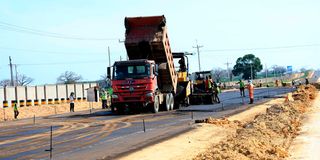
On a human level, the resumption of roadworks has created thousands of jobs for contractors, engineers, suppliers, and casual labourers. For many families, it means restored incomes, dignity, and the ability to meet daily needs.
In areas where roads were incomplete or impassable, renewed construction has improved access to schools, hospitals, and markets—making daily life safer and more efficient.
Economically, the impact has been equally significant. Contractors who had previously shut down operations due to unpaid dues have resumed work, restoring confidence in the construction sector and creating a ripple effect in related industries such as transport, hospitality, and the supply of materials.
Local economies are now experiencing increased activity as road networks are improved, travel times are reduced, and rural areas are better connected to national markets.
Securitisation has, therefore, not only addressed a financial backlog but also sparked a new wave of productivity, mobility, and opportunity. It stands as a bold and practical solution to a long-standing challenge—bringing visible, measurable benefits to Kenyans on the ground.
Apart from resuming construction on many stalled projects, the government will undertake several new ones nationwide, especially in the Eastern parts of the capital, agriculturally-rich areas such as Nyandarua and in many other parts of the country.
Most of the work will be undertaken through such government agencies as Kura, Kenha and Kerra, with funds obtained from the securitisation.
Stalled infrastructure projects with maximum impact on communities and the economy will be revived, and this will go a long way in rejuvenating the construction industry, creating jobs across the population and also unlocking infrastructure investments nationwide.
Some of the flagship projects targeted in this drive include the expansion of Kiambu Road through Kenha. This will entail converting the often-congested vital link to the city through Thika superhighway into a four-lane dual carriageway with two service lanes on either side, covering Pangani-Muthaiga-Ndumberi.
Funded by the China Exim Bank and expected to take 36 months to complete, the flagship project will have new interchanges, six pedestrian bridges, bus bays and non-motorised transport lanes.
It is set to improve mobility and safety, but most of all, ease congestion in Eastern Nairobi and the flow of traffic into the Thika superhighway.
Stalled roads whose construction has resumed include, in Nyandarua County, the Siranga–Boiman Road, Siranga–Charagita Road, and Charagita-Tumaini Road.
In Marsabit County, the Segel–Marsabit road has resumed, while in Turkana County, the Todonyang–Likitaung–Kalokol route is underway. In Homa Bay County on the other hand, the Mbita–Sindo–Sori road (11.4 km of which has already been blacktopped as of May 2025) is back on track, while, in Bomet County, the Silibwet–Merigi–Kapkimolwa road (whose progress was affected by rains) has also resumed construction.
Other roads whose construction has resumed are Kitui County’s Nguni - Nuu road and Enziu Bridge; Kwale County’s Kwale - Kinango road and, in Mombasa County, the Bamburi – Mwakirunge - Kaloleni road. Kajiado County’s roads, which have resumed, are the Ngong–Suswa road, in Lamu County the Garsen – Witu - Lamu road and the Lamu Old Town - Matondoni road have all resumed construction.
In Garissa/Isiolo counties, Garissa - Isiolo road has also been revived, and in Uasin Gishu County, the Soy – Serekea - Kilimani - Turbo road. Kisumu and Vihiga counties have seen the Seno – Kombewa - Kalandini road construction revived, Kakamega and Bungoma counties, the Kakamega - Navagolo – Musikoma road, while in Baringo County, the Barpelo – Tot – Sigor - Marich Pass route, which is under phased development across three lots, has also resumed.
Meru County has also seen its roads, which had stalled, resume. These include Chiakariga – Marimati - Gatunga road, Junction B6 - Katheri – Mpuri - Kithaku – Katheri.
In Kisii County, the bitumen upgrade of Eronge – Kebuse - Borabu - Makara Road has now resumed, while in Nairobi City County, construction of the Upper Hill - Haile Selassie interchange and underpass has resumed after power line relocation.
The much-talked-about Bus Rapid Transit Line 5 Project is also set to resume on the Thika Superhighway in Nairobi. Its resumption is now on the cards with Kunhwa Engineering & Consulting Co. Ltd already identified as the contractor.
The government has also gone all out to rehabilitate the access roads to Industrial Park facilities under the direction of Kura. This will entail the upgrading to bitumen standards of Mombasa Road (Devki) - Kinanie Park/ Kinanie Leather Park in Machakos County, which will be undertaken by the China Aerospace Construction Group (Kenya) Corporation Limited in collaboration with Global Link East Africa Ltd as a joint venture.
The author is a veteran editor, communications and editorial consultant .