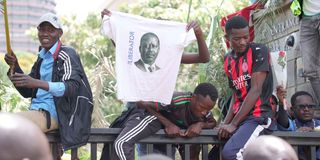
On Wednesday morning, as reports of the death of former prime minister Raila Odinga circulated on social media, editors at the Nation had to strike a balance between satisfying their audience and getting it right.
One question Kenyans kept asking was: “Why hasn’t the Nation reported it?”. The Nation lines were jammed with curious callers seeking to confirm the “rumour”, and anyone who knew someone at the media house reached out to them. Some concluded that the Nation and other legacy media houses were acting on “orders” to withhold the story and await an official announcement by the President.
The NTV morning show’s presenters eventually broke the story a little after 10am, more than two hours after the reports started circulating. They began by acknowledging the viewers’ questions on social media, before informing the audience that the former prime minister had died in India, where he had been undergoing treatment.
“We have confirmed with multiple sources in the former prime minister’s office and those in his party ODM, as well as government sources,” one of the presenters stated.
Another added: “It is important that we do this properly.” To the Nation team’s credit, it did a splendid job preparing for seamless coverage that lasted the entire day. The presenters followed the death announcement with a well-informed conversation about Raila — his life story, involvement in Kenya’s key political moments, and his immense contribution to Kenya’s democracy.
The decision to send the crew that was waiting to cover the Siaya Trade and Investment Conference to Mr Odinga’s home in Bondo showed quick thinking and flexibility.
More teams were dispatched to various parts of the country, with the live coverage giving viewers a wide-angle view of the developing story. However, the research and production crews could have done a better job with the graphics instead of displaying only portraits of the fallen leader, given the media house’s rich photo and video archives. They picked up later in the day.
The Public Editor put the question to Editor-in-Chief Joe Ageyo. Why did Nation take so long to announce Mr Odinga’s death?
Here’s his response: “We took all the time we needed to verify the story. We believe in being right rather than merely being first. We are a reputable media house, built on a strong foundation of trust and credibility that has carried us for over 65 years. That is what we guard at all times and at all costs — even if that means that, from time to time, we may not be the first with the story. So, while we may not always be found breaking a story, we would want to be found providing understanding to our audiences through accurate information and context. Raila Odinga’s death is such a monumental news event that no newsroom worth its name would want to bungle. We only broke the story when we were confident enough about the sources we had spoken to, even if the government and the family were yet to issue an official confirmation.”
Importance of verification
There could also be other considerations: Had the family been informed? Or would the media be breaking the news to some family members?
Kenyans’ palpable thirst for the truth — and clarity of where to seek it — speaks not only to the existing trust in legacy media, but also to the weight of responsibility placed upon it. They are held to a high standard and bound by the law, the Media Council of Kenya’s code of ethics, and their internal editorial policies and guidelines. They must strive to get it right. The consequences of getting it wrong are dire: from monumental awards for defamation to loss of public trust.
The Public Editor fully agrees with the Editor-in-Chief on the importance of verification. However, in this digital age, satisfying the audience also calls for speed.
Being right and first is the sweet spot. The next best is slow, but sure, and that’s what the team at Nation went for. Well done to both the Nation team and the public who waited to verify the information.
Contact the Public Editor to raise ethical concerns or request a review of published material. Reach out: Email: [email protected] . Mobile Number: 0741978786. Twitter and linkedin: PublicEditorNMG.