Hello

Your subscription is almost coming to an end. Don’t miss out on the great content on Nation.Africa

Ready to continue your informative journey with us?

Hello

Your premium access has ended, but the best of Nation.Africa is still within reach. Renew now to unlock exclusive stories and in-depth features.

Reclaim your full access. Click below to renew.

Newspaper vendor
Caption for the landscape image:

Crippled media bad for Kenyans

Scroll down to read the article

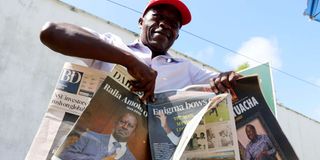
A newspaper vendor displays copies of local dailies with headlines of the death of former Prime Minister Raila Odinga on October 16, 2025.

Photo credit: Kevin Odit | Nation Media Group

This season—these 90 days of the long knives—fills me with dread even though I retired from the media three years ago. Companies, whether selling media products or beans, must pay their way to survive; if a company’s costs are more than its income, then it enters a nose-dive headed for a very hard landing. It can pull out of the dive in two ways. One, it can find new ways of making money or, two, it can cut its costs. The media find themselves with more costs than revenue and very few avenues for growing existing streams or creating new ones. So inevitably, every newsroom will get a share of its cuts, and that includes making changes to products (mainly reducing or sometimes closing them) and sending to the streets young, talented and otherwise wholesome journalists.

I stay away from these debates but often hear people ask: why can’t media make the digital changes needed to keep abreast with their consumers’ need and tastes? They conclude that “Githeri” media are useless and too corrupt and incompetent. 
What do media sell? What distinguishes its content from material pasted on billions of websites and social media posts? It is what some guy used to call “believability” or credibility to the rest of us. I see credibility attacks, commercial sabotage and regime hostility as the principle reasons for media woes, with management shortcomings, particularly not reading the real depth of consumer shift accurately, playing a strong supporting role.

Hit job on the media

Since the advent of blogging, a sustained hit job was done on the media, calculated to undermine their credibility, as a defence mechanism by corrupt people and other bad actors. This was not just the work of some backstreet bloggers eating on a bribe to pay rent, these were operations, possibly by PR companies, to protect the “reputations” of bad people by launching carefully calculated credibility attacks. 

One of those few occasions I sat down with the late Raila Odinga, I tried to explain to him that the media were in trouble because of a hostile policy environment, a position he disagreed with strongly. His argument was that TV had killed the newspapers and digital everyone else on the scene. 
But TNA came to power believing that the problem with Kenya was its media, civil society and the youth. They killed the media with commercial warfare and credibility attacks, civil society through draconian legislation, and disarmed the youth by presenting themselves as a youth-friendly government. They succeeded quite well.

Kenya’s mighty NGOs are a pale shadow of their former selves and the media cannot write the kind of stories that would protect democracy and speak truth to power, because they are susceptible to financial pressure. The 2013 election marked the return of anti-democrats to power and their actions made our country safe for corruption and dictatorship, and unsafe for democracy and the rule of law.

From 2013, bloggers became a part of the government, their job rarely mainline communication, but disinformation, propaganda and personality attacks. Officially, there was a departure from honest, routine communication and a bigger emphasis on unstructured, psyops -type activities that muddied the water and confused the public. Credibility, integrity and professionalism became red rags to the bull of blogging and its benefactors. 

Revenue crisis

Many media commentators, especially former journalists, are quite convinced that management incompetence takes the bulk of the blame for media predicament across the world. I would agree that media management teams may lose sight of the crisis and waste energy on career advancement and the desire to claim credit and all those other silly things that afflict companies across sectors. It is also possible that there could be a narrowness of vision in defining the problem, meaning that the prescribed solutions are ineffective. 

The current media crisis is not so much a cost crisis as a revenue crisis. Because to the advertiser, digital is cheaper and targets better. It is not so much a problem of changing consumer tastes and habits, it is a fundamental human and evolutionary issue. Man became the author of his own evolution when he learnt to communicate. It meant that he could modify his behaviour without the necessity of genetic mutations. 

I’m beginning to think that man has summited the evolutionary hill. There is more information than he can store in his brain and there is more processing capacity that is non-human and external to him. His continued evolution depends on his integrating with machines and tapping into data networks. You can’t serve a Bionic Age man data through newspapers.

We are all poorer, less safe, less free when the media stumble. The rigour, commitment to verification and the courage to speak the truth are an important part of holding the rulers accountable to the ruled, a prerequisite for democracy. Just like they think Mau Mau was about the Kikuyu fighting to retain female circumcision, they think the media are here to “bother” their political heroes.

It is a bad season for the good guys.

Mr Mathiu is NMG former Editorial Director. [email protected]