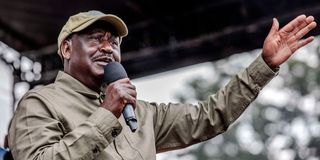
Maybe the children of Israel were meant to enter the Promised Land only as soon as Moses is no more. Because if we are honest, Raila Amolo Odinga was not your typical politician. He was a phenomenon, a gravitational field. He was a mirror that exposed the hunger and rot of our politics; a magnet that could pull unlikely coalitions into one tent; a megaphone for the dispossessed; and, for far too many careerists, a short-cut key on the keyboard of power.
You didn’t need a theory of governance when you had a position on Raila. You only needed to declare; with him or against him. That binary allowed the mediocre to climb aboard, to exchange scrutiny for slogans, to ride on an icon’s legend instead of deservedly earning a mandate. This is not a small thing. For two decades, Kenya’s most potent political credential was proximity to Raila, or defiance of it. The Raila Question replaced the Character Question. Our politics became a bypass road around values.
And those who opposed him discovered something equally convenient: you could dodge policy, dodge history, dodge your own failures, by turning every election into a referendum on Raila’s person. If you couldn’t build a hospital, you could still build a career declaring yourself the firewall against him.
As Kimani Ichung’wah shamelessly put it, in ridiculous timing, mind you, “I had to call the Rt. Hon Raila Odinga an old man (derogatory) for my politics.”
Raila Odinga saw politics as a means to an end. Those around and across him saw him as their means to politics.
In that sense, Raila’s presence produced a paradox: he kept the hope of a better republic alive, yes; but he also gave the laziest among us a ready-made script. The fastest way to avoid being examined was to be loud about Raila. It worked both ways. That is what they did to the legacy of a man who gave so much.
And yet, Raila’s courage under detention, his stamina through defeat, his stubborn insistence that Kenya could be better were not props. He carried the bruises in his body and the years in his eyes. He did the long work of building the national vocabulary for reform when it was extremely costly to speak. The young have grown up inside the vocabulary he helped make common. Devolution, whistle-blowing, electoral justice, police reform—these words live in the public square partly because he paid rent for them with his life.
But legends do not die; they pass the exam to become institutions. And institutions demand that we grow up. A politics that orbits a single star cannot raise a forest of leaders. A republic cannot mature if the only serious question it knows how to ask is “for or against.”
The most honest way to honour Mzee is to deny future pretenders the short-cut that swallowed us, and threatened his legacy to the very end.
What does that look like in practice? It looks like telling every 2027 aspirant—presidential, governorship, parliamentary, MCA—that the era of shields and shadows is over. You don’t get to hide behind a personality or a tribe or a grievance. You will show us your books, your budgets, your math.
You will publish your coalition agreements. You will state your anti-corruption triggers and the dates on which they bite. You will submit to open primaries or citizen juries in your party. You will debate in county halls, not just stadiums. You will commit to a 1-year, 2-year, and 4-year scorecard that a citizen panel can fire you against. And if you spend more time on TikTok than on tuberculosis rates, we’ll count that, too.
That is the country that Raila spent six painful years in detention dreaming about. Sober, accountable leadership.
It also means refusing counterfeit alternatives. Even as many of us agree—plainly—that William Ruto will not cut it for 2027, let us learn from our exhaustion. In 2022, too many boarded buses driven by anger and disappointment; we arrived poorer and angrier. This time, we interrogate the driver, the route, the fuel, and the fare. The alternatives being floated must survive an audit far tougher than the noise of their crowds.
My generation must be ruthless in a new way: ruthless about standards. Does this candidate expand citizen power or merely rotate elite faces? Does this manifesto cost our promises in shillings and megawatts, or in adjectives? Does this coalition agree on three non-negotiables—rule of law, fiscal honesty, and dignity of work—or is it another auction? If they cannot pass these tests now, they will fail us later, and with interest.
Taught us to refuse despair
And we must do our part with the same discipline we demand. Register to vote—in the millions. Audit the register. Volunteer as observers. Give small money to clean campaigns and starve the sludge. Flood ward forums, not just time-lines. Turn every speech into a policy interrogation.
Refuse to be herded into a false binary by consultants who believe chaos is a strategy. If someone says, “Choose between the devil you know and the devil you don’t,” tell them we are done choosing devils. We are hiring stewards.
Raila taught us to make the country a conversation, to refuse despair, to believe that audacity belongs to citizens, not just presidents. Let us inherit the courage and retire the short-cuts.
Raila Odinga was not infallible. He wasn’t perfect. The record carries its disappointments: misjudged alliances, uneasy compromises, moments when the thunder of the crowd overwhelmed the quiet of institutional building.
But the sum of what was good most certainly outweighs the sum of what was bad. His heart, most of the time, was pointed in the right direction—toward a Kenya that defends the weak, humbles the powerful, and keeps promises written in our Constitution. He was human, and he faltered, as we all have and will.
History will remember him favourably: as a man who helped bend the arc, even when others tried to break it. Our task is to finish the bend—with eyes open, standards high, and no more short-cuts.