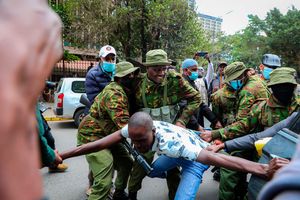
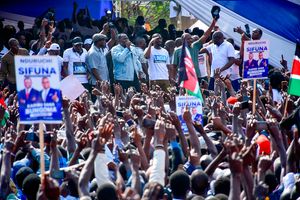
The tear gas drifting past shops on Nairobi’s Dubois Road on Friday, August 28, smelled no different from the gas that flooded Kimathi Street two years ago. The acrid smoke still burns the back of your throat, makes your eyes water and leaves a bitter metallic taste. The only real change is who is standing in the middle of the street.
Back then, wholesale traders in Nyamakima, Dubois and Gikomba pulled down their metal shutters early, wiped dust from their ledgers and cursed the young people outside. The mood was simple and impatient: “These Gen Zs are killing our turnover. They’re ruining the city’s economy. Why can’t they just go home and let us run our businesses?”
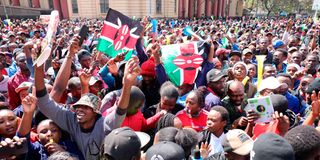
Fast-forward to now, and the scene looks familiar, except for one detail. The same shutters are down, but shopkeepers aren’t hiding behind them. They are in the street, wiping water and Vaseline from their eyes, clutching hand-painted signs and marching towards the glass facade of Times Tower.
The Kenya Revenue Authority reportedly raised the customs benchmark on a consolidated container from Sh2.5 million to Sh3.2 million. A change made in an office can suddenly make routine clearance costs exceed the value of electronics, shoes or hardware inside the box.
It turns out “Gen Z” was never really an age group or social media trend. It was simply the label slapped on the first wave of people to hit the financial wall.
For years, Kenya’s business community bought into a comfortable idea: pay your business permits, keep your head down, pay taxes on time and stay out of political noise, and you can avoid trouble. Young people confronting police during protests were seen as an inconvenience — a disruption to the serious business of making money.
But state machinery doesn’t stay in one lane, and economic pressure doesn’t respect middle-class respectability. Once a government faces little pushback over economic pressure, it can move to the next group. Two years ago it was university graduates struggling to figure out their future. Today it is the person who has spent 15 years importing phone cases, car parts or textiles from Guangzhou.
Many people watching Friday’s protests are calling the traders hypocritical. They argue, with some justification, that these business owners were largely silent when young protesters faced police action. And, yes, this sudden appetite for street action is rooted in self-interest. Few traders woke up with a philosophical awakening about civil liberties. They opened bank statements, looked at inventory costs and realised that staying open could mean going broke.
The point is not that the traders have suddenly become champions of every protester’s cause. They have discovered that economic policy can erase the distance between those they once dismissed and themselves. The same pressure that once felt like someone else’s problem has arrived at their shop doors, in their stock, margins and bank accounts overnight too now.
That is how life often works in Nairobi. When matatu operators strike, commuters complain about walking home. When public hospital doctors and nurses down their tools, patients curse the medical staff instead of asking why the health sector is under strain. When traders locked their doors two years ago, they blamed protesters for ruining their sales. In Kenya, we rarely care about the fire until our own blanket catches sparks. Is it selfish? Yes.
But it is also how things move. Political shifts rarely happen because everyone suddenly agrees on high-minded principles. They happen when different groups, driven by survival, realise they are confronting the same wall. The state’s favourite trick has been keeping people in separate boxes. It treats university students as troublesome kids, matatu crews as lawless thugs and small traders as wealthy complainers hiding taxable income. As long as those groups distrust one another, the system remains stable.
But when taxes rise and the cost of living increases, those artificial walls can weaken. The divide between young people with little to lose and established shopkeepers with much to protect begins to dissolve on the street.
Now, the merchant who ran from tear gas two years ago is standing in the same cloud as the young person who once confronted it. Maybe KRA ignores them. Maybe police push them back into their shops. Maybe the Small Traders Association eventually buckles under economic pressure and policing. But you cannot tear-gas a cargo container into clearing itself through customs.
You cannot make a ledger show a profit when the numbers do not add up. These Friday protests aren’t a carefully planned political movement, nor are they necessarily ideological. They are the result of a basic calculation: staying on the sidelines and playing by the rules has become more expensive than making noise in the street.