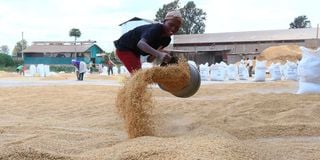
Local rice and wheat farmers must be suffering nightmares right now due to some taxation measures proposed by the Treasury, not, ironically, because they feel the government has overtaxed them, but because it has decided to drastically lower taxes on the import of the two commodities from outside the East African Community, ostensibly to meet demand which local production has failed to do.
According to proposals in the highly controversial Finance Bill 2023-24, import duty on rice will now be at 35 per cent, down from 75 per cent, while imported wheat will attract a 10 per cent tax, down from 35 per cent.
It is a fact that local growers, millers and distributors of the two commodities cannot satisfy the demand. While the country requires about 950,000 metric tonnes of rice, local farmers, on average, produce 180,000 tonnes per year. The shortfall must, of necessity, be addressed through imports.
As for wheat, it is in an equally precarious state. While the country consumes approximately 900,000 metric tonnes a year, it only produces 350,000 metric tonnes, which means the bulk of the flour we use for chapatti, mandazi and pastry has to be sourced from abroad. This cannot be good news for the country’s economy, whichever way you look at it.
In any case, the decision by the Treasury to reduce the custom duty on these two commodities certainly runs counter to the repeated assertion by the government that it intends to discourage the importation of products that can be found locally.
While it is laudable that the eventual goal is to encourage local production, lowering tax on food imports, even as a temporary measure, is clearly contradictory. The reason why rice and wheat farmers may sink into despondency is that such a measure will just dampen prices and allow profiteers ample room to flood the country with inferior produce at their expense.
And here we are not even talking about the precarious situation of the major staple crop in Kenya. We do not grow enough maize and the country has become a net importer of the staple even when the conditions are favourable.
The seeming desperation, which has made the country accede to the importuning of biotech conglomerates seeking a ready market to introduce genetically modified organisms (GMOs) into our food supply chain is simply unconscionable. That GMO crops are not here yet may not necessarily mean that the government has seen the light.
The judicial intervention that halted the move is most likely temporary and we may, God forbid, eventually have to eat stuff meant for hogs in the countries that grow it.
Unfortunately for our farmers, right now, Kenyans who have been suffering from the high cost of living would have scant reason to sympathise with them.
All that hungry consumers want is affordable food, and they couldn’t care less where it came from—the cheaper, the better. An empty belly and patriotism do not go together, which gives rise to the conundrum: How do you give incentives to grain farmers to grow more while at the same time opening the taps for imports which will flood the market?
One of the most important policy goals of this regime was to make Kenya self-sufficient in food. Indeed, according to its manifesto, it seeks to reduce dependence on basic food imports by 30 per cent. How this is to be done through the reduction of tax on such imports has not been spelt out. But one thing is clear; for the foreseeable future, we shall have to rely on imported food even during seasons of plenty.
This is because something went wrong when past governments paid lip service to investment in agriculture and scant attention to the actual food production.
They seemed to be merely content with reiterating how agriculture is the “backbone of the economy” while allowing commodity buccaneers free rein to break the farmers’ backs for quick profits.
Although the times may be hard due to exigencies beyond government control, judging by the shenanigans that are being uncovered practically every day, creating such loopholes may, in the long run, be counter-productive. The importation scandals that are already rocking the country may just be the beginning of worse things to come.
My unschooled views on this issue are simple; we need to go back to the basics. First, we must balance support for cash-crop production with greater investment in food crops.
If subsistence farmers can be given incentives to grow enough food in their quarter-acre plots for domestic use, they will stop the futile attempts to make a living by planting 20 coffee bushes or 10 avocado trees on those plots.
Secondly, highly-productive land which used to contain coffee or tea plantations is progressively being converted into housing estates for the elite. The proliferation of “gated communities” in many parts of Kiambu County, for instance, spells doom for food production.
It would have made sense to subdivide this land into plots and sell them for agricultural purposes. When the government talks about setting up aggregation plants for value addition at every ward level, one wonders what produce will be aggregated at this rate.