Building climate-resilient water systems in Northern Kenya
Sponsored by Northern Water Works Development Agency

CPA Andrew Rage Eysimkele, the Chief Executive Officer of Northern Water Works Development Agency.
The Northern Water Works Development Agency (NWWDA) was earlier established as Northern Water Services Board through a Kenya Gazette Notice No. 1716 dated March 12, 2004, as a State Corporation under the State Corporations Act and the Water Act 2002. The Water Act 2016 was enacted and the Northern Water Services Board was gazetted as Northern Water Works Development Agency vide special issue of the Kenya Gazette No. 28 dated April 26, 2019.
NWWDA covers an area of 244,809 square kilometres (about 43 percent of Kenya land mass), which has a population of approximately 3.5 million people and approximately 70 percent of livestock population in Kenya. The Agency is responsible for the development, maintenance and management of water and sewerage infrastructure in six counties, namely Garissa, Wajir, Mandera, Isiolo, Samburu and Marsabit. This vast, arid, and semi-arid landscape in Northern Kenya is acutely vulnerable to climate change. Hence, the Agency works at the frontline of Kenya’s water crisis, where prolonged droughts, erratic rainfall, and years of underinvestment have made water security a matter of survival. To meet its strategic objectives and mandate, and have a positive impact in the region, NWWDA embraces good corporate governance and service delivery.
Climate change is one of the most significant threats to the long-term sustainability of Kenya’s water resources. Its effects are increasingly evident through changing rainfall patterns, prolonged droughts, intense rainfall events, floods, rising temperatures and the degradation of water catchments. These impacts affect both the quantity and quality of available water, while exposing infrastructure and communities to greater risks.
At a national level, the statistics paint a grim picture of a sector under siege. Kenya is already a chronically water-scarce country, with per capita water availability currently standing at just 452 cubic metres, a fraction of the global benchmark of 1,000 cubic metres, and down from 647 cubic metres in 1992. If this is the national figures, imagine what they are in the arid and semi-arid areas of Kenya.
Climate change adaptation involves adjusting infrastructure, institutions and resource management practices to reduce vulnerability to climate impacts. This includes increasing water storage, protecting catchments, strengthening infrastructure against floods and droughts, and diversifying water sources. The agency is committed to developing reliable water infrastructure that can withstand the effects of climate change, including droughts and floods.
Technology and innovation are essential multipliers that can stretch every shilling, extend every drop, and make every system more resilient. Therefore, NWWDA recognises that the challenges of climate change, rapid population growth, and underinvestment cannot be solved with same approaches that we are used to. They require us to embrace the full spectrum of available technologies, from the simplest to the most sophisticated, and to adapt them to the unique contexts of our counties and communities.
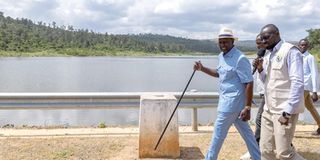
His Excellency President William Samoei Ruto officially launched Phase I of the Maralal Water Supply Project in Samburu County on November 10, 2025.
In the realm of water supply and distribution, the solarisation of boreholes and water pumping systems is a proven innovation that reduces reliance on expensive and carbon-emitting diesel generators. Solar-powered water supply systems offer a practical, climate-smart and potentially cost-effective solution. By harnessing Kenya’s abundant solar energy, these systems can reduce dependence on diesel-powered generators and unreliable electricity supplies while improving access to water in remote and underserved communities. In Northern Kenya, where grid connectivity is limited and diesel costs are prohibitive, solar-powered water systems are not just an environmental choice but an economic necessity. The Agency has solarised all the boreholes it has implemented in the region.
Desalination technology, particularly reverse osmosis, is another innovation with transformative potential for our region. The Agency has implemented several projects using this technology and paired it with solarisation. They include the Habaswein Water Project, Wajir Stadium Water Project, and Wajir State Lodge Water Project. Other similar projects are proposed to treat saline borehole water and provide communities in the region with a reliable source of clean water. These technologies can turn an unusable resource into a lifeline for communities that have historically depended on unreliable water trucking and emergency relief.
The Water Sector Climate Financing Plan 2024-2030 documents that Kenya loses approximately 10 percent of its GDP to climate-related shocks, with floods and droughts alone costing the economy between 2-2.8 percent of GDP each year. The period 2020-2023 saw Kenya experience its longest and most severe drought on record, leading to acute food insecurity for approximately 3.5 million people and the deaths of 2.6 million livestock in 23 ASAL counties. In Northern Kenya, these statistics translate into empty water pans, dried-up boreholes, dying livestock, and communities on the brink of collapse. Building climate-resilient water systems requires a comprehensive, multi-layered strategy that addresses water storage, water harvesting, groundwater management, infrastructure design, and ecosystem restoration, while also strengthening the institutions and governance systems that underpin water service delivery.
In Northern Kenya, this is not a choice. It is a necessity. The communities we serve have demonstrated remarkable resilience in the face of adversity, but they cannot do it alone. They need the increased support of national and county governments, development partners, the private sector, and the international community.
NWWDA has drilled and equipped boreholes, and constructed water pans, dams and other water supply systems in the six counties. However, because of low water coverage in Northern Kenya compared to national water coverage, this region requires concerted efforts from all stakeholders in the water sector, to increase water coverage.
The Water Sector Climate Financing Plan estimates a total financial requirement of Ksh482.4 billion for the period 2024–2030. This substantial investment requirement reflects the scale of the challenge facing Kenya’s water sector and the urgency of strengthening its capacity to withstand the effects of climate change. The financing is structured into three phases, with Phase I requiring Ksh114.6 billion, Phase II Ksh 199.5 billion and Phase III Ksh 168.3 billion. These phased requirements provide a basis for planning implementation, mobilising resources and coordinating investments over the seven-year period.
Mobilising Ksh482.4 billion within the 2024–2030 implementation period will require a coordinated financing strategy that brings together public resources, international support, private capital and community participation. The Government of Kenya is expected to play a central role through regular budget allocations and additional domestic funding for priority water sector programmes. Public financing is essential for projects that deliver significant social and environmental benefits but may not generate sufficient direct revenue to attract commercial investors. The government will also be instrumental in creating an enabling policy environment, coordinating sector institutions and ensuring that investments are aligned with national development and climate priorities.
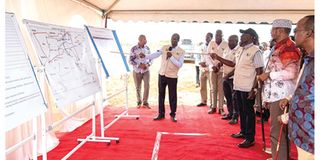
H.E President William Samoei Ruto commissioned the Eldas Town Water Supply Project Expansion on June 2, 2027 in Eldas Constituency, Wajir County.
Development partners will provide another important source of financing through grants, concessional loans and technical assistance. Such support can help Kenya implement large-scale infrastructure projects, strengthen institutional capacity and introduce climate-resilient technologies. International development institutions and bilateral partners can also support project preparation, feasibility studies, environmental assessments and capacity building. The strategic use of concessional financing is particularly important for projects serving vulnerable and underserved communities, where affordability and limited revenue-generating capacity may constrain commercial borrowing.
The private sector is expected to contribute through blended finance, commercial lending, public-private partnerships and other innovative financing arrangements. Blended finance combines public or concessional resources with private investment to reduce risks and make projects more attractive to investors. Loan facilities and seed funding can help unlock additional capital for suitable projects, particularly where there are credible revenue streams and clear arrangements for operation and maintenance. However, private investment must be structured carefully to ensure that financing costs remain manageable and that the pursuit of financial returns does not undermine equitable access to water and sanitation services.
Non-governmental organisations will also contribute through project implementation, community outreach, technical support and the mobilisation of resources for vulnerable populations. Communities and other local stakeholders are important because sustainable water security depends on local ownership, responsible use of water resources and the protection of infrastructure. Their contribution may include participation in project planning, catchment restoration, water resource conservation and the management of community-based water facilities.
The financing framework should bring these contributors together under a coordinated national approach, supported by transparent resource allocation, clear institutional responsibilities and effective monitoring. Rather than treating each source as an independent funding stream, Kenya needs to align government expenditure, development assistance, private investment and community initiatives with the priorities identified in the plan. This will help minimise duplication, improve the use of available resources and ensure that funded interventions deliver tangible results.
The Kenya Water, Sanitation and Irrigation Conference and Expo 2026, which ran on October 22-23, came at a very critical moment for the water and sanitation sector. The country is facing rising water demand, climate-induced droughts and floods, and a significant financing gap in this sector – challenges that no single institution can solve alone. This conference was therefore a marketplace of ideas towards rallying all stakeholders around the shared agenda in line with Vision 2030 and the Constitution of Kenya, and put all these plans into action.