Devolution: Bungoma’s people-centred approach to development
Sponsored by The County Government of Bungoma
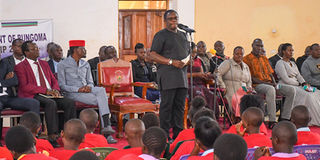
Bungoma County Governor H.E Kenneth Lusaka speaks during a county scholarship awarding ceremony.
The stated mission of the County Government of Bungoma is “to harness all potentials of the county through inclusive participation and collective responsibility to generate wealth for sustainable socio-economic development”. Towards this, the county government has consistently focused on people-centred interventions and investments to enhance collective responsibility in driving socio-economic change in the livelihoods of the approximately 1.8 million residents.
The current Bungoma County Integrated Development Plan (2023-2027) focuses on the following pillars:
- Food Security and Agriculture Transformation
- Improving Quality of Lives (Health, Water and Sanitation, Environment, Tourism, Gender, Youth and Differently abled, Early Childhood, Vocational Training Centres)
- Industrialisation and Infrastructure Development
- Technology and Innovation
- Lighting up Bungoma
Food security and agriculture
Unlocking Bungoma’s potential to create wealth from agriculture
Investments in crop farming: The County Government annually procures certified fertilizer and maize seed for 21,900 farmers in the 45 wards through the Farm Input Support Programme. In addition, the County Government has to date also procured and distributed avocado and coffee seedlings. Bungoma County continues to stand out for exemplary programme implementation, and in December 2024, it was awarded special recognition for the best-managed National Agricultural Value Chain Development Project (NAVCDP) in the country.
Village advisors in Agriculture: The presence of community-driven development committees, identification of Farmer Producer Organisations in each of the 45 wards, training of community institutions, and the support of Saccos, underscore the people-centred approach to service delivery in the agriculture sector.
Subsidised, mechanised agriculture services: Through this initiative, farmer groups are able to affordably hire farm machinery for use.
County investments in animal and fish farming: Under ongoing Ward-Based Projects, the County Government has so far supplied and delivered 108 dairy cows and 40 goats to registered farmer groups in various wards in the last one year. The are plans to establish community-based animal health workers, provide veterinary drugs and vaccines, construct livestock markets, and develop value chains for livestock products such as milk, meat, honey, eggs, and hides through the Kenya Livestock Commercialisation Project
Impact
- Over 80 percent of Bungoma residents are adequately fed
- 50 percent of previously disadvantaged people have been lifted out of poverty
- Over 75 percent of agricultural land have had productivity restored.
- Implementation of targeted agricultural projects to enable women and youth to have equal access to opportunities throughout the agricultural value chain.
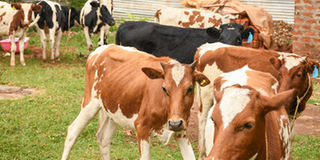
In the last one year, the County Government of Bungoma has distributed a total of 108 dairy cows and 40 goats to registered farmer groups in various wards, to improve livestock production in the county.
Improving the quality of lives
Expansion of health infrastructure and facilities
The county is served by 199 government health facilities from level-one to level-five. All facilities provide access to the Social Health Insurance Fund. The National Government has rolled out plans to build a level-six hospital in 2026.
The County Government has increased the number of health centres to 54 and built another 50 new dispensaries. This has had the positive effect of moving services closer to the people.
The health department also converted the engagement of 178 health workers from contract to permanent and pensionable terms, and employed another 27 doctors. It also recruited 10 Oral health workers. The move has had a positive impact on Primary Health Care in many ways.
For the first time, the maternity wing at the Naitiri Sub-County hospital is full and patients don’t have to be referred to Webuye, because they have a doctor to handle all maternity cases.
Bumula Sub-County Hospital has three resident doctors, so patients do not have to be refereed to Bungoma Referral Hospital. For the first time, Cheptais Sub-County have a doctor.
Impact
- Reduced facility-based deaths
- Number of nurses per 100,000 population has increased from 24.29 to 27 against a target of 35.
- Reduced the number of inpatients (admissions) under five from 389,533 to 388,337, surpassing a target of 370,056
- Reduced maternal and child death rate by 0.07 percent.
- Increased the percentage of TB patients completing treatment from 89 percent in 2020 to 90 percent in 2024.
- Reduced malaria prevalence from 19 percent in 2021 to 11 percent in 2024.
- Increased sanitation facility coverage from 75 percent in 2021 against a target of 100 percent.
- Increased Sanitation facilities functionality to 85 percent against a target of 100 percent.
- Increased the population sensitised on WASH to 90 percent in 2024 against a target of 100 percent.
Improving access to water and sanitation
Water services: In March 2024, an MoU was signed between the KOICA Kenya office, Ministry of Environment and Natural Resources, and Lake Victoria North Water Services Board (LVNWSB) for the construction of the Sirisia-Chwele Water Supply Project.
The project involves construction of a new water supply system that includes a water treatment plant with a capacity of 2,000 cubic meters per day, a 36km water supply pipe work, seven water kiosks, and several communal water points at select primary schools in the target area. It will take five years to implement, and will benefit over 50,000 locals when completed.
In January 2024, the Malaba-Bungoma water project, a Ksh690 million jointly funded Kenya government and African Development Bank project, was commisioned. The project encompasses construction of a water intake point at Ndakaru along the Malakisi River, complete with a conventional water treatment plant. It will serve an estimated 180,000 residents in the county.
The Chebyuk-Kibabii mega water project, with a daily capacity of 4000 cubic metres, is under construction, and will supply water to over 86,000 households across Mt Elgon, Sirisia, Kanduyi and Kabuchai.
To enhance access to safe, clean water for domestic use, the County Government has made significant progress through interventions such as sinking boreholes across the county under the Community Empowerment Fund and the FloCA programme, extending water pipelines for last-mile connectivity, and protecting high-yielding water springs. The FlloCA programme has funded 30 water schemes by upgrading high-yielding water points with solar installations.
In total, both KOCA I and KOICA II water projects will serve 140,000 residents. Plans are underway to start KOICA III.
Environmental management: In line with the Presidential directive to plant trees and attain 30 percent tree cover in Kenya by 2032, Bungoma County Government has given itself a target of planting 19 million trees annually. Among the planned projects is riparian land conservation.
The County Government has robust plans to plant trees along the streams, rivers, dams and protect the wetlands, and has partnered with the Kenya Forest Service (KFS), National Environment Management Authority (NEMA), and other players, to help create enough forest cover while also supporting initiatives that conserve the environment.
In waste management, the County Government is encouraging each sub-county to have a dump site. Members of County Assembly have agreed to contribute Ksh1 million each from the ward development fund in the Financial Year 2025-2026, to establish a proper waste management system.
Gender, youth and differently-abled persons
The County Government has enacted gender-responsive policies, laws, and regulations across all departments to foster women’s economic empowerment and ensure their meaningful participation and representation in county-level planning, budgeting, implementation, and monitoring of development programmes and projects at every level.
Gender: The County Government has strengthened its response to gender-based violence through awareness campaigns, support services for survivors, and the establishment of safe spaces. This initiative also includes training of law enforcement and community leaders on handling GBV cases sensitively and effectively in all the 45 wards.
Given the cross-cutting matters of gender, the responsible department works closely with other departments to champion gender responsiveness in interventions being undertaken in various sectors. This is to ensure no one is left behind in economic empowerment.
The County Government has made it intentional to work with all labour markets. Women get supported with viable and affordable credit. The first batch of Ksh12 million trade loans benefited 1,000 small-scale traders, primarily Mama Mboga businesses, fostering economic growth and financial independence.
Sports: Construction of the Chemoge High Altitude Training Centre is progressing well. Phase One is now complete. This facility will provide world-class training amenities for athletes.
The Masinde Muliro Stadium is being modernised. Phases 1 and 2 are done and the third is underway. The National Government supplied 10,000 seats for the terraces.
In recognition of the county’s rich culture and to promote relations, even across the border with Uganda, the County Government organised key cultural events. They included hosting the Bamasaba King (Omukuka) and participating in the Embalu ceremony in Mbale, Uganda.
The County Assembly has passed critical policies in support of youths, women and children. They include the Youth Policy, Sports Policy, Gender Mainstreaming Policy, Disability Mainstreaming Policy, and the Children’s Policy. These will go a long way in preserving culture.
Transforming early childhood and vocational education
Early childhood learning: The County Government is collaborating with various institutions to re-skill all teachers so that they are not left behind. One of the areas being prioritised is digital literacy because of its links to the tenets of Competency-Based Education (CBE). Digital learning is being piloted in all the 45 wards
Capacity building of our ECDE teachers remains a key component of the County Government’s mandate. A total of 1,900 teachers have so far been trained in collaboration with the Unicef. The education department hopes to achieve the United Nations recommended staffing levels of one tutor per 25 students. To date, the County Government has recruited over 2000 ECD teachers on permanent and pensionable.
As a result of investments done to date, enrolment of ECDE children has gone up from 40 to over 95 percent. The County Government runs a feeding programme in all the ECD centres to ensure none of the children goes hungry for lack of enough food at home.
Vocational training: The County Government has invested heavily in vocational training centres, resulting exponential growth in terms of institutions and enrolment rates. A total of 89 vocational training centres have been built across various wards.
The centres have been equipped with the adequate and appropriate tools and equipment. Trainers have undergone capacity building, ensuring quality training.
In collaboration with TVET/CDACC and the Bungoma National Polytechnic was able to train 170 VTC trainers on Competence Based Education and Training (CBET). The education department is planning to have all VTC trainers trained in CBET. Implementation of CBET curriculum will help improve the employability of TVET graduates. The County Government also confirmed 303 VTC instructors on permanent and pensionable terms.
Industrialisation and infrastructure development
Boosting movement, land use, trade and fire safety
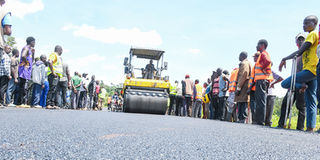
Under our Road Maintenance and Upgrades initiative, the County Government opened and gravelled 953km out of the targeted 1,100km of roads, constructed six bridges and 40 box culverts across all 45 wards, and upgraded 11.5km of urban roads to bitumen standards in Bungoma Town. This will open up rural areas, enabling the movement of goods and services to accelerate economic growth.
The 20.85km Misikhu-Brigadier Road upgrade is currently at 50 percent completion. The National Government has since taken over the site, and the work is scheduled for completion within the current financial year.
The County Government enacted a county spatial and integrated physical development plans, and developed land inventory, established a GIS lab, and surveyed over 80 percent of markets and urban centre, and managed to resolve the boundaries.
The County Aggregation and Industrial Park (CAIP) has realised significant progress despite inordinate delays in receiving the National Government’s co-funding. While we have spent over Ksh90 million, the National Treasury has only disbursed Ksh61.5 million of the allocated Ksh250 million. With the proposed County Government Additional Allocation Bill, Bungoma will receive an additional Ksh105.3 million to accelerate the development of the industrial park in Sang’alo.
The market infrastructure development programme has seen a facelift at Chwele Market, which is currently 90 percent complete, while the construction of the Kipsigon and Kamukuywa markets is on schedule.
Additionally, the County Government has constructed 30 metal stalls and an auction ring at Dorofu Market in East Sang’alo Ward, as well as another 30 metal stalls in Maraka Ward.
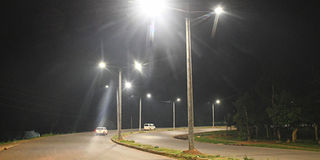
Lighting up the streets to enhance security and extend hours of trade.
Ksh500 million have been set aside towards buying land to decongest the current market and get more people off from selling their wares on the roads.
To enhance public safety and transport, the County Government has overhauled the Kanduyi Fire Office and commissioned the Webuye Fire Station. A total of 130 light masts have been installed on the 6.5km Musikoma-Kanduyi dual carriageway and fast-tracked the upgrading of Matulo Airstrip to facilitate passenger services.
Technology and innovation
The County Government has developed an automated County Integrated Performance Management Framework whose implementation will ensure that the entire County is pulling in the same cohesive strategic direction and can effectively measure achievements towards the Governor’s Manifesto and global Sustainable Development Goals (SDGs) as integrated in the third-generation CIDP. All county employees signed performance contracts and appraisals for FY 2024/25, aligning their work with the county’s development goals.
Furthermore, in line with global trends and in the spirit of Strengthening Human Resource Capacity, the County Government has trained 600 staff members, re-designated 88 staff, and absorbed 194 casual workers into permanent roles to leverage their existing knowledge and experience in service delivery.
To enhance accessibility and efficiency, Ward Service Centres are being established in all the 45 wards, where citizens can access services. This includes establishing ICT centres in every ward, ensuring stable internet connectivity to facilitate e-governance and service delivery.
Additionally, the County Government is implementing a robust Hospital Management Information System across major health facilities, supported by stable internet infrastructure. These reforms and initiatives reflect the County Government’s administration’s unwavering commitment to an efficient, transparent, and responsive public service that truly serves the people of Bungoma County.
Automated revenue collection and seen improved accountability of over 60 percent rise in revenue collection.
Promoting a 24-hour economy
Under the Urban Centres Street Lighting Programme, the County Government continues to install solar lights despite significant challenges at the outset, primarily due to vandalism.
The County Government’s dedicated staff have remained resilient, conducting repairs and replacements as needed. This programme is crucial in enhancing security and promoting a 24-hour economy.
Through the Energy Partnership, Bungoma has signed a Memorandum of Understanding (MOU) with the Rural Electrification and Renewable Energy Corporation (REREC) for a matching fund project, with the County Government and REREC contributing Ksh45 million each.
Under Phase 1, 21 transformers have been installed in 21 wards, benefiting 660 households. Phase 2 will target the remaining 24 wards.
The Bumula Energy Centre, launched in September 2024, is set to be a game-changer for Bungoma County. With a budget of over Ksh600 million, it will connect over 5,400 households to electricity and serve as a hub for renewable energy initiatives, clean cooking solutions, and environmental conservation.


