How international partnerships are boosting employability of Kenyan youths in green economy
Sponsored by GIZ

Students go through the paces of how to install solar panels.
By Pauline Ongaji
The green economy is creating opportunities in areas such as renewable energy, electric mobility, clean cooking technologies and sustainable infrastructure. However, these opportunities require a workforce with practical competencies that match industry needs.
This is where the Employment Promotion for Women for the Green Transformation in Africa (WE4D) programme, funded by the German and the Norwegian governments and jointly implemented by Deutsche Gesellschaft für International Zusammenarbeit (GIZ), WTS Energy, the National Industrial Training Authority (NITA), and Kenyan TVET institutions, is making a difference.
Thomas Jaeschke, the WE4D Team Leader at GIZ Kenya, says Germany's partnership with Kenya is designed to ensure that the country's transition to a green economy creates quality employment opportunities, particularly for young people and women.
“Through the Employment Promotion for Women for the Green Transformation in Africa programme, Germany is supporting skills development in renewable energy and e-mobility, while promoting inclusive economic growth,” he says.
He explains that the programme responds to the growing demand for technical expertise in green sectors by equipping learners with industry-relevant technical skills alongside entrepreneurship, workplace health and safety, environmental awareness, and career readiness competencies.
“The goal is to prepare graduates for both employment and self-employment opportunities within Kenya’s expanding green economy,” he adds.
The programme is helping transform vocational training by ensuring learners are not only trained for certificates but prepared for real workplaces.
According to the Director of the Technical University of Mombasa (TUM) TVET Institute Dr Michael Odhiambo, the partnership between TUM, WE4D programme and WTS Energy has changed how students are prepared for careers in the expanding green economy.
He says the initiative combines TUM's training expertise, WTS Energy's industry connections, and GIZ's technical and financial support, to deliver market-driven skills development.
"Unlike traditional training models, the programme links learners directly to industry from the outset," Dr Odhiambo explains, noting that students are exposed early to workplace expectations, industrial attachment opportunities, and career pathways.

A lesson on solar power installation.
Jaeschke adds that this employer-driven approach is one of the programme’s greatest strengths, saying: “WE4D works closely with WTS Energy, NITA, TVET institutions and private sector companies to develop competency-based curricula that reflect actual workplace needs.”
The project aims to train 800 young people, support the creation of 480 jobs in renewable energy and green transition sectors, and improve working conditions and incomes for 270 individuals.
This industry connection has become one of the biggest strengths of modern TVET training. Instead of graduates entering the job market without practical exposure, they leave with experience, confidence and skills that employers can immediately apply.
The renewable energy sector provides a clear example of this transformation. As Kenya expands solar energy adoption, the demand for skilled technicians capable of installing, maintaining and troubleshooting renewable energy systems continues to rise.
At the Rift Valley National Polytechnic, the WE4D programme has strengthened solar photovoltaic training through improved trainer capacity, provision of modern equipment, and delivery of industry-focused learning. The polytechnic’s Head of the Department of Electrical and Electronics Engineering Michael Rotich, says the institution has trained 241 solar PV technicians, including 122 men and 119 women.
As pointed out by the Head of Telecommunications Department and Technical Coordinator of the WE4D programme at the polytechnic, Samuel Kongo, the programme has also challenged traditional perceptions about technical careers by encouraging greater participation of women. This, he says, is a key achievement, observing that women are increasingly entering renewable energy careers and proving their ability to succeed in technical fields.
The impact of practical skills development extends beyond training institutions. Employers are also benefiting from graduates who are better prepared for workplace demands.
Senior Service and Installations Engineer at Sun King Clinton Njeru, says companies require technicians who can apply technical knowledge in real situations. He explains, for example, that renewable energy technicians must understand customer needs, correctly install systems, diagnose faults and recommend appropriate solutions. These abilities require practical exposure, not classroom learning alone.
He adds that renewable energy is also transforming communities by supporting small businesses, improving access to electricity and creating new economic activities in areas previously underserved by reliable power.
Beyond employment, skills training is creating opportunities for entrepreneurship. A trained solar technician can establish a business, provide services within local communities and create additional employment opportunities.
The Manager of NITA Nairobi, Fidelis Odumo, says collaboration under WE4D has supported the development of Kenya's first national curriculum for solar photovoltaic technicians while expanding access to training for persons with disabilities. The institution's practical approach ensures trainees learn using real equipment, preparing them for workplace realities.
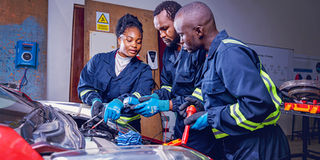
Practical EV training at NITA Nairobi.
Meanwhile, NITA Athi River is supporting Kenya's emerging electric mobility sector by training technicians in areas such as battery systems, and electric vehicle electronics and safety procedures. The institution’s Manager of Industrial Training Millicent Otom, says partnerships with industry are helping ensure that training remains aligned with the needs of the rapidly growing electric vehicle sector.

Training on EV at NITA Athi River.