How FibroScan machine is helping Lions Hospital to catch liver damage early
Sponsored by Lions SightFirst Eye Hospital
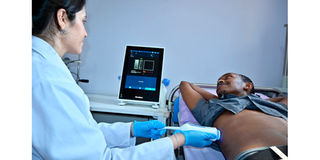
The FibroScan machine in use.
By Millicent Mwololo
Diabetes doesn’t just mess with your sugar levels or your heart, kidneys, or eyesight. It also quietly damages your liver, and many people don’t even know this until it’s too late.
Liver issues tend to creep in silently; no pain, no warning signs, and by the time symptoms show up, much damage is already done.
But now, Lions SightFirst Eye Hospital in Nairobi, has brought in this amazing technology called a FibroScan – a total game-changer.
This machine has completely changed how doctors catch liver damage. It’s quick, taking about five to ten minutes, and most patients no longer have to undergo invasive and painful procedures.
FibroScan assesses the liver through vibration-controlled transient elastography using elastic shear waves. It checks for stiffness in the liver, which shows if there is any scarring, and also how much fat is stored in it.
Now, here is where it gets interesting. Most people wouldn’t even think of the liver when they talk about diabetes complications. But according to Dr Rilwan Adan, who heads the Lions Diabetes Care Centre, the connection is very real. She explains: “When you have diabetes, especially Type-2, your body ends up with too much sugar in the blood. That sugar gets converted into fat, and one of the first places that fat runs to is the liver. Over time, that fat builds up and starts causing trouble.”
Thus, when your blood sugar stays too high for too long, the liver gets overloaded with fat. That fat starts to replace healthy liver cells. “Over time, the liver becomes inflamed, which can lead to scarring and eventually cirrhosis or even cancer. It’s a slow, silent process,” Dr Rilwan observes. You might feel fine while your liver is suffering quietly. That’s what makes screening so important.
Previously, this condition was referred to as non-alcoholic fatty liver disease, but the name has changed to something more fitting: Metabolic Dysfunction-Associated Steatotic Liver Disease, or MASLD. “What it means is that fat is building up in your liver not just because of diabetes, but could also be due to obesity, type 2 diabetes and high cholesterol in your body,” Dr Rilwan explains. And you don’t even have to look overweight to have it. She points out that some people who appear lean could be carrying fat deep inside their bodies, and would still affect the liver the same way.
The scary part is that MASLD doesn’t show symptoms until after the damage is done; when the liver is already failing. That’s why early detection is crucial, and precisely the reason FibroScan is highly important. This machine helps doctors know whether your liver is healthy, slightly scarred, or seriously damaged. It also helps them to figure out how much fat is in the liver, and so the medical team at the Lions SightFirst Eye Hospital would know whether to intervene with lifestyle changes and medication, or refer you to a liver specialist.
Dr Rilwan says before the hospital acquired the FibroScan, doctors relied on liver biopsies. This involved slicing off a small piece of the liver and sending it to a laboratory for assessment. She goes on: “Not only was that painful, but it also took time, and not everyone could access it. With FibroScan, that has changed. It’s painless, fast, and incredibly accurate. It gives you results in minutes, and because it takes multiple readings, the results are more reliable.”
At the Lions SightFirst Eye Hospital, if someone comes in with high blood sugars or obesity, an individualised patient’s assessment is done to determine who needs to go through a FibroScan. “The hospital first conducts liver function tests, and if a patient’s results are deranged, we try and investigate for other causes of liver damage,” Dr Rilwan points out.
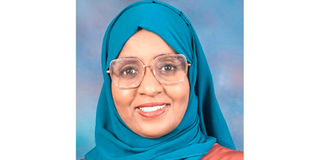
Dr Rilwan Adan, Head of Lions Diabetes Care Centre at Lions SightFirst Eye Hospital in Nairobi.
The patient is then recommended for a FibroScan. And it’s not just for diabetes. Even people with hepatitis from other causes, that is, alcoholic hepatitis, viral hepatitis or toxins, are being screened, she shares. The goal is to catch any liver scarring early and refer for management.
The hospital makes use of the most advanced FibroScan machine for the high accuracy it gives. A fibrosis score of below 7 indicates little or no scarring. A score within the range of 7-9.5 indicates moderate scarring, while that between 9.5 and 12.5 is indicative of severe scarring. Any score above 12.5 implies advanced scarring or cirrhosis.
For fat levels, the machine uses something called the controlled attention parameter (CAP) score. A CAP score ranging from 238 decibels per metre (dB/m) to 260 dB/m indicates that 11 up to 33 percent of the liver is fatty. A score between 260 dB/m and 290 dB/m implies that 34 up to 66 percent of the liver is fatty. A score above 290 dB/m signals that over 67 percent of the liver is fatty.
Using findings from the FibroScan, the hospital provides holistic care via a multidisciplinary team in the Metabolic Clinic, providing thorough assessments of patients found to have metabolic dysfunction.
Losing between 5-10 percent of one’s body weight can help reverse the fatty liver condition. This can be achieved through lifestyle modifications like prescribing individualised meal plans, physical activity plans and even weight loss therapies, with the guidance of a doctor and an in-house nutritionist.
And just so you know, if your liver function tests are off, or if you are living with diabetes or obesity, or ever had hepatitis, you should get a FibroScan. What makes FibroScan additionally valuable is that it helps the medical team to stratify the patients according to risk levels and take appropriate action – whether to put them under close monitoring or send them to the specialists.
If your liver is in the early stages of damage, you can turn things around. If it’s moderately affected, you can get specialist care early enough to manage the situation and avoid full-blown liver failure.
“This machine has truly changed how we handle diabetes care,” says Dr Rilwan. “It has brought liver health into the spotlight and is helping so many people catch problems early. And the peace of mind it gives? Priceless. You walk in with questions and walk out with answers without the stress of invasive procedures or waiting for weeks for results.”


