Engineering integration: Why modern buildings need more than connected technologies
Sponsored by HSC Systems Limited
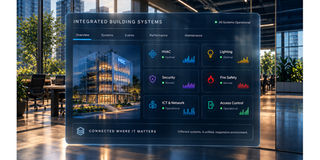
Across Africa, the modern building is becoming increasingly sophisticated.
A commercial facility today may bring together systems like CCTV, access control, fire detection, HVAC (heating, ventilation and air conditioning), lighting, communications, data networks, audio-visual systems and a growing range of digital technologies. Each serves a distinct purpose, but the real challenge begins when all these technologies have to operate within the same physical environment.
Installing them is one task. Making them work together effectively is another.
Too often, building technologies are treated as individual installations, delivered by different vendors and managed as separate systems. While each system may perform its intended function, the absence of a coordinated approach can create operational inefficiencies, security vulnerabilities, duplicated infrastructure and a complicated maintenance environment.
This is where engineering integration becomes critical.
Integration is more than connecting systems
Systems integration is sometimes understood simply as connecting different technologies. In practice, it is much more deliberate.
A properly integrated building is one in which different systems can communicate and respond to one another where there is a genuine operational need, while still maintaining the technical integrity and security requirements of each system. That requires consideration from the earliest stages of a project.
Consulting and design determine what the building needs to achieve. Engineering translates those requirements into an appropriate technical architecture. Implementation brings the architecture to life, while ongoing maintenance ensures that the systems continue to perform as intended.
This lifecycle approach is particularly important because no two buildings operate in exactly the same way.
A hospital has different requirements from a hotel. A corporate headquarters operates differently from a university, data centre or financial institution. Integration therefore cannot be based on a one-size-fits-all catalogue of technologies. It has to begin with the operational needs of the environment.
The building as a responsive environment
One of the clearest examples of integration can be found in Extra Low Voltage (ELV) systems. Modern buildings increasingly depend on several ELV technologies, including building management systems, smart lighting, room management, fire detection and alarms, emergency communication, video surveillance, intrusion detection and access control.
Individually, each performs an important function. Together, when properly engineered, they can create a much more responsive environment.
Consider a fire alarm. In an isolated environment, triggering the alarm may simply activate a siren or notification. In an integrated environment, the event can initiate a coordinated sequence of responses across the building.
Depending on the system architecture, CCTV can be directed towards the affected area for visual verification. Designated emergency doors can be unlocked. Elevators can be recalled to an appropriate fire mode. HVAC systems can be shut down to limit the circulation of smoke. Public address systems can provide evacuation instructions.
The significance is not that one system has replaced another. It is that the systems have been engineered to understand when their functions need to intersect.
That is the difference between a collection of building technologies and an integrated building environment.
The digital backbone matters too
While ELV systems support building operations, security and environmental controls, ICT infrastructure provides the digital backbone through which people, information and technology interact.
Modern enterprises depend on reliable connectivity for everything from data servers and cloud applications to wireless networks, collaboration tools and audio-visual systems.
Data and network infrastructure therefore has to be considered as part of the wider building environment rather than as an entirely separate concern.
This includes data centre infrastructure, wired and wireless networks, server and cloud environments, and data and network security.
The workplace layer is equally important. Smart meeting rooms, commercial displays, unified communications and video conferencing have transformed how organisations collaborate. In hospitality, interactive IPTV, guest content casting, digital signage, room booking and wayfinding increasingly form part of the guest experience.
These technologies may appear different on the surface, but they depend on a common principle: Infrastructure that allows them to function reliably and, where required, interact with other systems.
Integration does not mean putting everything on one network
One of the misconceptions surrounding systems integration is that all building technologies should ultimately operate on a single network.
That is neither necessary nor desirable. Different technology environments have different technical and operational requirements.
Enterprise ICT networks are designed to support high volumes of data, user mobility, cloud connectivity and business applications. ELV environments, meanwhile, may support life-safety systems, automation and security technologies that require different levels of isolation, resilience and response.
Fire and life-safety systems, for example, cannot simply be treated like another corporate application.
The objective is therefore not to make every system identical. It is to create the right interfaces between them.
This requires a clear understanding of where systems need to communicate, what information needs to be exchanged and how those interactions can take place securely.
Maintaining appropriate segregation between systems can help protect automation, security and life-safety infrastructure from ordinary corporate data traffic while reducing the risk of operational interference.
Integration, in this sense, is as much about knowing what should remain separate as it is about understanding what should be connected.
Designing for the full project lifecycle
The quality of an integrated technology environment is determined long before the first device is installed.
A building project involves multiple stakeholders, from developers and architects to consultants, contractors, IT teams, facility managers and technology specialists. When technology decisions are made independently, conflicts can emerge later in the project.
Space requirements may not have been considered. Network infrastructure may not support future requirements. Different systems may use incompatible interfaces. Maintenance responsibilities may be unclear.
Early coordination can address many of these challenges before they become expensive problems.
It also changes the role of technology from something added towards the end of construction to something considered as part of the building's overall design. That approach becomes increasingly important as buildings become more digital.
From smart technologies to smart architecture
The next stage of building technology is unlikely to be defined simply by adding more devices. The greater opportunity lies in how existing technologies are architected.
A building with dozens of disconnected smart devices is not necessarily smarter than one with fewer technologies that have been carefully selected, engineered and integrated around its operational needs.
The real measure is what happens when those technologies need to work together.
Can a security event trigger the appropriate response across access control and surveillance? Can building systems respond to changing operational conditions? Can facility teams see and manage information from the systems they are responsible for? Can new technologies be introduced without having to rebuild the entire infrastructure? These are engineering questions as much as they are technology queries.
Building for what comes next
African cities are developing rapidly, and the buildings supporting this growth are becoming more technologically complex.
For developers and organisations, the challenge is no longer simply acquiring the latest technology. It is creating infrastructure that can accommodate changing requirements without becoming increasingly fragmented.
That calls for a shift from thinking about individual systems to perceiving the building as an interconnected technological environment.
Good integration does not make every system disappear into one platform. Instead, it gives each system a defined role while creating carefully engineered relationships between them.
The result is a building where technology works in the background, responding when required, supporting the people who use the facility and giving those responsible for its operation greater control.
Ultimately, the smartest building may not be the one with the most technology. It may be the one where the technology has been engineered to work together in precisely the places where it matters.
____________________
By Norman Mithika, Mary Wanjiku and Peter Ouma: Marketing and Brand Strategy Team, HSC Systems Limited
For more information, email us at [email protected]


