Two motorbikes, a car and a lost phone: One Nairobi salesman's climb on instalments
Sponsored by Watu Credit

Watu Credit client David Nyandiga.
By Kabui Mwangi
The day David Nyandiga lost his phone, he was a taxi driver with a car and no way of finding a passenger.
He was driving for Uber in Nairobi, in a car he had acquired on hire purchase. The app that sends a driver his customers and maps his routes runs on a smartphone, and he did not have the cash to replace his.
So he did what he had done twice before when he needed a tool for work and could not pay for it outright. He bought it in instalments.
Nyandiga, who now sells cars for a living, has financed four working assets this way: Two motorcycles and two Samsung smartphones. He has paid off every one, in payments of a few thousand shillings a week for the motorcycles and about Ksh100 a day for his latest phone.
His is the arithmetic of much of Kenya's working economy, where the tool comes first and the money to pay for it comes from using it. Micro, small and medium-sized enterprises account for about 90 percent of the country's businesses and employ more than 15 million people, according to the International Finance Corporation.
Yet the gap between the credit they need and the credit they get is equivalent to nearly 21 percent of gross domestic product, the World Bank Group's private-sector arm said in an August statement. It called limited access to affordable credit one of the main barriers keeping small businesses from expanding and creating jobs.
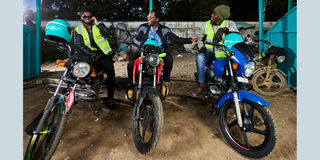
Into that gap have stepped asset financiers – non-bank lenders that hand over a motorcycle or a phone against a deposit and collect the balance in small, frequent payments. Nyandiga's lender for all four assets was one of them, Watu Credit.
Twice the deposit, half the time
Nyandiga was selling bread for a living when he took his first motorcycle on credit. He put down Ksh50,000 and paid off the balance in weekly payments over about a year.
The machine went to work on deliveries and brought in about Ksh2,000 a day, by his account. “The motorbike really helped me,” he says.
When he went back for a second, he put down Ksh100,000 and cleared the balance in six months: Twice the deposit, in half the time. He hired a rider and put the new machine into bread distribution, paying Ksh2,200 a week on one motorcycle and Ksh2,500 on the other.
"For me, it was working," he says.
The first motorcycle outlasted its loan. When he later applied for a sales job at Pepsi, with a territory to cover through Nairobi traffic, he says owning his own transport helped him get it.
Later came the car, on hire purchase, and the Uber work. Then the lost phone.
The phone as a tool of trade

He replaced it with a Samsung Galaxy A23, financed through Watu Simu, the lender's smartphone arm. Once that was paid off, he took a Galaxy A15, which he cleared last year at about Ksh100 a day over roughly 12 months, by his recollection.
Buying a phone this way costs more than paying cash. What the borrower gets in return is the device on day one, with no collateral and no payslip.
The demand is not hard to explain. Kenya had 52.3 million smartphones connected to its mobile networks at the end of June, about two-thirds of all handsets and two million more than three months earlier, according to the Communications Authority of Kenya's latest quarterly statistics.
Owning one is another matter. A joint report by the regulator and the Kenya National Bureau of Statistics, drawn from a survey of 25,000 households and published last year, found that 11.3 percent of Kenyans use a mobile phone that belongs to someone else. Ownership and internet use, it found, tracks income.
When the money runs short
The model rests on lending to people a bank would turn away, and on what the lender does when they fall behind.
Emerging from Kenya in 2015, Watu has reached more than 18 million individuals across its footprint through targeted mobility and smartphone financing solutions.
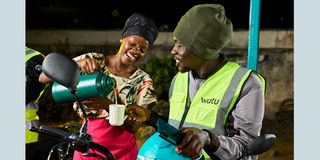
"We work with people who are unbanked and who are also entrepreneurial," says Godlisten Shayo, the company's Head of Customer Engagement. "Since inception, we have issued hundreds of thousands of logbooks, translating directly into true ownership for our customers."
The checks are simple: Legal age, a national identity card, a registered M-Pesa line and a relative or referees who can vouch for the borrower. The harder work, Shayo says, starts after the sale.
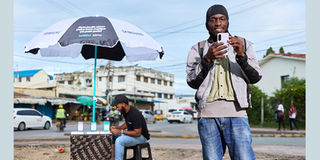
Within 48 hours of taking an asset, each customer gets a call from a trained agent. It covers the total cost of ownership, the daily payment, the option of paying ahead, the consequences of paying late and the help available if payments stop.
"One of the biggest jobs of our after-sales officers is to understand what the difficulty is," he says.
The responses range from restructuring a loan to advice on earning more from the asset. "Sometimes we talk to customers about other ideas: Delivery work, registering for Uber or Bolt, having a rider take up the bike," Shayo says.
It is, more or less, the route Nyandiga worked out for himself.
There are harder edges. A financed phone can be locked when payments are missed, though Shayo says customers get free five-minute unlocks, up to three times a day, for emergencies. Where an asset has to be repossessed, he says, the customer is given up to 21 days to put things right.
His team of about 230 handles roughly 2.5 million calls and 2.2 million chats a year, on a toll-free line and a WhatsApp channel open seven days a week.
Nyandiga owes the lender nothing today. He made the last payment on the Galaxy A15 last year and now sells cars for a living.
Would he borrow again? If the need arose, he says, yes.
____________________


