The professor who started in a kitchen full of smoke: Violet Kadenyeka Mugalavai, 1960-2026
Sponsored by Andrew Gwadiva
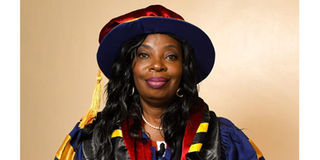
Prof Violet Kadenyeka Mugalavai spent 30 years teaching Kenyans how to feed themselves better. She learnt the subject long before she had a word for it, crouched over a three-stone fire in a railway town, taught by her mother and her aunties to cook mrenda and mitere while the smoke made her eyes stream.
She wrote about that fire in a notebook she kept in her last years. “My mother and my aunties taught us how to make different types of vegetables.” Fifty years later she would hold a Kenyan patent for a fortified flour, direct a food processing centre built with American funding, and sit on the senate of a public university. The line between the two runs straighter than it looks.
She was born on December 21, 1960, in Butere, one of the stations where her father worked for the East African Railways and Harbours. Her mother was a teacher. There were nine children, and she remembered a childhood of fetching firewood and river water, and competing with her siblings over who could carry the biggest bundle.
School took her from Nairobi to Mombasa, where she and her siblings walked to Mariakani Primary and spent their bus fare on fried cassava. From Lugulu Girls in Bungoma, she went to Alliance Girls, Kikuyu, and came out with a Division One. At The Highlands School in Eldoret, she chose Food and Nutrition for her A-levels. It was a choice most people would have called soft. “I followed my dream,” she wrote. “And my dream came true. I have no regrets.”
She graduated from Kenyatta University in 1984 with a Bachelor of Education in Home Economics, and went straight into a classroom. Moi Girls School Eldoret got nine years of her: Home Science, Biology and Chemistry, plus the tennis coaching, the Rangers, the Home Science club and the careers desk. Teachers who were there still describe a woman who did not stop moving.
In October 1993, she joined Moi University’s Chepkoilel Campus as a graduate assistant. She was a secondary school teacher walking into a department of lecturers, and she knew exactly what that meant. Over the next three decades, she took a Master’s from Kenyatta in 2000 and a doctorate in Human Ecology from Moi in 2008, both on scholarship, and climbed every rung of the academic ladder. Lecturer, senior lecturer, associate professor in 2015, full professor in 2026.
The climb was documented in her own hand. When her full professorship application went in, her son Andrew sat with her and worked on the file. On the day of her interview, she kept phoning him, and he kept telling her she had it, and she kept repeating it back to him. When the letter came, she called him first, and they prayed together.
What she did with the rank is the part that matters.
She founded the Food Processing Training and Incubation Centre at the University of Eldoret, in partnership with USAID and Purdue University, and directed it. It was a teaching facility, a research base and a small factory at once. Women and young people came in with sorghum, millet, cassava, orange-fleshed sweet potato and amaranth, and left knowing how to turn them into products people would actually buy. In 2021, the Kenya Industrial Property Institute granted her a patent for Unga Nutritious, the fortified flour behind Uji Pap and Ugali Pap.
She was not content to leave it on campus. In March 2021, she ran a workshop on scaling out Unga Nutritious at STAWI Foods and Fruits in Nairobi, and by early 2022, she was training stakeholders in Kolol and traders at Marura Market. The point was always to get the flour into shops and into children.
The research behind it was relentlessly practical, and there was a great deal of it. Her CV lists around 60 refereed journal articles from her associate professor years alone: Sorghum composite flours, rice fortification, postharvest technology in Elgeyo Marakwet, drought-tolerant crops in Kerio Valley, food security among vulnerable households during Covid-19. She published with Bruce Hamaker and Mario Ferruzzi of Purdue and with Hugo De Groote of CIMMYT. Her students tested whether mothers in Moiben would accept a pumpkin and millet porridge for weaning, whether hotels in Eldoret town would buy baked goods made with fortified millet instead of wheat, whether children aged six to twenty-four months would take a mushroom-enriched flour. She was not interested in knowledge that stayed on a shelf.
She carried that work out into the world. She presented at the Food Processing Innovation Lab annual meeting in Senegal, at Feed the Future in Kampala, at the Scale Up conference at Purdue where she showed a poster on her centre, at the Africa Nutrition Leadership alumni meeting in Addis Ababa, and at the first Africa Postharvest Congress in Nairobi, where she spoke on technology-based incubation. In 2022, she was at a conference on the role of insects in food systems, still following the subject wherever it went.
She built the programmes as well as taught them, developing and reviewing curricula for degrees in Nutrition and Dietetics, Food Science, Human Nutrition, Food Security and Apparel and Fashion Design. She served as Head of the Department of Family and Consumer Sciences, Acting Dean of the School of Agriculture and Biotechnology, Director of Industrial Linkages and Partnerships, and a senator for over a decade. She examined externally at Maseno, Rongo and Machakos.
And she chased money, cheerfully. “I enjoy writing proposals for research grants,” she wrote. “These have been my hobby for a while.” The funding came from USAID, the McKnight Foundation and the National Research Fund, and the fellowships took her to Wageningen, to Pretoria, to the Africa Nutrition Leadership Programme in South Africa. Her work carried her to Germany, the United Kingdom, the United States, Australia, the Netherlands, Senegal, Mali, Ghana, Nigeria, Uganda and Tanzania.
Outside the university gate she did the same work without the letterhead. She gave indigenous seeds to households to keep crop diversity alive. She put kitchen gardens and orchards into Lelboinet Primary, the University of Eldoret Primary School and the Eldoret School for the Hearing Impaired.
She ran nutrition workshops for farmers, processors and county officers in Elgeyo Marakwet. She sat on the boards of Maria Soti Girls Education Centre and Kaiboi Technical Training Institute, and gave motivational talks across Western Kenya and the Rift Valley aimed squarely at girls who had been told to lower their sights.
Prof Mugalavai died at St Luke’s Hospital, Eldoret, on September 17, 2026, at the age of 65. She leaves three children, five grandchildren and several hundred former students, a good number of whom are now lecturers and professors themselves.
She had been in the middle of things to the end, leading the new Master of Science in Food Security programme, and collecting four fresh certificates in 2024, at 63, because there were still things she wanted to know.


