What the Kenyan government is doing to increase adoption of clean cooking options
Sponsored by The Energy News Network
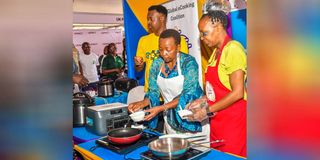
Her Excellency Rachel Ruto, First Lady of Kenya, showcases electric cooking at the 6th Clean Cooking Week in Kilifi, August 2025.
Kenya is locked in a race to achieve universal access to clean cooking solutions by 2030. The drive is getting more urgent because of two key reasons: Time is running short, as the 2030 deadline is just over four years away. Also, high dependence on traditional cooking fuels is costing the country through ill-health and lost economic opportunities for the individuals tasked with collecting fuelwood. They are mostly girls and women.
It is estimated that more than 65 per cent of Kenyan households use traditional cooking fuels that harm people’s health and deny women and children opportunities to advance socially and economically. This reality is energising the race by the Government of Kenya to implement various policies and strategies aimed at accelerating access to clean cooking sources and adoption.
The government is implementing the Kenya National Cooking Transition Strategy (KNCTS, 2024). This strategy aims to guide and orient the country toward the goal of universal access through five interconnected action agendas. Through this strategy, the country aims to have at least 50 percent of households in Kenya using LPG stoves; 30 percent using bioethanol; 10 percent using electricity for cooking; 7 percent using sustainable biomass stoves (briquettes and pellets); and 3 percent using biogas.
In the foreword to the Kenya National Electric Cooking Strategy (KNeCS) 2024, the Energy and Petroleum Cabinet Secretary (CS) Mr Opiyo Wandayi, says electric cooking holds immense potential for Kenya, not only as a pathway towards cleaner and more sustainable cooking methods, but also as an avenue to address the broader developmental challenges associated with the use of fuelwood, such as poor health, environmental degradation, and economic stress.
This strategy, says the CS, “outlines a pathway to unlock this potential and realise an array of positive development outcomes, from creating jobs through local manufacturing to improving health outcomes and economic opportunities for women and girls.”
The Director for Renewable Energy in the State Department for Energy, Dr Faith Wandera, asserts that clean cooking, which she describes as a “public health priority”, matters for the country.
She says: “Kenya stands at a pivotal moment. Our mission is clear: To ensure that every Kenyan household has access to clean, safe, and efficient cooking solutions. Cooking in Kenya has historically been dominated by biomass fuels such as firewood and charcoal, which expose millions of households to harmful smoke, drive deforestation, and disproportionately burden women and children.”
Dr Wandera adds that the transition from polluting fuels and technologies to clean cooking solutions is central to health, gender equity, environmental protection, investment and economic growth.
She adds: “Kenya’s clean cooking agenda is framed as a ‘Triple Win’: Saving lives by eliminating smoke from kitchens, creating jobs through local manufacturing and supply chains, and protecting the planet by reducing emissions.”
Dr Wandera observes that the Kenya National Cooking Transition Strategy (2024) sets a clear pathway to achieve the universal access goal. The multifuel roadmap promotes alternatives such as LPG, biogas, bioethanol, and sustainable biomass, while stimulating local enterprise development and job creation across the clean cooking value chain.
According to the Ministry of Health Household Airpollution Strategy, traditional fuels such as wood, charcoal, and kerosene expose households to dangerous indoor air pollution, which is a silent killer responsible for over 26,000 premature deaths annually in Kenya.
Dr Wandera says these impacts are particularly severe for women and children, who spend the most time near cooking fires, leading to respiratory diseases, eye problems, and long-term health complications.
“Hence”, says Dr Wandera, “clean cooking is a life-saving intervention which drastically reduces exposure to harmful smoke, improving maternal and child health outcomes, lowering healthcare costs, and enhancing overall wellbeing.”
She points out that the government has called for collective action by development partners, the private sector, civil society, and communities to accelerate progress towards universal access to clean cooking solutions.