Thousands of Kenyans fear they have lost millions of shillings through an online trading platform known as QVSE after they were locked out of their accounts and told to deposit more money before they could withdraw their funds.
Quant Vest Stock Exchange (QVSE), operated by a man known as Carl Grindan, recruited thousands of Kenyans, mostly mid-level professionals such as teachers, boda boda operators and small-scale traders, with promises that an initial investment of Sh65,000 or Sh129,000 could generate profits and grow into millions within months.
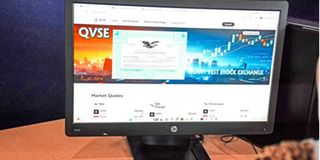
A user tries to log in to the Quant Vest Stock Exchange (QVSE) App. The Capital Markets Authority has listed it among illegal, unlicensed funds.
Photo credit: Billy Ogada|Nation Media Group
Once they put in the principal amount, Carl, whom followers fondly referred to as Prof Carl, would send trading codes that allowed them to make money by trading shares of American companies such as Tesla and Apple.
Among those counting their losses is Edwin Mutuma, a Laikipia-based hotelier who says he was introduced to QVSE in August by a friend who claimed to have made more than Sh400,000 from the scheme.
“It seemed interesting,” Mr Mutuma said. “I got the Sh65,000 capital from my savings and set an alarm for the 4.30pm and 8.30pm trading times. Carl would send a code to BonChat [a WhatsApp-like messaging application that the Nation found out has roots in Hong Kong] and we’d pick and put it in our accounts and you’d see your deposit growing daily, seven days a week. Sometimes he’d reward us with extra trading sessions, meaning more money in our online accounts.”
Day after day, Mr Mutuma watched his money grow on the platform, convinced he had found a quick way to make money trading US stocks. He was told to also download Binance, the cryptocurrency exchange, where QVSE investors could convert their gains into stablecoins and eventually cash out to their M-Pesa wallets. Carl took a 20 per cent cut from the withdrawals.
Carl also encouraged investors to recruit new members, promising additional returns that could double their initial principal. The promise fuelled a recruitment frenzy among Kenyans, drawing more people into the scheme. In staff rooms, teachers recruited fellow teachers, colleagues pitched the opportunity to co-workers, while family members urged relatives to join.
At times, he pressured them to recruit new members, with those who failed to do so having their accounts frozen for days.
Among those recruited this way was Justus, a teacher based in Kitui, who asked to be identified only by his first name. He said he first heard about QVSE in May through a family member.
“I was suspicious of it at first, but seeing how strongly they believed in it, I asked to be given three months to observe how things would turn out,” he says.
A month later, the family member offered to use his Sh65,000 in profits from the platform to sign Justus up. “I agreed.”
The first red flags emerged in late August, when Carl announced a “humanitarian campaign” under which some investors began receiving automatic daily deposits of $90 (Sh11,648) for 10 days.
Justus withdrew his money, but partly. “I withdrew Sh47,000. It made me believe the scheme was genuine after all,” the teacher says. “Once you see money coming out, you stop questioning a lot of things.”
Then on September 5, Carl froze withdrawals, accusing investors of creating multiple accounts to increase the amount they could trade. Each account required a unique phone number and national ID number, meaning some investors were using friends’ and family members’ details to create accounts. He cited a US rule requiring all financial institutions, including broker-dealers, to establish anti-money laundering programmes.
A user tries to log in to the Quant Vest Stock Exchange (QVSE) App. The Capital Markets Authority has listed it among illegal, unlicensed funds.
Photo credit: Billy Ogada|Nation Media Group
He then asked members to deposit fresh funds of Sh65,000 or Sh129,000 to “verify their accounts”.
Mr Mutuma says it is at this point that it “dawned on me that this is a sketchy scheme”. By the time his account was frozen, he had grown his money to $2,100 (about Sh271,740).
“I had never withdrawn anything since I joined, sadly. I wanted to wait for it to grow and grow,” he says.
“My account had $870.39 (Sh112,654). Seeing it there but not being able to touch it was frustrating,” says Justus. “If the money is mine already, why should I pay again just to get it? That’s the point I knew something wasn’t right.”
The Capital Markets Authority (CMA) told the Nation that QVSE is not licensed in Kenya and that copy trading is not officially recognised and therefore unregulated.
On Saturday, the regulator flagged QVSE and GIG among 15 entities operating in Kenya illegally.
“These entities are the subject of active investigations by the Directorate of Criminal Investigations (DCI) in collaboration with the CMA and other law enforcement agencies,” CMA said.
Hours later, Prof Carl took to Bonchat to rubbish CMA’s statement as “performative and lacking real substance”.
“It is simply a way for them to signal to the public that they are taking action, rather than being based on anything tangible,” he said. “Some platforms have been shut down over a year and the fraudsters have long vanished. What was CMA doing all this time? At this time, do not let anxiety take hold. Please rest assured that I’m always with you; I will never disappear ...”
An administrator of a WhatsApp group for Kenyan investors, which was disbanded shortly after Carl froze withdrawals, claimed the team had 12,005 members. If every member had paid the reported minimum contribution of Sh65,000, that would amount to Sh780 million.
The Nation could not independently verify the membership figure, the amount paid by individual members or the total amount raised. It is not clear if the scheme recruited people in other countries.
Regina, also a teacher, had pumped nearly Sh200,000 into the scheme, some of it borrowed.
“I need the rest of the year to mentally process all of this before I can discuss it,” she told the Nation when approached for an interview.
Mr Mutuma says, looking back, the red flags were many.
“I once tried to screenshot chats. He [Carl] flagged me and messaged me to warn me about it,” he says.
Investors could also not withdraw their principal, and they could not take out less than $100 (Sh12,945).
Multiple investors told the Nation that complaints like errors on accounts were also not welcome, and Carl got agitated if one continued complaining.
Last month, the National Assembly Speaker directed the Finance and National Planning Committee to investigate QVSE’s operations and regulatory status and report its findings within two weeks. The findings have not been made public.
In July, the company was flagged in Ghana for promoting and offering unlicensed investment products in the country without a license.
Carl initially told investors they would begin cashing out their balances from September 12, but pushed the deadline by a week.
Still, some who put in additional cash said withdrawals have yet to be effected.
“Members deposited their money for self-verification but they’ve not received the money. Why is this happening, Professor?... You gave a deadline of 72hrs and now members are suffering like that; others took money for businesses. Tell members what is happening. No member has withdrawn today, yet you say members should verify their account; where will the trust come from?” one Kenyan lamented.
“I now accept QVSE is completely over and now only AI [artificial intelligence bot] is managing us,” another said.
Other investors, like Mr Mutuma and Justus, have decided to walk away.
“I have learned my lesson and given up,” the hotelier says.
Regina said: “It is hard, it has broken friendships because we all need answers from the friends and colleagues who introduced us to it, yet they have gone silent on us.”