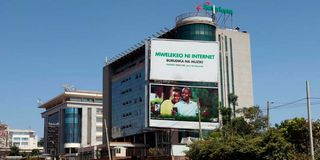
The High Court has nullified the sale of the government's 15 percent stake in Safaricom to Vodacom Group, finding that the transaction was undertaken in breach of the Constitution and law.
A three-judge bench ordered restoration of the shares to government, saying the divestiture was marred by inadequate public participation, concealment of material information, an arbitrary pricing process and failure to address national security concerns arising from the transfer of effective control of the telecommunications company to foreign investors.
"In light of our findings above, we hold that there was no reasonable, meaningful and purposive public participation in respect of the divestiture, thus violating Articles 10 and 118 of the Constitution," Justices Francis Gikonyo, Roselyne Aburili and Tabitha Ouya said.
The decision is a major setback for the government's plan to raise funds for the proposed National Infrastructure Fund through the sale of state assets.
The government had sold its 15 percent stake for Sh204.3 billion, translating to Sh34 per share. In the deal, the government also received about Sh40.7 billion through the sale of its future dividend rights on the remaining 20 percent stake.
The case was filed by activist Tony Gachoka and others, who challenged the sale of what they described as a critical national asset.
Activist Tony Gachoka.
Photo credit: File | Nation Media Group
The judges rejected the argument by Vodacom Group that the petitions had been overtaken by events after Parliament approved the transaction on March 31, 2026, with the sale scheduled to take effect the following day. They said the petitions challenged the constitutional foundation of the transaction itself, and that Parliament's subsequent approval could not cure the alleged violations.
The court found that although Parliament conducted public hearings in 30 counties, critical documents relating to the transaction — including the share purchase agreement and the agreement concerning future dividend rights — were not made available to the public.
"We are thus in consonance with the petitioners that material information and documents were concealed from the public, Cabinet and the National Assembly," the judges said.
The court said public participation must be more than a numerical exercise involving public meetings and hearings.
"Public participation must be qualitative, that is, real, purposive and meaningful," the judges said, adding that the process must involve transparency, integrity, adequate information, inclusivity and an opportunity for the public to influence the decision.
The judges said the government had failed to demonstrate that the critical transaction documents were provided to the public before or during the parliamentary hearings.
They also found that the proposed sale was presented to Parliament and the public as a partial divestiture when, in reality, the transaction involved a much larger corporate restructuring that would give Vodacom effective control of Safaricom. Under the arrangement, Vodafone Kenya's stake in Safaricom would rise from about 39.9 percent to 55 percent, while Vodacom Group would acquire full ownership of Vodafone Kenya. The court said the arrangement therefore amounted to a takeover, rather than simply a sale of a 15 percent government stake.
The judges found that this information was not adequately disclosed to the public, Cabinet or Parliament.
The judges also faulted the government for failing to subject the transaction to competitive selection of a strategic investor. They said Parliament's own joint committee report had acknowledged that competitive selection would have been preferable, but that the government did not use such a process.
On the Sh34 per share price, the petitioners had argued that Safaricom was worth between Sh70 and Sh80 per share and that the government risked losing as much as Sh250 billion. The respondents maintained that the price represented a market-based premium and that the government had engaged KCB Investment Bank as its transaction adviser and commissioned an independent valuation.
Pricing process 'arbitrary'
The court, however, found that the pricing process failed the rationality test and was arbitrary. It also rejected the argument that the sale of future dividend income was merely a legitimate fiscal decision to finance infrastructure. The judges said converting regular dividend income into an upfront payment deprived future generations of the benefit of a public asset.
They further held that the transaction raised serious national security concerns, because Safaricom operates critical infrastructure, including systems supporting elections, government payment programmes, mobile money and the personal data of millions of Kenyans.
"Based on the analysis above, we find that the divestiture removes the long-term sovereign control of a critical infrastructure, transforms regular and perpetual dividend income into an upfront single payment, dissipates public assets in the shares sold, thereby compromising the right of future generations from benefiting from the public assets," said the court.
The court said transferring effective control of such infrastructure to a foreign entity without a prior national security assessment violated the government's constitutional obligation to safeguard national security.
The judges rejected the argument that existing regulators, including the Communications Authority and the Office of the Data Protection Commissioner, were sufficient safeguards. The court said regulatory oversight could not substitute for proactive measures to identify and mitigate national security risks before the government relinquished control of a strategic asset.
Amounts to a merger/takeover
The court also found that the transaction had been structured as a share sale while effectively amounting to a merger and takeover, raising issues under the Competition Act and the Capital Markets Act.
The judges consequently declared the divestiture invalid, null and void, and quashed the parliamentary decision approving the sale, together with approvals, exemptions, agreements and other actions relating to the transaction. The court ordered that the 15 percent Safaricom stake be restored to the ownership of the government of Kenya on behalf of the people.
The judges declined to suspend their judgment to allow the Attorney-General, Safaricom and other respondents to appeal, directing them instead to make a formal application for a stay.