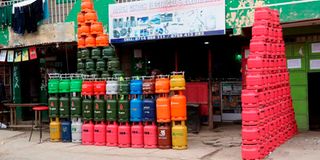
Prices of cooking gas have surged by up to Sh390 in Nairobi in the wake of the Middle East conflict that has triggered a spike in the cost of two key components of Liquefied Petroleum Gas (LPG).
Rubis Energie Kenya is selling the 13-kilogramme pack at Sh3,530, up from Sh3,140, reflecting a jump of 12 percent, while the same quantity has shot up to Sh3,510 from Sh3,140 at TotalEnergies Marketing Kenya.
The price surge reflects the global spike in the cost of propane and butane due to the supply disruptions caused by the US-Israel war on Iran.
Saudi Aramco, one of the leading suppliers of LPG globally, raised the price of propane by $205 (Sh26,477.80) per tonne to $750 (Sh96,870) from the start of this month, while butane prices climbed by $260 (Sh33,581.60) per tonne to $800 (Sh103,328).
Butane and propane are the two components mixed to make the LPG used in most markets, including Kenya. The other components are isobutane, butylene, and propylene.
Besides increased prices of the commodity in the global markets, shipping costs have also gone up due to the blockade of the Strait of Hormuz route, where nearly a quarter of the world’s fuel passes.
“We wish to inform you of an adjustment in LPG prices, effective April 1, 2026. This adjustment is driven by an increase in Saudi Aramco LPG contract prices, together with ongoing supply constraints arising from the current Middle East situation, which continues to impact global LPG availability and freight costs,” one of the local LPG wholesalers said in a circular to oil marketers.
“These developments have led to higher costs across the LPG supply chain, including from our import and supply partners and have consequently increased the landed cost of LPG in Kenya.”
Consumers in other parts of the country are likely to be hit with the price hikes in the coming weeks.
Another supplier, Sonatrach, which is owned by the government of Algeria, increased prices at higher margins with the cost of a tonne of rising by $325 (Sh41,977) to $850 (Sh109,786) and butane by $400 (Sh51,664) per tonne to $900 (Sh116,244).
The Middle East conflict has hit Saudi Aramco, Sonatrach and other global firms sourcing fuel and gas from the Gulf region.
Iran blockaded the Strait of Hormuz last month and has also bombed natural gas and crude oil facilities of neighbouring countries in retaliation for the US-Israel attacks.
Higher prices of LPG are set to hit consumers who are also faced with the increased cost of living in the wake of the recent hikes in pump prices.
A litre of diesel rose by Sh30.09 to Sh196.63 while that of petrol increased to Sh197.60 from Sh178.28 in Nairobi, effective Wednesday.
Increased costs of fuel will hit consumers, given that farmers, producers of goods, electricity generators and service providers like transport firms will pass the impact of costly fuel to the end-users.
Prices of cooking gas had remained unchanged for a year, boosting uptake of the commodity and helping drive the government’s efforts to scale up use of LPG as the number one cooking fuel.
Consumption of cooking gas jumped 14.7 percent to 475,950 tonnes last year from 414,880 tonnes used in 2024.
But this month’s spike in retail prices is likely to hit demand, especially amongst the low-income households that are most vulnerable to economic shocks.
Kenya does not control the prices of LPG, a scenario that has left consumers solely at the mercy of fuel marketers.
Parliament adopted legal changes that exempted LPG from VAT, the 3.5 percent Import Declaration Fee and the two percent Railway Development Levy.