Every Saturday morning, long before the sun rises over Kombani in Kwale County, a group of determined youth armed with gloves, brooms, and bins fan out across the town.
Their mission is not only to clean the streets, but also to collect what many consider useless plastic bottles, old boxes, wrappers, and broken glass, which they turn into treasure.
At the centre of this remarkable transformation is Wahapahapa Waste Management Group, a community-based initiative that is changing lives through environmental conservation and innovative recycling. When Nation visited the group at their office over the weekend, the team was already at work, sweeping walkways, emptying litter bins, and sorting garbage.
Nsema Hoka, the group’s founder and Director, was supervising the cleaning while offering guidance to the group members, mostly youths between 19 and 35 years old.
“We start work by 5am every Saturday. We have divided Kombani into six zones, from A to F, and each weekend we focus on a different zone. Our aim is to ensure every part of our community is clean,” Ms Hoka said.
But this is not just a cleanup campaign. It is a movement driven by innovation, passion, and a desire to provide sustainable livelihoods for youth, especially those at risk of idleness, drug abuse, or early motherhood.
Wahapahapa began in 2018, not as an environmental group, but as a small gathering of five friends at a maskani—a common youth hangout spot in the Coast region.
“At first, we just wanted to keep our maskani clean, then we moved on to cleaning Zote Beach, where our hangout was based. But we soon realised we could do something much bigger,” Ms Hoka recalled.
What started as a casual clean-up evolved into a structured programme. Today, the group has 34 active members, including young mothers, school dropouts, and former maskani regulars who now earn a living through garbage collection, recycling, and environmental awareness campaigns.
Wahapahapa Group members sort out glass bottles based on sizes in Kombani, Kwale County, on July 5,2025.
Photo credit: Mishi Gongo | Nation Media Group
“We knew we couldn’t just clean without thinking of sustainability, so we decided to start recycling waste into useful and beautiful products that we can sell,” said Ms Hoka.
Each week, group members collect waste from households, shops, eateries, and open spaces in Kombani. Initially, the service was free, but to sustain operations, they introduced a small collection fee of Sh20 per household.
“At first, it was very hard. People would tell us, ‘Why should we pay you, yet we pay taxes?’ Others thought we were county government workers,” Ms Hoka said, adding that over time, as they saw the changes, more people came on board.
The waste is taken to a store, a collection point, where it is sorted. Organic waste is recommended for composting at the household level. Recyclables such as plastic, aluminum, paper, and glass are separated.
“We work with local recycling partners. Glass bottles go to a group in Ukunda that turns them into coral-like materials. Plastic is sold to another team that moulds it into new products,” said Salim Said, one of the members.
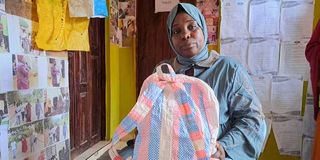
What the group keeps is used to make items such as bags, aprons, wall décor, mats, flower vases, and even toys. These products are sold at local exhibitions like the Diani Regatta, a cultural and environmental event that draws tourists and residents alike.
“We make at least 150 kilos of waste collection per person every month. We also do what we call ‘plastic hunting’, where we go around collecting as much plastic as we can, especially after public events,” said Mr Salim.
Beyond recycling, Wahapahapa is offering a lifeline to many youths who once felt forgotten.
“For many of us, this group saved our lives. Most of us were stuck in maskanis, jobless, exposed to drugs, and crime. But this group gave us purpose and hope,” said Salim Jereko, the programme coordinator.
“After we finish collecting and sorting waste, we sit together to talk, share challenges, and encourage each other,” he added. “It’s a safe space.”
“Here, we are treated with respect. We work, earn some money, and support one another emotionally. Sometimes we bring our children along, though it’s tough because we don’t have a daycare,” said Ms Zainab Ali a young mother.
Indeed, half of the group members are young mothers, and childcare remains one of their biggest challenges.
“We are appealing to the county or well-wishers to help us set up a small daycare. That way, the mothers can work knowing their children are safe and close,” said Ms Hoka.
The initiative has also taken environmental education into the heart of Kombani’s informal settlements. Their focus is on changing the attitudes of those who contribute most to illegal dumping, youths in maskanis, small vendors, and households.
“We go to maskanis and speak to youths about the dangers of dirty environments and the link between waste and disease. We talk to food vendors about separating garbage and using leftovers as compost,” said Ms Hoka.
Like many grassroots initiatives, Wahapahapa is not without hurdles.
“We need a tuk-tuk or small truck to transport the waste,” Ms Hoka points out. “Right now we use a cart and sacks, which is exhausting and time-consuming.”
Funding is also a challenge. “Sometimes members go for weeks without pay. We depend on exhibition sales and small community fees,” she added. “But if we had proper funding, we could train more youths, expand to neighbouring areas like Ng’ombeni and Kinondo, and even register a full-fledged recycling centre.”
Security and stigma are also concerns. “Some people still see us as chokoraa or county askaris. They don’t understand that we are doing this out of our own initiative,” said Mr Salim.
Despite this, the group remains motivated and hopes to open a workshop where products can be made and showcased, and eventually launch their own brand. Their vision includes selling to hotels, tourist shops, and online platforms. They also hope to introduce technical training in product design, waste engineering, and green entrepreneurship.
“We want to be a model for other counties. Imagine if every town had a youth group turning waste into opportunity, how many lives would change,” said Ms Hoka.
The group is now appealing to the Kwale County Government, the National government Ministry of Environment, and non-governmental organisations for help.
“We are not asking for handouts. We have already proven this works. We just need a little boost. Give us tools, give us a space, give us a chance, and we will transform more lives,” said Ms Hoka.
They also urge private companies, especially those in the tourism and packaging sectors, to consider partnerships.
“We can provide them with eco-friendly products and help meet sustainability goals,” said Mr Salim.
In a region often in the news for crime, drug abuse, and unemployment, Wahapahapa is proof that change can come from within and that sometimes, the most powerful solutions lie in the most overlooked places.