Premium
Kenyan innovator pressing profits from edible oil machine
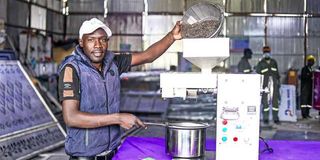
Edible Oil Machine Fabricator Founder Davis Bahati stands next to a Sunflower Edible Oil Pressing Machine manufactured at their workshop in Utawala, Nairobi, on August 13, 2025.

In kitchens across Kenya, the sizzling of frying onions and the rich aroma of simmering stews almost always include one essential ingredient—edible oil.
However, most of it is imported, making households vulnerable to fluctuating global prices, currency shifts, and supply chain disruptions. Palm oil from overseas has long dominated the market, deepening this reliance and its risks.
Now, in a small Nairobi workshop, a new chapter unfolds. Here, young innovators are pressing oil from crops that Kenyan soil already knows how to grow.


Davis Bahati, a self-taught inventor, had his lightbulb moment in 2023. “There was a shortage of cooking oil where I lived for nearly four days. Eating meals without oil made me reflect on how essential it is, and how dependent we are on imported supplies,” he recalls.
He realised he was spending a significant portion of his income just buying cooking oil for his family. Frustration soon gave way to curiosity, which then turned into action.
Kenyans could produce their own oil affordably, sustainably, and locally, and this simple idea quickly became a hands-on experiment.
Bahati began assembling parts sourced locally, drawing on the mechanical engineering skills he had honed in Japan. With imported machines taking months to arrive, a locally made solution could serve communities faster.
After several trials, his design worked. He shared the concept with his engineering partner, Samuel Murimi, and using their savings of approximately Sh2.8 million, they formed Edible Oil Machine Fabricators, a startup that builds edible oil extraction machines for farmers and small-scale entrepreneurs.
They had their breakthrough when they developed a multifunctional oil press that could process various oil-producing crops commonly found in Kenya, such as sunflower, peanuts, soybean, macadamia, coconut, and canola.
“Our goal was to create a machine that was efficient, durable, and, most importantly, versatile. It includes a heating element that warms the shaft to the right temperature based on the seed being pressed. It is designed to consume minimal electricity while still delivering strong output,” he says.
The machine processes between 10 and 15 kilograms of seeds per hour, depending on the crop. The crude oil is then refined before it can be used for cooking.
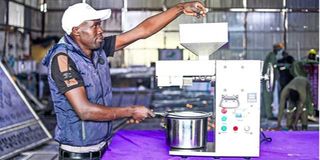
Edible Oil Machine Fabricator Founder Davis Bahati stands next to a Sunflower Edible Oil Pressing Machine manufactured at their workshop in Utawala, Nairobi, on August 13, 2025.
Instead of requiring separate machines for different crops, their design supports multipurpose oil extraction. This versatility saves farmers time and money, ultimately boosting profitability.
Stainless steel containers
The single-phase machine is built for ease of use. Once connected to power, the operator switches on the heating element to warm the screw housing to the required temperature. When ready, seeds are poured into the funnel, and with the press of a button, the machine begins extraction. Oil flows from the central outlet, while the seed residue is expelled separately.
The company offers two options. A filter machine that purifies the oil, or the traditional method of natural decanting in stainless steel containers. Notably, the machine does not require a three-phase power connection, making it accessible to rural farmers operating with single-phase household electricity, a critical feature for energy-constrained communities.
The units come with a one-year warranty and have undergone all required checks to meet both local and international standards. Kenya’s large population of small-scale farmers and youth entrepreneurs presents a unique opportunity for growth. Recognising this, the company’s focus has been on empowering these groups to create jobs and add value, especially in rural and urban communities where underutilised crops are abundant.
Because their produce serves as raw material for oil production, the machine expands the market for these crops, boosting income and creating jobs, especially for youth and women.
Bahati says that the numbers speak for themselves. “Using our standard machine, you can process 750 kilograms of sunflower seeds and get about 135 litres of oil. Given current retail prices for edible oil, this can generate good profit margins for small processors,” he says.
Rural communities
The price of a machine ranges between Sh285,000 and Sh350,000, depending on capacity and whether add-ons like filter units are included. Their clients include cooperatives, youth groups, farmers’ SACCOs, and individual entrepreneurs.
“The machine is easy to operate, even for someone without a technical background. Once trained, anyone can start producing and selling edible oil. It is a practical business, especially in areas where oil is expensive or scarce,” he says.
Since most of the population depends on farming, introducing this technology encourages increased cultivation of oil-producing crops, boosting both production and employment. The founders are passionate about empowering youth and rural communities by providing tools that help turn farm output into income.
“We are targeting farmers and youth, especially those with productive land but limited resources. Our machines fill that gap,” he explains.
To date, the initiative has generated around 400 employment opportunities.
In some areas, youth groups have begun pooling resources to purchase a shared machine and launch small-scale oil production businesses. In others, farmers have added oil pressing to their existing crop enterprises, increasing their earnings and diversifying their income.
“It is a compelling vision, a decentralised edible oil industry powered not by imports and multinational corporations, but by local entrepreneurs using locally made machines to process locally grown crops,” he adds.
Although Edible Oil Machine Fabricators began with a local focus, regional interest has grown faster than expected. The venture now serves 48 clients in Kenya and has expanded its footprint to Uganda, Tanzania, and South Sudan, with inquiries coming from Ethiopia and Rwanda.
“East Africa faces a common challenge—rising demand for cooking oil alongside heavy reliance on imports. We want to be the go-to supplier of affordable, durable oil extraction machines across the region,” he explains.
To meet growing demand, the company plans to scale up production, refine its machine models, and expand its after-sales support network. They are also exploring partnerships with agricultural NGOs, government agencies, and impact investors who share their vision of building resilient local value chains.
Like many SMEs in Kenya, the company faces significant challenges, including securing finance to scale production. Competition from imported oil extraction machines also limits their market share.
Through persistent online and physical promotions, he is gradually overcoming these obstacles and remains optimistic about future growth.
“I am leveraging technology to enhance customer experience and boost machine performance by improving efficiency. This includes increasing the volume of raw materials processed at one time while reducing power consumption per unit,” he notes.
The company’s next phase will focus on product innovation to design compact, affordable machines tailored for micro-enterprises.
Currently, about 65 per cent of the raw materials are sourced locally, the remainder imported. The company plans to source all materials locally to reduce production costs and enhance sustainability.