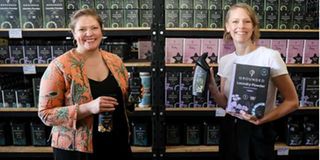
Two sisters driving eco-friendly cleaning to promote sustainable wellness
Grounded co-founders Alison Root (left) and Megan Root at the Grounded Production plant in Regen, Kiambu County, on November 26, 2025.
The conventional notion of health and beauty has broadened to focus on general well-being and internal balance rather than just outward appearance.
A “whole self” approach to health is what consumers are seeking in products and activities.
As consumers become more conscious of the products they bring into their homes, there is a growing shift toward choices that benefit both people and the planet.
The women-owned and family-run company Grounded is reinventing sustainable cleaning in an era of more deliberate decision-making.
Through its line of eco-friendly products, the company improves everyday household environments while creating a ripple effect that supports local farmers, reduces waste, and protects natural resources.
Founded in 2016 by Megan Root, a manufacturing professional passionate about wellness, the venture arose from a personal transformation.
After immersing herself in holistic practices—from yoga and Ayurveda to traditional Chinese medicine, she began to see every day cleaning products in a new light.
What many considered harmless essentials, she saw as a significant but largely overlooked contributor to both personal well-being and environmental health.
Wellness journey
“Through my wellness journey, I realised that cleaning products were one of the most overlooked factors affecting our homes and our surroundings,” she says.
Conventional products were contributing to indoor air pollution and even causing health issues, while alternatives simply did not exist locally.
When she moved to East Africa, this became even more evident, as few options were both effective and accessible.
With interest in how environmental toxins shape short- and long-term health, she began experimenting in her kitchen.
Grounded Co-founder Megan Root holding a body bar soap at the Grounded Production plant in Regen, Kiambu County, on November 26, 2025.
There, she crafted simple, non-toxic formulations inspired by traditional soap making, planting the seeds for what would eventually become a new approach to sustainable cleaning.
She saw an opportunity to develop cleaning products using local ingredients.
After years of trial and error refining her formulations, she launched Grounded, providing an eco-friendly and accessible alternative to chemical-laden products in East Africa.
Three years later, she invited her sister, Alison Root, to join as co-founder.
With a background in agriculture and global health across East and Southern Africa, Alison brought a perspective that deepened the venture’s purpose and amplified its impact.
The sisters pooled their savings as start-up capital and reinvested every earning to build a strong, sustainable foundation. Their approach eventually attracted impact-driven partners who championed local manufacturing and environmentally responsible practices.
Today, 80 per cent of their ingredients are sourced from local farms, including by-products from other production processes such as second-grade coconut oil.
Aloe Vera, essential oils and other botanicals are also grown in Africa, with close collaboration with farmers to strengthen agricultural value chains, support local communities, and reduce waste.
“Our goal from the beginning was to create a business that would bring health and wellness to homes. We see ourselves as part of a larger movement to create a more sustainable economy,” Ms Alison explains.
Synthetic fragrances
The company now offers over 50 products for home, personal, baby, pet and sensitive skin care, from laundry powders and disinfectants to hair care and body bars. The products are priced between Sh40 and Sh22,000.
They avoid conventional additives such as synthetic fragrances, parabens and hormone disruptors entirely.
Its solar-powered factory in Kikuyu works diligently to minimise its carbon footprint by recycling paper through Chandaria, plastics through Mr Green Africa, and organic waste through InsectiPro, which converts it into protein for animal feed.
The company employs 30 people who embrace reverse innovation, returning to basics with natural, time-tested ingredients.
Each ingredient is vetted against international safety databases, and local sourcing is prioritised to reduce environmental impact further.
Ms Megan says that rather than simply replacing chemicals with natural alternatives, the team focuses on re-engineering cleaning to work naturally, which drives ongoing R&D.
Raw materials are sourced from trusted local suppliers, and upon arrival, they undergo rigorous quality testing before being transitioned into small-batch production to ensure consistency.
The facility operates five main production lines specialising in solid and liquid soaps.
Waste is carefully segregated and sent for recycling or composting, so nothing goes to landfill. It is a clean process in every sense, and every bottle reflects that care.
“We have even convinced our packaging partners to switch to 100 per cent post-consumer recycled plastic.
The plastic they use is also UV protective, ensuring the products remain effective while reducing the demand for new plastic,” she says.
She adds that all their packaging is made from recycled materials sourced and manufactured locally.
A defining feature of their products is their concentration. Unlike conventional detergents, which require large amounts per use, these formulations are designed to last longer.
“Our laundry detergent lasts for 66 loads per 2kg container. It is a simple idea, but it has a significant effect. Offering concentrated products helps our customers reduce the need for frequent repurchasing, which means less plastic waste,” she explains.
Additionally, they have partnered with several local businesses and organisations to offer refill stations throughout Nairobi and beyond.
Locations such as Lang’ata Link, ECANDI, Shamba Cafe and Express Shop Kilifi, now offer customers the opportunity to refill their cleaning supplies.
This refill model is about making sustainable choices easier and engaging the community in a more circular approach to consumption.
Reduce plastic waste
“We want to make it as easy as possible for people to choose sustainable products. Refill stations are a way to reduce plastic waste and encourage reuse of containers,” she notes.
As a company that strives to make wellness accessible to all, ethical sourcing is key.
Its products are made with plant-based ingredients and are free from harmful chemicals like phthalates, synthetic fragrances, and bleaches, commonly found in conventional cleaning products.
“We have always focused on making products people can trust—safe for their families and homes, and genuinely effective while still being eco-friendly,” she shares.
She adds that using local, sustainable ingredients allows them to support their own communities rather than relying on imported products.
“It is a win-win for everyone,” she says.
Alison explains that in the early days, education was a major hurdle.
Many people had never heard the term “non-toxic” and didn’t understand why conventional products could be harmful.
“We had to raise awareness through demos, markets, and plenty of conversations. On the operational side, sourcing local materials that met our standards proved to be challenging. However, perseverance and partnerships helped us close those gaps,” she notes.
In 2020, the company expanded operations with a new production facility in Kikuyu, increasing production capacity tenfold. By 2022, it had opened an even larger space in Magana to meet growing demand.
They plan to expand their product line, support local farmers, and enhance waste reduction strategies.
Currently distributed in Kenya, Rwanda, Uganda and Tanzania, it is exploring further regional expansion while developing new formulations in high-demand categories, including its recently relaunched personal care line.
“Our vision has always been to build a company that sells products while being a force for good. Every day, we are reminded that the decisions we make today will shape the world our children live in tomorrow,” Ms Megan concludes.
Follow our WhatsApp channel for breaking news updates and more stories like this.