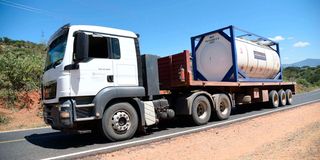
Kenya will truck oil from the Turkana oil fields in the initial stages of production, a move meant to speed up the project besides delaying the financial burden of building a pipeline.
Energy and Petroleum Cabinet Secretary Opiyo Wandayi on Monday disclosed the plan in which an estimated 20,000 barrels per day (bpd) will be produced from the fields in the initial phase.
Use of trucks to ferry the oil from South Lokichar to the port of Mombasa will cut the initial costs of the project from the estimated $3.4 billion (Sh440.8 billion). This will ease pressure on the National Treasury, which is expected to eventually foot costs of building the 892-kilometre pipeline from Lokichar to Lamu Port.
Delays in constructing the pipeline were cited as a possible hurdle that could derail the Kenya oil dream, underscoring why opting for road transport could help minimise delays.
Kenya, through Gulf Energy, expects to start commercial production of the oil Block T6 and Block T7 by December 2026 before scaling up by 2032.
“During the first phase of this project we are going to do trucking. Of course, there are other opportunities in the future to do other infrastructure like the pipeline,” Mr Wandayi said on Monday.
The ministry had earlier disclosed that the Sh440.8 billion will be used to fund construction of the crude oil pipeline, tanks and the drilling of the wells.
An estimated 50,000 bpd are expected to be produced daily when the project enters its second phase after two to three years.
This will be the second time that Kenya will be relying on trucks to get the crude oil from South Lokichar, a plan that greatly hinges on a robust road network connecting to the port of Mombasa and spanning hundreds of kilometres.
Kenya also trucked nearly 180,000 barrels of crude oil in 2020 under the Early Oil Pilot Scheme (EOPS). The scheme that initially targeted 500,000 barrels was used to test the appeal of the Turkana oil in the global markets.
The revelation on plans to use trucks comes days after the Ministry of Energy approved the commercialisation plan of the oil blocks, paving the way for ratification from Parliament before granting Gulf Energy the green light to start works on the blocks.
Gulf Energy fully acquired the project from Tullow Kenya BV, the subsidiary of British oil exploration firm Tullow in September this year in a $120 million (Sh15.56 billion) deal.
The entry of Gulf Energy has raised Kenya’s hopes of becoming the third oil producing economy in the region after South Sudan and Uganda.
Gulf Energy is expected to finally unlock a project that Tullow had failed to progress in over two decades since it discovered the commercially viable oil.
Funding hitches and rejection of the commercialisation plan (Field Development Plan) were the two major reasons that stopped Tullow from starting commercial production of the oil.