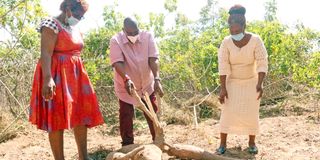
Kenya Agricultural and Livestock Research Organisation director-general Dr Eliud Kireger (centre), deputy director-general for crops Dr Felister Makini (left) and the director, industrial research, Dr Teresia Munga, inspect a cassava tuber in Mtwapa, Kilifi County.
Cassava cuttings should be obtained from mature stems from plants that are nine to 18 months, long enough with at least five nodes.
In mono-cropping, the recommended spacing is a square arrangement, 1m by 1m giving 10,000 plants per hectare or 4,000 plants per acre.
According to Dr Munga, cassava is a hardy crop and has an extensive root system that enables it to grow in poor soils.
Harvesting can be mechanically done using a pull harvester attached to a tractor.
With six new varieties that mature in about eight months now available, growing cassava should not be a tedious task.
Dr Theresia Munga, the Kenya Agricultural and Livestock Research Organisation (Kalro) director of industrial crops at Mtwapa centre, says the new varieties are Shibe, Karembo, Tajirika, Siri, Nzalauka and Karibuni.