Kiambu County is steadily losing arable land due to rapid population growth, urbanisation, and continued land subdivision. This leaves many farmers with smaller farms and limited space for conventional agriculture. Consequently, an increasing number of farmers are switching to high-value crops such as herbs and spices in order to maximise income per unit area and diversify their revenue streams.
One of the leaders of this transformation is William Gitau, founder of the Healthy Living Tech-Agri Campaign CBO, also known as the Helitech Organisation, which is based in Kamburu Ward in Kiambu County.
According to Gitau, Kiambu County remains one of Kenya’s major agricultural hubs, traditionally known for producing maize, beans, sweet potatoes, arrowroots, bananas, coffee, tea, fruit and vegetables. However, increasing population pressure and land subdivision have significantly reduced average farm sizes, with many farmers now operating on less than one acre.
“This reality demands a shift in thinking. The future of smallholder agriculture may no longer depend solely on producing bulk commodities, but rather on embracing diversified, high-value enterprises that generate more income from smaller spaces,” he says.
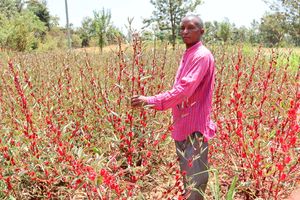
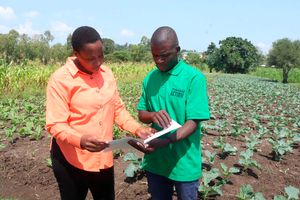
William Gitau, founder of Healthy Living Tech-Agri Campaign CBO, commonly known as Helitech Organization, at his herb and spices model farm in in Kiambu County on June 4, 2026.
Photo credit: Richard Maosi | Nation Media Group
Through the organisation, he runs demonstration farms and training programmes to help farmers transition from conventional to agroecological systems that are profitable, environmentally sustainable and socially inclusive.
He says that he was motivated to venture into herbs and spices by both economic and ecological factors. “I realised that many smallholder farmers were trapped in low-value production systems where they cultivated large volumes of crops but earned very little income,” he explains.
At the same time, he observed growing consumer demand for healthy foods, natural products, medicinal plants, and organic produce.
Working with his partner, George Wang'ang'a, Gitau identified herbs and spices as the ideal business venture because they can be cultivated in small areas, generate high returns and support biodiversity. These crops also attract pollinators, improve soil health when properly integrated, and create opportunities for processing and adding value, as well as providing access to expanding local and international markets.
Gitau’s journey into agriculture began after he spent seven years in seminary training to be a priest.
“Having been born and raised in a farming community, improving economic conditions for smallholder farmers became a major motivation for me to return,” he says. The transition, however, was not easy. “I had to adapt to the shift from religious life to agriculture, address community perceptions, and encourage the adoption of modern farming methods in place of traditional practices,” he adds.
This led to the establishment of the Helitech Organisation, which has since become an important platform for providing local farmers with agroecology and agribusiness training.
Gitau notes that agriculture is a lifelong learning process. He has benefited from training and mentorship from institutions and organisations such as the Food and Agriculture Organization and the Kenya Organic Agriculture Network, as well as from farmer field schools and community-based organisations. He started experimenting with herbs and spices on small plots, learning through observation, research, farmer exchanges, field visits and practical experimentation.
“What started as a small demonstration has evolved over time into a learning centre where farmers, young people, students, researchers and visitors come to learn,” he says.
William Gitau, founder of Healthy Living Tech-Agri Campaign CBO, commonly known as Helitech Organization, at his herb and spices model farm in in Kiambu County on June 4, 2026.
Photo credit: Richard Maosi | Nation Media Group
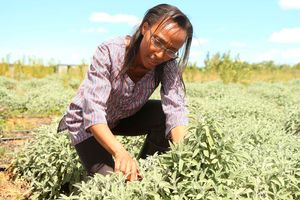
Today, Gitau cultivates and demonstrates over 30 varieties of herbs and spices, including orange thyme, lemon thyme, garden sage, mint, white oregano, African blue basil, lemongrass, verbena, lemon balm, lavender, marjoram, stevia and blue vervain, as well as several other indigenous herbs used for medicinal and culinary purposes.
“The diversity is intentional. Agroecology teaches us that diversity breeds resilience. The more diverse our farms are, the more resilient our farming systems become,” he says.
To maintain productivity, Gitau follows agroecological farming principles focused on building living soils. These include compost production, mulching, crop rotation, intercropping, agroforestry, biological pest management, water harvesting, organic fertilisation, pollinator management and soil cover management.
He notes that many herbs have significant nutritional and medicinal value. For example, thyme is rich in antioxidants and aromatic compounds such as thymol, and is commonly used in traditional remedies for respiratory health. Sage contains anti-inflammatory compounds and has traditionally been associated with supporting memory and cognitive function. Oregano is renowned for its high antioxidant content and contains compounds such as carvacrol and thymol, which is why it is so widely valued as a culinary and medicinal herb.
“As modern societies face increasing rates of non-communicable diseases, there is growing interest in returning to diverse diets that include herbs, indigenous vegetables, fruits, legumes, and minimally processed foods,” says Gitau. “While herbs are not a substitute for medical treatment, they play an important role in promoting dietary diversity and supporting healthier food systems.”
Their main consumers are traders, farmers, restaurants, hotels, herbal processors, training institutions and agroecology practitioners. The organisation is also exploring opportunities in essential oils, export markets, and value-added herbal products. Fresh herbs are sold in bunches, by the kilogramme or in customised quantities, depending on customer needs. Dried herbs, meanwhile, are packaged in consumer-friendly quantities ranging from 50 grammes to one kilogramme.
Gitau says that adding value remains a major focus because it increases profitability while reducing post-harvest losses. Although yields vary depending on the season, the crop and management practices, he emphasises that their focus extends beyond quantity to sustainability and profitability.