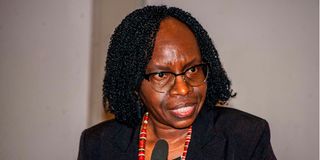
State-owned enterprises and Agencies are struggling to repay on-lending loans, a reality that Auditor-General Nancy Gathungu has now warned risks exposing the government to higher interest and more appetite to borrow.
In her report to the National Assembly Public Debt and Privatisation Committee on the performance audit of management of on-lending activities in Kenya, Ms Gathungu also warned that the failure by the agencies to meet their loan obligations exposes the national government to budget constraints and cuts in various sectors.
On-lending is when the government secures loans directly from international creditors and then lends it to State Owned entities (SOE) and agencies, which are responsible for utilisation and repayment.
The SOEs are legal entities established by the government through various Acts of Parliament which the government holds all or the majority of shares, like Kenya Pipeline, Railways, etc.
The entities implement priority government policies, projects and programmes.
The government can on-lend the loans contracted from the lenders with the same conditions or with different conditions to the on-lending beneficiary.
The report indicates that as at June 30, 2024, the on-lent loans to 35 State Owned Enterprises in the agriculture, energy, finance, health, and transport, and water sectors stood at Sh874.9 billion.
Out of this, Sh153.8 billion was due as at June 30, 2024, but only Sh1.6 billion had been repaid, representing a paltry 1.04 percent.
“The default on repayment of on-lent loans by State Owned Enterprises presents the risk of shifting the debt repayment burden to the National Government,” reads the report.
Ms Gathungu says in her report that the default in repayment of the on-lent loans has constrained the National Government’s budget, resulting in the government sourcing additional financing through borrowing and budget cuts across government entities.
According to the report, the water sector had the highest number of on-lent loans, which stood at 58 out of the 95 loans that were advanced as of June 30, 2024.
A report by the National Treasury on the annual Public Debt report indicates that the external debt sustainability analysis for the country indicates a high risk of debt distress.
In the Transport sector, Kenya Railways entered into an agreement with the Ports Authority –Take or Pay Agreement (TOPA) for the collection of rates and charges payable for the transportation of goods using the SGR line.
However, the audit revealed that KPA has not been remitting the full amount to the escrow account as per the agreement, thus limiting Kenya Railways' revenue.
According to the report, during the year under review, Kenya Railways failed to meet its loan repayment due to the monthly retention by the Kenya Ports Authority, which was responsible for collecting and remitting SGR freight revenue to an escrow account on behalf of Kenya Railways.
The report revealed that from July 2023 to December 2024, KPA collected Sh22 billion, out of which Sh16 billion was transferred to the escrow account and retained Sh6 billion.
“This unauthorized revenue retention deprived Kenya Railways of sufficient funds required for loan repayment. Further indicated KPA’s non-compliance with the agreement and adversely affected Kenya Railway’s financial obligations towards repayment of on-lent loans,” reads the report.
The move by KPA to retain the amount means that Kenya Railways Corporation is not generating enough revenue to pay the loan acquired for the building of the Standard Gauge Railway line from Mombasa to Malaba.
The report notes that the National Treasury to this end has written a demand letter to recover Sh6 billion, which KPA retained.
In the water sector, the report revealed that entities mainly in the Coast region are not generating adequate revenue due to high cost of operation caused by electricity bills, some averaging to 80 percent of total operational cost.
Ms Gathungu also says in her report that in some instances, the water agencies lack documents and information about their loan obligations.
“It is true as reported by the Audit, Narok Water and Sewerage Services and Ol-Kalou Water Company has not been provided with any form of communication by the implementing agency-Rift Valley Water Works Development Agency with regard to their loan obligations, hence not in a position to factor the loan repayment in their budget,” reads the budget.
The audit report covered six financial years from 2018/2019 to the financial year 2023/2024. The years were chosen because it is the period in which about 60 percent of the sampled loans matured.