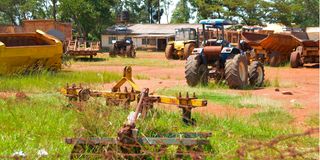
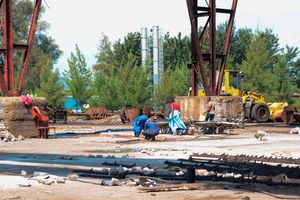
Nabii Yohana, the self-proclaimed prophet who claims divine powers, should probably pray for his village of Nandolia in Bukembe West Ward, Kanduyi Sub county, Bungoma County.
Nandolia — a once lively, now sleepy village that gained prominence in the 1970s when Nzoia Sugar Company was established — seems to have been afflicted by a quiet plague: rust.
This reddish-brown crust creeps across the roofs of roadside shops, abandoned harvesters, tractors, and trailers on Nzoia Sugar’s yard.
The plague of rust has spread from the heart of the once-mighty Nzoia Sugar, which, when built in the 1970s, breathed life into the village, spawning all kinds of economic activity.
“It was Nzoia Sugar that enabled people around here to build mabati houses and educate their children,” says Saulo Busolo, former chairperson of the Kenya Sugar Board, who has since transitioned into full-time farming.
Today, with the state-owned sugar factory on its knees, the village is dying a slow, silent death.
Albert Kimoli, a cobbler, has spent the past 15 years repairing shoes for Nzoia Sugar workers. But after the company laid off 70 per cent of its staff due to financial struggles, business has been bleak.
“Long ago, customers would return quickly to collect their shoes,” he says. “Today, customers hardly come back.”
This grim picture is mirrored across virtually every village near ailing state-owned sugar factories, creating a phenomenon of ghost towns in the sugar belt.
You see it in the once-vibrant town of Mayoni, next to Mumias Sugar. You feel it in Muhoroni and Chemelil in Kisumu County, and Sony in Migori County.
A section of the once-thriving Mayoni trading centre near Mumias Sugar Company, on June 10, 2025.
Photo credit: Alex Odhiambo | Nation Media Group
When you think of the sugar industry, you likely picture sugarcane fields and factory chimneys. But its impact runs much deeper — creating a powerful ripple effect throughout the local economy.
A single sugar mill doesn't just process sugarcane. It supports thousands of jobs — from factory workers to field officers. Then there are the farmers, most of them smallholders, who rely on payments to feed their families, pay school fees, and keep small businesses afloat.
Truck drivers who transport sugarcane, roadside vendors who sell snacks, welders fixing broken machinery, and input suppliers — all rely on the industry. When a mill is running, money flows. Villages are alive. Small towns thrive.
Now imagine when that chain breaks — when a factory shuts down due to mismanagement or lack of sugarcane. The impact isn’t confined to factory staff. Entire communities feel the sting. That’s the multiplier effect: one industry affecting many others.
“Mayoni, that ramshackle town you passed while coming here, was the London of this area,” says Busolo.
Beyond the vast cane plantation, smoke could be seen billowing from Mumias Sugar. But the smoke neither inspired hope nor calmed the frustrations of local youth, many of whom claim the new investor, Sarrai Group, hasn’t done enough to hire locals.
A sugarcane-laden truck rumbled past the Nation team, but it wasn’t clear whether it was heading to West Kenya’s Kabras factory or Mumias Sugar.
Mayoni Bar & Restaurant, recalls 65-year-old Ramadhan Wataka Otembo, was the first high-rise building in all of Mumias.
Back in the days, this bar was the temple of adulation, attracting visitors from far and wide, according to Otembo.
“But today, if you go there, you’ll just find people drinking uji and mandazi,” he says.
An aerial view of Muhoroni Town and part of the sugar nucleus estate on July 1, 2025.
Photo credit: Alex Odhiambo | Nation Media Group
During the Booker Tate era — when Mumias Sugar was managed by an international consultancy — the company carved out four acres from its 8,700-acre nucleus estate to build jua kali sheds for villagers.
“All of them have since been abandoned — and instead, people live in them,” says Moses Malala, chairman of Mayoni Market.
Paint has peeled off, windows gape open, and doors hang loose or are missing entirely. Inside, grass and weeds push through cracked floors, growing undisturbed where artisans once laboured.
As a new round of sugar sector reforms begins with the privatisation of state-owned sugar factories, residents and the business community in some of these areas hope the ghost towns will be revived.