Firewood use in institutions is not only environmentally damaging but also expensive to sustain, with schools spending hundreds of thousands of shillings each term to procure logs for cooking.
A growing number of schools are now turning to clean cooking stoves powered by electricity and solar energy, marking a major shift in how institutional meals are prepared. The transition is helping to reduce costs, protect the environment, and ensure learners receive meals on time.
In Kiambu County, PCEA Mama Ngina Primary and Junior Secondary School has recently embraced clean cooking as it seeks to serve a rapidly growing student population of nearly 2,500 learners.
Deputy Headteacher in charge of Administration, Rachael Ndune, says the school had limited space and many classrooms were located near the kitchen, making smoke from firewood a major concern.
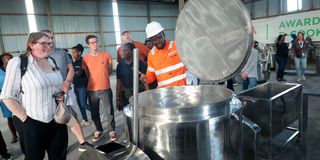
Simon Nyaudo working on Solar Powered Cookstove at Ecobora Factory in Kajiado on April 18,2026.
Photo credit: Evans Habil | Nation Media Group
“Our cooks often suffered from smoke-related health issues, and at times some failed to report to work because of the effects of smoke. With e-cooking, we believe their health and that of the learners is better safeguarded,” says Ms Ndune.
She revealed that the school spent close to Sh300,000 per term on firewood. “Wet wood also meant slower cooking, leading to delays in serving food to learners,” she told Climate Action in an interview.
The school feeding programme has long been a lifeline for many children. At one point, between 2,000 and 2,500 learners were fed through the programme. Even after later changes, porridge continued to be served widely, while some children depended on leftover lunch packed to take home for dinner.
“We are excited because children will now enjoy meals prepared in a cleaner environment, free from smoke and burning,” says the deputy headteacher.
At Al-Huda Muslim School in Majengo, Kajiado County, the old firewood system had become unsustainable. The school, with a population of about 820 learners, depended on two pick-ups of firewood every month.
This cost nearly Sh20,000 per month, excluding water and other kitchen expenses.
According to the school’s Senior Teacher, Shaaban Iddi, who is in charge of environment and the feeding programme, the institution was spending close to Sh40,000 each month to keep the feeding programme running.
“We were really suffering when we were using firewood. Kajiado is an Asal area and, as you know, we do not have enough trees around, so it was causing us many problems,” says Mr Iddi.
Because trees are scarce, the school sometimes had to seek county government approval before cutting branches to supplement fuel supplies. Mr Iddi says delays in approvals often disrupted meal preparation.
Solar powers at Alhuda Primary School in Kajiado on April 18,2026 where they power solar-powered Cookstove.
Photo credit: Evans Habil | Nation Media Group
The smoke from the traditional kitchens also took a toll on workers. Cooks spent hours in smoky environments that affected their eyes and breathing. During rainy weather, lighting the firewood became even harder, delaying meals for children.
That, however, changed when EcoBora, a Kenyan clean energy company, introduced solar- and grid-powered institutional cookstoves at the two schools.
“When the company came in, we sat down and decided that this project must take off. They brought the panels, installed them, and funded the system for our school and the community,” he explains.
The school adopted the clean energy cooking stoves early this year, and as learners prepare to return for the second term, Mr Iddi says operating costs have reduced significantly.
For the Kiambu school, Ms Ndune says the institution is also planning to expand its solar system, which currently helps pump water, to support kitchen operations and lower future energy costs.
With the e-cooking system, dishes such as githeri, which can take five to six hours on firewood, can now be prepared in two to three hours, depending on preparation.
EcoBora Business Development Lead Joy Kwamboka says the company identified a huge gap in institutional cooking.
“In Kenya, we have over 92,000 educational institutions, including schools, training camps, and universities. We came in to help address this gap by manufacturing electric cookstoves here in Kenya, tailored to specific country needs,” she explains.
Ms Kwamboka says the company’s baseline studies a few years ago found hundreds of thousands of schools in East Africa still using firewood, making meals costly and unreliable.
“In Kenya alone, a single school can emit up to 700 tonnes of carbon dioxide through firewood consumption. By introducing electric cookstoves, schools no longer need to outsource firewood. This means we are saving trees and reducing carbon emissions,” she says.
The firm has already expanded to counties including Nairobi, Kajiado, Kiambu, Siaya, Meru, Laikipia, Nyamira, and West Pokot, with schools serving as demonstration centres for others interested in switching to clean energy.