‘No photos here’: State blocks access to cleared Karura section
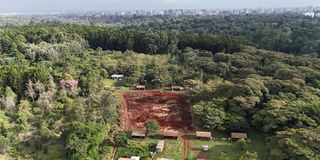
An aerial view of a section of Rangers Village, which was recently cleared, inside Karura Forest

Following alarm bells raised by Friends of Karura Forest (FKF), which jointly manages the green space with the government, the Nation can confirm that a series of undisclosed activities have reportedly been taking place since February 21, 2026, under tight security.
The conservation group says the operations appear to be conducted discreetly and away from public scrutiny, raising questions about what exactly is happening within the protected area.
An investigation by the Nation has since established that in a section of the forest around Trail 15, several trees have been cut down and parts of the land cleared, with access to the area tightly controlled.
The section is also surrounded by a cemented house and a cluster of wooden semi-permanent houses, about five in total.
During a spot check at the site by Nation, a woman could be seen washing clothes outside one of the structures while music played in the background, signalling that the houses may be occupied by families.
At one corner of the site, beneath a large tree, four security officers stopped our team and demanded to know where we were headed.
“No photos are allowed here. Do not let them leave without checking their phone,” a Kenya Forest Service (KFS) officer ordered his colleague.
“Any pictures or videos taken in this area must be deleted,” he warned.
His colleague then took this writer’s phone and proceeded to go through the photo gallery. Satisfied that no images had been taken, he returned the device.
“This area is under protection for now. No one is allowed to access it…There is no path you can use past this point,” one of the officers said in a stern tone.
The area in question is Rangers Village, located between Trail 15b and Trail 20.
Just recently, an area near here was in the news after it was discovered that the government was building a tarmac road inside Karura Forest, leading to uproar. At the time, KFS explained that it was tarmacking the road to staff quarters in order to facilitate the movement of its rangers.
This time round, FKF says, a fresh round of activities started weeks ago. The first signs were noted on Saturday, February 21, 2026, when a group of men carrying chainsaws entered the forest through the KFS Gate 15 access point.
“Ten men with saws came…We stopped them first, four left but six remained,” an insider at the conservation group, who did not want to be named for fear of reprisal, said.
“The remaining six were eventually cleared to access the forest and started clearing the area.”
However, days later, the situation escalated. On Monday, February 23, 2026, FKF received information that a backhoe excavator had been brought in and was now digging up inside the protected area.
“We immediately questioned this because such activity had never been communicated with us.”
On February 24, 2026, FKF formally wrote to the Chief Conservator of Forests seeking clarification. However, the conservation group says it has never received a response.
Moreover, FKF says that it had been unable to independently verify what is happening at the site because the area has since been turned into a restricted zone.
“They have now cordoned off the area and declared it a security zone,” FKF said.
“No one is allowed to access it.”
When the Nation contacted KFS to clarify whether the cleared section lies within a designated protected area, KFS said its position remains what it stated in a release issued last week on its Facebook page on February 28. However, the press statement doesn’t clarify this point.
KFS declined to provide any further details beyond the information contained in that communication.
‘Making room for seedlings’
While FKF has never received a response to its queries, on Monday March 9, Environment Cabinet Secretary Deborah Barasa said that the government is clearing land to make room for a tree nursery and temporary accommodation for National Youth Service (NYS) personnel who will nurture them.
“We need a lot of seedlings. We need to mobilise and strategise all the forest stations to produce 2 million to 10 million seedlings, one of them being at Karura Forest,” she said during an interview on NTV’s Fixing the Nation.
However, Karura Forest is jointly managed by the government through the Kenya Forest Service and the local community through Friends of Karura Forest under a joint management framework. The latter reckons it should have been involved in any decision-making to clear additional land for tree seedlings and living quarters.
Additionally, the conservation group notes that on Feb 19, 2026, just days before the first men arrived with chainsaws, KFS and FKF had a Joint Management Committee meeting which discussed all projects concerning Karura.
However, FKF claims the new development, restriction of a section of the forest and clearing it for seedlings were not discussed at the meeting.
“All projects concerning Karura forest are supposed to be…nothing like that was mentioned.”
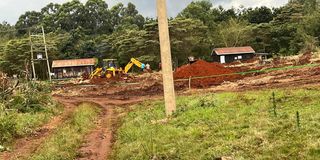
An excavator inside Karura Forest.
FKF now fears the clearing could be linked to plans to construct facilities for the NYS inside the forest, a move the conservation lobby strongly opposes.
“The issue is not about seedlings or conservation work. The issue is cutting trees and building what they are calling the NYS barracks inside the forest,” FKF said.
“They have about 55 hectares of land outside the forest. Their headquarters is only about 2.7 kilometres from here. If they need facilities, they can build them there. Why bring construction inside a protected forest?” an FKF official wondered.
“We are simply saying that we should not cut down trees.”
However, KFS emphasised that the works do not involve encroachment into protected areas.
“There has been no excision of Karura Forest land, nor allocation to private developers or encroachment into protected indigenous forest or core conservation areas as alleged by a section of the civil society,” KFS said.
“No trees have been felled, only removal of old tree stumps.”
CS Barasa also addressed speculation that the cleared land was intended for permanent housing developments and dismissed it as false.
“It is not true. That is a lie,” she said, explaining that only temporary accommodation structures for NYS personnel would be set up.
“These are temporary homes for NYS personnel because to achieve two to ten million seedlings, we need the human resource capacity to do that,” she said, adding that they would consist mainly of two to three container units placed within forest stations alongside the nursery facilities to support seedling propagation.
Tree nurseries at Karura
Currently, Karura Forest is estimated to occupy 1,041 hectares. The forest has three areas where it nurtures young seedlings: two are under KFS, and one is under the FKF.
The KFS nurseries produce about 1.5 million seedlings, but have the capacity to increase this to 3 million. FKF produces 70,000 indigenous seedlings, but can accommodate 100,000.
FKF officials argue that the forest already has enough space for seedlings to sustain restoration and conservation efforts.
“The question now is why there is a plan to increase production by another two million seedlings.”
But CS Barasa says more room is needed under President Ruto's 15 billion tree-growing campaign.
“The 15-billion tree planting agenda is really bringing to life the spirit of Wangari Maathai when it comes to restoration of our ecosystems…In Karura, we were just clearing space to propagate between two and ten million seedlings so that we can green our city and ensure the forest is well covered,” she said.
The CS added that the seedling programme is expected to supply trees for planting across a range of landscapes, including roadsides, institutions and community lands.
The CS linked the initiative to Kenya’s long-term target of increasing national forest cover from the current levels to 30 percent, arguing that expanding seedling production is critical to achieving climate resilience and ecosystem restoration.
“We must improve our forest coverage from about 12 percent to 30 percent so that we can achieve climate resilience, ecosystem restoration and improved livelihoods,” she said.
However, CS Barasa acknowledged that the initiative had generated public concern, particularly among conservation groups and residents keen to protect the legacy of Karura.
“Unfortunately, in our country, sometimes even positive initiatives become politicised,” she said.
However, FKF insists that Karura Forest is a conservation forest designed to restore indigenous ecosystems rather than support commercial forestry or large-scale infrastructure.
“This is not a plantation forest…Karura is a conservation forest where trees are planted to restore natural ecosystems, not to be harvested or to support construction projects,” the official said.
Follow our WhatsApp channel for breaking news updates and more stories like this.


