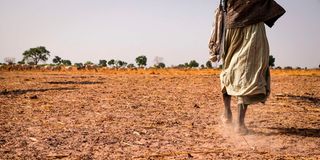
The failure of the short-rains season in the country is pushing large parts of the country to the brink of a worsening drought, experts warn.
This year, arid and semi-arid counties experienced unusually dry conditions. Only Garissa and Tana River stated to have recorded near-normal rainfall, while all other monitoring stations reported deficits ranging from below average to severely low levels.
The pattern highlights widespread rainfall suppression across the country, aligning with forecasts issued by the Kenya Meteorological Department. According to the experts, they warned that the impacts will intensify in the coming days, thus warning that urgent measures must be taken.
In an exclusive interview with Climate Action, Edward Muriuki, the acting Director of the KMD, explained that the current weather reports highlight a worsening situation; that of rainfall deficits, prolonged dry spells, and significantly warmer temperatures are converging. As a result, it threatens food production, livestock survival and water security across 23 asal counties.
This year’s short rains, which are significantly important for farmers, have failed to meet expectations, and in certain areas, have completely collapsed with no rainfall recorded. Counties such as Mandera, Wajir, Marsabit, and parts of Lamu have recorded less than 10 per cent of their expected short rainfall this season.
However, in Wajir, no single amount of short rains was recorded in October. Many parts of Garissa, Isiolo, Kitui, and the coastal strip managed 20–50 per cent of their seasonal average, signalling what experts describe as one of the most severe rainfall deficits in recent years.
“These are areas now experiencing a second consecutive year of poor or failed short rains,” Muriuki said, noting that the cumulative effect of back-to-back failures intensifies the drought crises.
As the crisis intensifies in the east and north, rainfall patterns across the rest of the country have been highly erratic.
Meteorologists attribute this season’s unusual patterns to the combined influence of two major global climate drivers: La Niña in the Pacific Ocean and a negative Indian Ocean Dipole (IOD).
Both phenomena suppress the formation and movement of moisture in the Indian Ocean basin, limiting cloud formation and ultimately reducing rainfall across East Africa.
These are drivers that cause or influence weather patterns. When you have such a combination, you find that over the eastern African region, rainfall or moisture is suppressed in the Indian Ocean. And this combination normally is historically linked to severe drought periods in our region,’’ Muriuki explained.
La Niña events, marked by the cooling of the central and eastern Pacific, are linked to dry conditions in East Africa.
Farmers across Kenya’s key agricultural regions are already feeling the pressure. Dry soils, withering crops, and shrinking water sources are forcing families to make difficult decisions about food and income.
In pastoralist communities, grazing fields have dried up, leaving livestock weakened and threatening household economies.
“The situation is not good,” said Muriuki, “what we are facing is a rapidly escalating humanitarian and livelihood crisis.”
The drought situation is worsening due to the poor performance of the ‘October, November, December’ rainfall season.
17 counties are classified in the ‘Normal’ drought phase but deteriorating, while six counties, including Mandera, Wajir, Garissa, Kilifi, Kajiado and Tana River, remain in the ‘Alert’ phase.
The Alert Phase includes Mandera, Wajir, Garissa, Kilifi, Kajiado, and Tana River.
The six counties require close monitoring due to emerging drought conditions and potential impacts on food security, water access, and pasture availability.
Kwale County, previously classified in the Alert phase, has now moved into the ‘Normal’ phase following the moderate rainfall received during the last week of October.
However, the prevailing high temperatures may erode these gains, particularly affecting vegetation conditions and water availability in drought hotspots such as Lungalunga and Kinangop sub-counties.
Normal Phase includes Marsabit, Samburu, Turkana, Taita Taveta, West Pokot, Tharaka Nithi, Embu, Kwale, Kitui, Nyeri, Isiolo, Laikipia, Narok, Baringo, Makueni, Meru, and Lamu.
“Normal means things are okay, but they may also need to keep monitoring because it is deteriorating. The drought situation is on a worsening trend in these counties, with major livelihood zones experiencing stress, particularly in the water and livestock sectors,” Muriuki explained.
According to the forecasts, the weather over the next seven days is expected to remain largely hot and dry across the country, with only occasional isolated showers in the highlands, Lake Victoria Basin, and parts of the coastal and northeastern regions.
“When we say temperatures will be ‘higher than average,’ we mean they will surpass the norm. This adds an extra burden on farmers already facing significant rainfall deficits.” Muriuki explained.
Forecasts for the coming three months show that most parts of Kenya will experience predominantly sunny and dry weather through January and February, with rainfall mainly confined to December, particularly in southern areas.
A few rainy days may still occur in January and February over the Lake Victoria Basin, the Highlands west and east of the Rift Valley (including Nairobi), the South Rift, the southeastern lowlands, and coastal zones.
In the northern half of the country, isolated showers are expected early in December, after which dry conditions are likely to persist through the rest of the season. Temperatures across all regions are projected to be warmer than the long-term average.
The National Drought Management Authority reported that 1.8 million people across the arid and semi-arid lands are currently food insecure.
That number is expected to rise to 2.14 million by January 2026, driven largely by the cumulative effects of failed rains and escalating water scarcity.
According to Muriuki, the coming weeks offer little hope for substantial rainfall, urging farmers to take measures to reduce losses and protect what remains of their harvests.
Among the key advisories issued are aggressive mulching to retain soil moisture, avoiding fertiliser application, which can burn crops in dry conditions, shifting to drought-tolerant or fast-maturing crops, such as green grams, if moisture is still available in the soil, together with harvesting and storing any available rainwater, including from roofs, ponds, and small pans.
“These measures are not long-term solutions,” Muriuki said, “but they can help prevent total losses in a season like this.”
The government maintains that it is working closely with affected counties to coordinate interventions. Monthly meetings involving agencies across the livestock, nutrition, health, security, and education sectors help determine where support is needed most.
Mr Muriuki emphasised that the Kenya Meteorological Department continues to release daily, weekly, and monthly forecasts, information which the public is encouraged to take seriously.
“Forecasts are timely, accurate, and reliable, and should be used for planning and decision-making,” KMD said, cautioning that no one should be caught off-guard given the consistent warnings issued ahead of the season.
County governments have also begun issuing their own advisories, including water rationing, livestock offtake programs, and localised emergency interventions.
“Water is going to be central to our future,” Muriuki said. “If we do not invest in harvesting and storing it now, we will continue to suffer from multi-year drought cycles.”
The National Drought Management Authority oversees Kenya’s Drought Early Warning System, a comprehensive framework designed to monitor and respond to drought risks.
The system tracks four key categories of indicators: biophysical, production, access, and utilisation.
It combines the remote-sensed data with primary and secondary information on both environmental and socioeconomic conditions.
NDMA further goes ahead to analyse this data to produce monthly early warning bulletins, which classify the drought phase for each county.
By focusing on the most relevant indicators, the system helps determine the severity of drought and disseminates timely information to guide early interventions, ultimately aiming to protect lives and livelihoods.
“Forecasts exist for a reason; taking them seriously is key to protecting lives, livelihoods, and communities,” Muriuki emphasised.
Over the next six days, between December 9 and 15, most parts of the country are expected to be sunny and dry with rainfall being expected in a few areas in the highlands east and west of the Rift Valley, the Rift Valley, the coast, north-eastern and the south-eastern lowlands. Daytime (maximum) average temperature of more than 30 degrees Celsius is expected in some parts of the country, including the coast, north-eastern and north-western Kenya, as well as over some parts of the South-eastern lowlands, the rift valley and the highlands west of the rift valley.
Night-time (minimum) average temperatures are expected to be less than 10 degrees Celsius in some parts of the highlands east and west of the rift valley, the rift valley and in the vicinity of Mt. Kilimanjaro.