AI data centres consume world's power and water at unprecedented scale
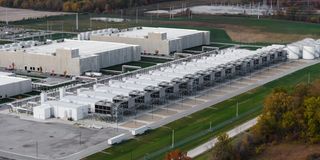
A data centre in Columbus city, Ohio.

It's the world’s newest habit. Looking for a photo? Turn to Artificial Intelligence (AI). Transcribe a video to text? AI can generate it in seconds. Struggling to write a text message, email or need relationship advice in the wee hours of the night? AI has answers.
This is generative AI — a subfield of the technology that many people use daily. But Vincent Koech, a software developer, explains that AI extends far beyond content creation.
“There are other forms, such as predictive AI and conversational AI, designed to interact with users and forecast outcomes.”


Every day, millions of people are turning to AI for various reasons and as its demand expands, research by the United Nations University’s Institute for Water, Environment and Health titled “Environmental Cost of AI’s Energy Use: Carbon, water and land footprints” estimates that the AI global market will grow from $189 billion to about $5 trillion by 2033.
But as you type that prompt and hit “send”, have you ever wondered what powers this convenience? And what it means for the planet?
Data centres
Behind every AI interaction is a vast network of data centres that are responsible for processing, distributing and storing large amounts of information. Their operationalisation, Koech explains, requires a lot of energy, which the report estimates could double to consume three percent of the world’s electricity by 2030.
“If data centres were a country, it would have ranked 11th globally in electricity consumption. The energy consumed by data centres in 2025 was enough to supply the annual residential electricity needs of the entire population of sub-Saharan Africa, 1.3 billion people, for 2.6 years,” says the report.
Water scarcity
But it's not just power. AI's growing appetite for electricity is only part of the problem; climate advocates are also questioning its water use.
Last year alone, the report reveals, data centres consumed enough water to fill 1.8 million Olympic-sized pools. If the water were redirected to Africa, it would meet the basic domestic needs of more than 600 million people each year. By 2030, the UN report estimates that AI could use as much water as 1.3 billion people.
“The public debate still often treats AI as software, but AI is also physical infrastructure: data centres, electricity generation, cooling systems, transmission networks, chips, minerals, land and water,” said Kaveh Madani, the institute's director and the report's lead author.
Data centres, Koech explains, require a lot of water to cool the servers that run AI models.
“The servers use graphic processing units (GPUs) unlike the CPUs on our computers. GPUs run intensive tasks of crunching through large datasets. Water is therefore required to cool them down,” he elaborates.
Think of it this way. You are exercising on a hot day. Sweat forms on your skin, absorbs body heat and evaporates leaving you cooler. In many data centres, water performs the same job: absorbing heat before evaporating.
“The centres use fresh water because salty water accelerates rusting of server components and chips,” he adds.
Related litigation
Increasingly, data centres are becoming a source of tension rather than celebration in some parts of the world. An analysis published last week by the London School of Economics found an increase in climate-related lawsuits challenging water consumption, energy sources and air pollution of data centres.
Across the US, for instance, some communities have lamented that data centres' insatiable water demand is exacerbating water shortages.
What it means for Kenya
By last year, only 32 countries hosted AI-specialised data centres, with the vast majority concentrated in the US and China. However, cities like Nairobi are positioning themselves as tech hubs. Dubbing the capital as the “ Silicon Savannah”, President Ruto has, in previous addresses, revealed plans to host data centres.
“When I went on a trip to the United States, we signed an agreement between G42 of UAE, Microsoft of America and Kenya to establish data centres,” President Ruto said while addressing Kenyans in Qatar
“To switch on that one data centre, we would need to shut off power for half the country. That’s when I knew there was a problem.”
Already, millions of Kenyans face water scarcity and such a project could heighten the problem.
During London Climate Action Week, the United Nations launched a global transparency initiative urging AI companies to publicly disclose the environmental footprint of their data centres, warning that unchecked growth in electricity and water consumption could intensify pressure on already scarce resources, particularly in vulnerable regions including sub-Saharan Africa.
“As demand for energy continues to rise, we must confront one of its fastest growing sources: AI data centres. Artificial intelligence can accelerate climate solutions.
It can help cure disease, transform education, and enable humanity to tackle challenges once thought beyond our reach. We must harness that potential, “ said António Guterres, UN Secretary-General.
“But AI is also hungry for land, water and power. The data centres behind it already consume more electricity than most nations. Despite these obvious concerns, communities are often left in the dark about the environmental impact of the infrastructure rising around them."
He proposed the “AI Environmental Transparency Initiative” while calling on AI companies to measure and publicly disclose the environmental impacts of its systems.
Follow our WhatsApp channel for breaking news updates and more stories like this.