Climate solution or debt sentence? The controversial forest fund dividing COP30
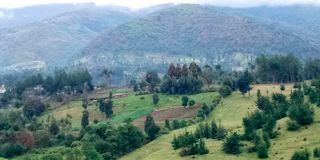
The Aberdare ecosystem showing gradual conversion of land from forestry into agriculture and other related human activities. The $125 billion megafund proposed at COP30 aims to reshape the global forest economy.
What you need to know:
- The fund has secured significant momentum, with initial pledges topping $5.5 billion.
- Norway has committed $3 billion over a decade, while Brazil and Indonesia have each pledged $1 billion.
At the heart of the COP30 climate summit happening in Brazil lies a monumental and contentious proposal: the Tropical Forest Forever Facility (TFFF).
Championed by Brazilian President Luiz Inácio Lula da Silva, this $125 billion megafund aims to reshape the global forest economy.
But beneath its ambitious promise to make living forests more valuable than cleared land, the initiative is mired in a complex debate over financial risk, governance, and its true beneficiaries.
Hailed by President Lula as ‘an unprecedented initiative’, the TFFF's mechanism is simple in theory: raise billions from wealthy nations and private investors, invest the capital, and use the returns to pay up to 74 developing countries for conserving their existing forests. The goal is to create a permanent, self-financing incentive for preservation.
"The launch of the TFFF at COP30 marks a turning point," said Brazil’s Environment Minister, Marina Silva. "For the first time, we have a global mechanism that recognises the value of forest ecosystem services and offers permanent incentives for their preservation."
The fund has secured significant momentum, with initial pledges topping $5.5 billion. Norway has committed $3 billion over a decade, while Brazil and
Indonesia have each pledged $1 billion. The World Bank will serve as the interim host, and a key provision mandates that aAt least 20 per cent of all payments to countries must be allocated directly to Indigenous Peoples and local communities, recognising their role as frontline forest stewards.
A paradigm shift with deep-seated risks
For Africa, home to the critical carbon sink of the Congo Basin, the TFFF's potential is both transformative and troubling. A predictable revenue stream could offer nations like the DRC and Gabon a viable financial alternative to extractive industries or deforestation-driven agriculture.
But civil society groups from Latin America, the Caribbean, and Africa have raised concerns. More than 50 organisations warned in a joint statement that the fund’s structure could trap developing nations in a cycle of debt without guaranteeing forest protection.
Their main worry is that the TFFF depends on global financial markets, which can be unstable. The fund plans to invest mostly in bonds from emerging markets, which are often volatile. If the markets drop, like during the Covid-19 pandemic, payments to forest countries would decrease, even if those countries met their conservation goals.
“In other words, it is ultimately the taxpayers of the Global South themselves who must finance the protection of forests historically deforested by corporations from countries in the North,” the groups argued.
Experts warn that governments might be forced to cut spending on health or education to service bond debts, potentially worsening the drivers of deforestation.
Governance gaps and greenwashing
Another major criticism is the fund’s detachment from the official UN Framework Convention on Climate Change (UNFCCC). Liane Schalatek, a climate finance expert, cautioned that the TFFF risks “further undermining the financial mechanism of the UNFCCC and the Paris Agreement,” where developed nations have a legal obligation to provide climate finance.
Transparency and governance are also major concerns. While the 20 per cent allocation for communities is a positive step, advocates warn that without robust safeguards, funds may not reach the frontline forest stewards. Past initiatives have been plagued by delays and losses.
A particularly alarming risk, raised in a report by the World Rainforest Movement, involves the fund’s separate investment arm, the Tropical Forest Investment Fund. Forest countries will have no say in where their conservation money is invested, potentially financing state-supported “clean” projects like hydropower dams or mining for batteries—ventures often linked to ecological damage and community displacement. The fund’s current exclusion list only explicitly bars coal, oil, and gas, leaving the door open for other destructive industries.
A test for global solidarity
Despite the debates, many see the TFFF as a necessary and bold experiment. Conservation International has labeled it a “watershed in global nature financing” for its attempt to bridge conservation and mainstream finance.
The fund’s ultimate test will be whether it can navigate market risks, ensure equitable benefit-sharing, and avoid financing projects that cause harm under a ‘green’ label. Its success hinges on reaching the $125 billion goal, establishing transparent and accountable management, and bolstering on-the-ground enforcement against illegal logging, mining and trafficking.
The TFFF stands as a powerful symbol of Global South leadership. Yet, its legacy will be determined not by its ambition, but by its execution—proving whether it can truly protect the world's vital forests and the people who defend them, or if it becomes another financial instrument that benefits the powerful more than the planet.


