Don’t just cut fossil funding, finance renewables
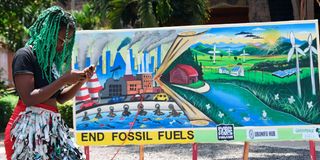
A woman walks past an artwork advocating for the end of the fossil fuels during campaign march at Ubunifu Hub in Nairobi on September 16, 2023.
What you need to know:
- International public finance for fossil fuel projects declined by 78 per cent in 2024, marking a major milestone in the global transition away from dirty energy
- Despite reductions in fossil finance, renewable energy funding rose by only Sh 413.6 billion (USD 3.2 billion), less than one-fifth of the funds freed from fossil fuels. This slow pace threatens to stall the energy transition, particularly in vulnerable countries
Decarbonising the global economy is the hardest challenge humans have ever taken on. It’s an enormous feat with awful consequences if we fail and profound benefits if we succeed. That is why the 78 per cent decline in funding for fossil fuel projects in 2024 is a significant milestone. An indication that the campaign to end international public finance for fossil fuels and pump resources into clean energy is finally bearing fruit.
Findings of a report by the International Institute for Sustainable Development (IISD), however, call for a sobering reflection. While funding for fossils worldwide is significantly declining, renewable energy investments aren’t spiking, at least not fast enough.

Under the Clean Energy Transition Partnership (CETP) launched at COP26, countries and public finance institutions committed to ending international public finance for fossil fuels by 2022 and supporting investments in clean energy. As of last year, many signatories of CETP have honoured their word, slashing public financing for overseas fossil fuel projects by between Sh 1,422 (USD11) and Sh 2 trillion (USD 16 billion), a major milestone in the fossil fuel phase-out journey.
A worrying trend, though, is now emerging. The reduction in fossil funding is not matched by a surge in investments in clean energy. Where, then, is the funding saved from fossils going, if not into the renewables basket?
To put it into context, CETP finance for renewable energy increased by only Sh413.6 billion (USD 3.2 billion) in 2024 compared to pre-commitment levels. Meaning less than one-fifth of the funds shifted from fossil fuels were redirected to clean energy. This is not what the energy transition was meant to look like. Slashing financing for dirty energy does only half the job. Scaling funding for renewables completes the job.
For years, the lack of a strong political and corporate will to starve the fossil industry of resources has meant this polluting sector has grown unchecked. Now, the steep reduction in its financing is the clearest indication yet that, finally, governments and powerful financial institutions are waking up to the reality of our time.
This means the end of fossil fuel dominance is upon us.
Should we celebrate this? Of course, we should. Fossils are losing, and renewables are finally winning. However, the battle is far from being won. Wealthy nations are investing in clean energy, but some resources are sliding back to fossil fuel project financing. It’s like recovering proceeds of plunder and letting the looter keep part of the booty.
Out of the 17 wealthy nations, ten signatories have aligned their energy finance policies with the CETP pledge fully, although loopholes exist. Italy and Switzerland, for instance, have policies permitting fossil fuel financing, while the US, Germany and Switzerland approved in excess of $10 billion in fresh funding for fossil fuel projects between 2023 and 2024.
Such a path is fraught with risks. With the fossil industry already reeling from the blow of declining financing, we cannot slack off. When you wound the enemy in battle, you must finish off the job. Failure to do so puts you in danger of being devoured. It’s a no-brainer that dirty energy interests would capitalise on the gaps left by delayed investments in clean energy to fight back by blocking progress and reversing the gains made so far.
Many energy-poor and climate-vulnerable countries struggle to attract the necessary capital to build clean energy infrastructure. Already weighed down by debt and devastated by the impacts of climate change, countries in the Global South are often unable to put up solar and wind farms, manufacture energy storage, or even upgrade their existing grid.
It’s unjust and unacceptable for Africa, for instance, a continent with nearly 40 per cent of the world's total renewable energy potential, to receive only 3 per cent of the financing for clean energy investment. Even with this staggering potential, inadequate resources delay the prosperity that comes with a clean energy transition.
Having a steady flow of international public finance, therefore, is critical to catalyse clean energy projects, ease the suffering and transform economies. A clean energy finance target of Sh5.42 trillion (USD 42 billion) in emerging markets, as prescribed by the report, would be a solid start.
Obviously, achieving the ambition of a fossil-free future, powered by clean and renewable energy, requires all hands on deck, with political leaders, financiers, policymakers, civil society organisations, and citizens working together. Nothing beats collective action.
By enacting legislation and making fresh commitments to scale renewable energy investments, governments will have set their countries on a strong path to that clean future. They owe this to their taxpayers, who must continually hold their political leaders accountable.
Call to action
Countries have the power to compel public finance institutions, including multilateral development banks and sovereign wealth funds, to ensure that climate and energy transition goals are at the core of their business model rather than an afterthought.
Financiers control the purse strings. By adopting tighter checks on energy projects, they would nip dirty projects in the bud. This would also ensure that only clean energy projects secure funding.
The world has demonstrated that it’s possible to cut fossil fuel funding. Ending its financing is a milestone, not the finish line.
We must now redirect funding towards clean power for the future of the people and the planet.
Victor Odhiambo is a Climate and Energy Strategic Communications Consultant


