Over the decades, every rainy season brings news reports that tabulate human and livestock deaths, the destruction of key infrastructure such as roads, railway lines, and bridges, while agriculture suffers immense losses.
"We have become a country that never learns. Every heavy rainy season leaves us devastated," said Town and County Planners Association of Kenya Chairman, Mairura Omwenga.
He said the recent tragedy of landslides in Elgeyo Marakwet County where over 30 lives were lost should inspire the start of a serious effort to ensure rain does not end being a curse to the nation.
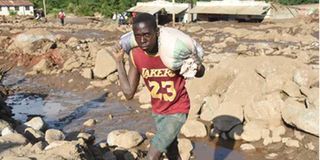
Kenya Red Cross team and locals searching the bodies of victims of a landslide at Kapchebogel village in Baringo North on August 7, 2024.
Photo credit: Florah Koech / Nation Media Group
Another high casualty tragedy occurred On April 29, 2024, when a debris flow swept through Mai Mahiu area in Nakuru County, killing 48, displacing hundreds and rocking the general economy.
The horror stories have persisted in the past such as Kenya Red Cross data that sampled the 1997/98 El Niño rains. The floods killed more than 2,000 people.
Mr Omwenga said: “The problem is deep and multifaceted since it has serious components like climate change, poor formulation, enforcement and administration of land management policies as well as general disinterest.”
On November 6, Interior CS Kipchumba Murkomen told Nation that the government is in the process of addressing the problem.
"We have to ensure that preventable damage remains well in check and where we are ambushed, we ensure our response is timely, well-coordinated and support efforts are effective," he said.
"When the government tries to move people from river banks and politicians lead the vulnerable to resist, when development approvals are haphazardly done without keen interest on waterways, when we destroy water towers and grab water way leaves...we can only demand change of capitalistic culture that pawns human lives," he said.
Deputy President Kithure Kindiki while addressing the Elgeyo Marakwet tragedy had said that "President William Ruto has ordered for the immediate re-evaluation of all rainy season-related risks, areas vulnerable and actions that are both short, mid and long-term in matters mitigation of social and economic ruins be implemented.
Prof Kindiki said the government will work with all stakeholders to ensure the President's directive is attended to immediately.
Former Deputy President Rigathi Gachagua while reacting to the Elgeyo Marakwet tragedy in Murang'a County on November 3 said: “We cannot be a country that waits for people to die so that we can rush there to unleash deceptive bereavement and philanthropy to the victims with an eye on political mileage".
Alfred Opere from the Meteorology Department at the University of Nairobi said enforcement of regulations governing settlement in zones designated as flood-prone has been a major problem in Kenya.
“Enforcement is weak; partly due to weak institutional capabilities as well as humanitarian considerations given this rot has gone on for long; where the illegalities are older than the laws and policies in place.”
Henry Miheso of the Architectural Association of Kenya worries that since independence, 43 per cent of natural disasters are caused by floods.
"We have encroached on nature's waterways, we have neglected our drainage systems, we have become a country of illegal and reckless garbage dumping; hence blocking waterways and lost green spaces that helped in absorbing and slowing down rainwater.”
Eugene Wamalwa, who has previously served as minister for Devolution from March 2018 to September 2021 and Water and Irrigation from July 2015 to January 2018, said. "The biggest problem that we have is having people in government who mint money using tragedies.”
He added: “The weatherman usually gives timely warnings about these tragedies, the cyclic nature of the disasters are well known and what ought to be done is there in a myriad of reports.”
However, he added: “The problem we have is that we have officers both in the national and county governments who would become malnourished should these tragedies be eliminated.”
Trans Nzoia Governor George Natembeya on October 6 told Nation that "you won't tell me that you are building a dam above human habitation for any sane reason".
He added that "you cannot tell people living in landslide and flooding areas to move to safer grounds without telling us where they ought to go and on whose bill".
Mr Natembeya said his last assignment as Rift valley regional commissioner empowered him with vast insights into how tragedies are a powerful source of income by the high and mighty.
"It is the work of government to ensure lives and property are safe. You sense a situation that threatens lives and property and as government you are supposed to respond to it without undue inconvenience to the affected," he said.
Grace Githiri from Kihoto Estate in Nakuru County said over 5,000 people have been displaced by Lake Naivasha's invasion into private lands and human habitation.
“Our situation depicts a brazen abandonment by both the national and the county governments.”