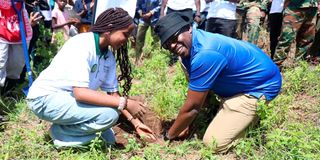
Kenya is turning to what officials and industry figures are calling a "tree economy," positioning trees as economic assets rather than instruments of conservation alone, as the government pushes its target of growing 15 billion trees by 2032.
Speaking at the launch of the Kenya Corporate Sustainability and Leadership Forum, Principal Secretary for Environment and Climate Change Dr Festus Ngeno urged companies to view trees as productive investments rather than charitable gestures.
"Every tonne of carbon your organisation sequesters is an asset. Every hectare your company restores is an investment. Every community you engage is a partner in shared prosperity," he said.
The push comes as Kenya's forest-cover figures have stayed flat for four consecutive years even as timber extraction from government forests has risen. Total forest area has stayed at 5.226 million hectares since 2021, and forest cover has remained at 8.83 per cent of national land through 2025, according to the 2026 Economic Survey. Over the same period, softwood sales from government forests rose from 7,900 true cubic metres in 2021 to 663,100 cubic metres in 2025.
The approach sits within the Kenya Tree Economy Initiative (Ketei), which seeks to link tree planting with jobs, industry and income rather than treating it solely as a climate or conservation programme. Mayiani Saino, deputy director for multilateral environmental agreements at the State Department for Climate Change and Forestry, said Ketei sits within a broader framework that includes the National Landscape Restoration Strategy, climate action plans, land degradation neutrality commitments and the country's biodiversity strategy.
"The ambition is to make restoration economically sustainable rather than dependent on short-lived campaigns," she said.
But the industry meant to anchor that economy says the value chain connecting Kenyan-grown trees to Kenyan industry remains weak. Kaberia Kamencu, chairperson of the Wood, Timber and Furniture sector at the Kenya Association of Manufacturers (KAM), said the country's dependence on imported wood is deepening rather than easing.
"Kenya is a net importer of wood and wood products," Kamencu told Climate Action. "And the situation's been becoming more critical as time goes by."
Kenya imported approximately Sh6.5 billion ($50 million) worth of wood and wood products from its East African neighbours in 2017. KAM projects that Kenya's wood deficit could widen to $500 million by 2030.
Kamencu said about 90 per cent of the wood and wood products used in the government's Affordable Housing Programme are imported, despite the programme representing exactly the kind of domestic demand the tree economy is meant to capture.
"We are seeing a deeply concerning situation, to be honest," he said.
"For a nation seeking to grow 15 billion trees and build a domestic tree economy," he argued, "the programme should be creating a ready market for locally produced timber and wood products."
Kamencu estimated that increasing the share of locally manufactured wood products in the housing programme could retain about Sh12.5 billion in domestic production each year and generate an additional Sh2.5 billion to Sh3 billion in tax revenue.
"If we pull our socks up," he said, "Kenya could become self-sufficient in forestry and eventually move into surplus."
For the tree economy to work, backers say, businesses need to see trees as bankable rather than symbolic. Dr Jackson Koimbori, head of Kepsa Consult and senior circular economy and climate change coordinator at the Kenya Private Sector Alliance, said corporate Kenya is shifting from corporate social responsibility toward environmental, social and governance (ESG) reporting.
"Under CSR, planting trees could be enough to show that a company was doing something for the environment," he said. "ESG is changing that conversation. Companies are now expected to demonstrate the impact of their actions, not simply report that they planted trees."
"Data collection still remains one of the greatest challenges," he said.
There is a gap between planting and growing. A seedling can be counted the moment it goes into the ground, while its survival may not be known for months or years. The national campaign has already faced questions over its figures: one platform was reported to have recorded about 700 million trees, while the ministry reported nearly two billion.
Judith Odhiambo, head of sustainability at KCB Group, said the bank has embedded ESG into its operations since 2014, and that credible data remains essential to financing green projects and preventing greenwashing.
"One of the things that is coming out clearly is that it's important to guard against greenwashing," she said.
Saino said Kenya has made progress in establishing reporting frameworks and involving stakeholders, but remains behind schedule on more difficult areas, particularly carbon emissions and accounting.
Dr Eliane Ubalijoro, Director General of Landscape Alliance, said scientific evidence must guide where public and private capital is invested, including matching species to local conditions and distinguishing areas suitable for commercial forestry from those where planting could cause ecological harm.
Kamencu said the choice of what to plant, and where, will also determine whether the tree economy delivers. He put the country's indigenous tree types at about 421, and said commercial forestry currently relies on a narrower range of species.
"What's the best tree here? What tree will I plant here and will not survive but will thrive?" he asked.
He pointed to dryland forestry as one of the country's biggest untapped opportunities. Kenya's high-potential agricultural areas account for about 13 per cent of its land, he said, leaving large transitional, arid and semi-arid areas where trees could provide new sources of income through timber, fruit, fodder, medicine, gums and charcoal from species such as Acacia tortilis.
"Once we are done with commercial forestry in this 159,000 acres, it is imperative that we focus on dryland forestry," Kamencu said. "The future of this country is in dryland forestry."
Koimbori said the incentive for farmers, manufacturers and banks to participate depends on visible markets and credible data.
"Once we are shown this is a path to money, we are left alone," he said.
He said that means building markets beyond timber, ensuring farmers receive a share of the value created, and expanding local processing so that Kenyan-grown trees supply Kenyan industry instead of being replaced by imports.