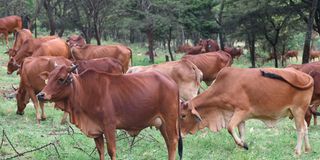
Kenya has received a $42 million grant, equivalent to approximately Sh5.4 billion, from the Green Climate Fund to reduce methane emissions from its dairy sector across 12 counties.
The Dairy Interventions for Mitigation and Adaptation (DaIMA) project aims to reduce national livestock emissions by 20 per cent by 2032.
The announcement was made at a parliamentary breakfast dialogue on methane emissions in Nairobi on Wednesday, where the Principal Secretary for the State Department of Livestock Development told participants that the livestock sector accounts for over 70 per cent of Kenya’s total methane emissions.
“The Livestock Sector contributes 28 per cent of the total national emissions, which is over 90 per cent of total agricultural emissions,” the PS said in a statement. “The main source of these methane emissions is through enteric fermentation, which is 96 per cent of livestock emissions.”
“About 2 per cent of livestock methane is also produced from anaerobic manure management system. About 2 per cent of Nitrous Oxide emissions is also produced when manure is allowed to decompose in open areas.”
Without intervention, the PS warned, total emissions from the livestock sector are expected to increase by 49 per cent from the current level of 31 million tonnes of carbon dioxide equivalent by 2030.
The DaIMA programme is expected to focus on livestock genetics and breeding management, feeds and feeding management, animal health, milk loss reduction and manure management. This, the Ministry of Agriculture says, focuses on improving productivity rather than reducing herd numbers.
“We have identified the most practical pathway to reducing methane emissions intensity by lowering the emissions associated with producing one unit of milk, meat, or eggs,” the ministry said. “This approach focuses on improving productivity, efficiency, and animal health so that each animal produces more output per unit of emissions, thereby delivering climate and economic gains.”
Scientists say that testing diet quality in Kenya’s semi-intensive dairy systems found that improved feeding increased feed intake by 29 per cent, milk yield by 23 per cent, and methane per kilogramme of milk by 15 per cent.
Separately, a study on Kenya’s beef sector identified a 52 per cent methane mitigation potential across arid systems through combinations of better breeds, feeds and disease prevention, without reducing herd sizes.
“It is important for farmers to see that possible reduction of methane can actually be an economic potential, a place for investment,” said Claudia Arndt from the International Livestock Research Institute (ILRI).
The findings on animal health added a food security dimension to the climate argument. Current calf mortality in Western Kenya’s beef systems stands at 16 per cent, with 80 per cent of those deaths caused by preventable infectious diseases.
“Research showed that halving calf mortality would generate enough additional protein to feed the equivalent of 2.2 million people annually, while simultaneously reducing emission intensity. Eliminating preventable calf deaths entirely would meet the protein needs of 4.5 million people,” ILRI’s data indicates.
Kenya signed the Global Methane Pledge at COP28 in Dubai in December 2023, committing to a 30 per cent cut in methane emissions by 2030. The livestock sector, which supports 1.8 million households through the dairy value chain alone and underpins livelihoods across more than 85 per cent of the country’s land mass, is central to meeting that commitment.
“About 150 countries have signed on to the 30 per cent methane reduction by 2030. That’s just four years away,” said Dr John Mutunga, the chairperson of the departmental Committee on Livestock and Agriculture in the National Assembly.
“Methane is a short-lived climate pollutant, yet it is 68 times worse than carbon dioxide. It doesn’t receive as much attention as carbon dioxide. How we handle organic waste also contributes to methane emissions,” Dr Arndt added.
The programme launches amid public sensitivity around livestock interventions. A mass vaccination campaign announced by the government last year triggered a public backlash, with critics linking it to comments attributed to philanthropist Bill Gates about livestock and methane emissions, and to the government’s decision to grant diplomatic immunity to staff at the Gates Foundation’s Nairobi office. The controversy drew widespread attention on social media. It generated significant public debate about the relationship between foreign-funded climate programmes and Kenya’s agricultural sector.
Kenya has also developed a broader national action plan on short-lived climate pollutants covering 20 mitigation measures across energy, transport, waste and agriculture. Researchers project that without policy action, premature deaths from air pollution in Kenya would exceed 25,000 annually by 2050.
The DaIMA programme is part of a wider East Africa initiative and will be implemented through the Kenya Climate-Smart Agriculture Strategy.