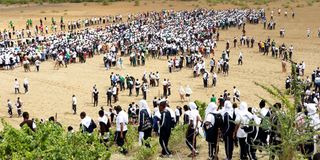
Kenya has set a new Guinness World Record after 4,124 people simultaneously planted mangrove seedlings in less than 30 seconds at Kwa Fara Beach in Jomvu, Mombasa, in a landmark conservation event that brought together thousands of students and environmental enthusiasts from across the Coast region.
The record-breaking exercise, held on Sunday to mark the International Day for the Conservation of the Mangrove Ecosystem, was spearheaded by the Kenya Scouts Association (KSA) and the M-Pesa Foundation.
The beachfront was filled with excitement as students, teachers, environmentalists, government officials and community members came together to demonstrate the role young people can play in combating climate change and restoring damaged ecosystems.
The event aimed to set a new Guinness World Record by having 5,000 people plant mangrove seedlings simultaneously in less than 30 seconds.
After the planting exercise, organisers, together with Chief Forest Conservator Dr Clement Ng'oriareng of the Kenya Forest Service (KFS), collected documentary evidence, including videos, photographs and official records, for submission to Guinness World Records.
Guinness World Records adjudicator Carl Seville outlined the strict rules that had to be followed. These included planting only young and native mangrove species, planting them correctly by hand without using digging machinery and having at least 3,000 participants for the attempt to qualify.
Kenyan Students plant trees during an event to mark International Mangrove Day at Jomvu Kuu Kwa Fara Village in Mombasa, where Kenya Scouts attempted to break yet another Guinness World Record by planting 5,000 Mangrove trees in less than 15 seconds in this photo taken on July 26, 2026.
Photo credit: Kevin Odit| Nation Media Group
After reviewing the evidence and verifying that the guidelines had been followed, Mr Seville officially announced that the participants had achieved a new Guinness World Record with 4,124 qualified participants.
“I want to congratulate everybody involved in this truly incredible achievement,” said Mr Seville, a few hours after the event ended.
The successful record brought international recognition to Kenya while highlighting the country's commitment to protecting its coastal ecosystems. More importantly, the event encouraged young people and communities to continue planting trees and conserving mangrove forests for the benefit of future generations.
Mangrove forests protect coastlines, support marine life, absorb carbon dioxide and contribute to a healthier planet. KSA Chief Executive Officer Moses Danda described the event as a proud and historic moment for Kenya.
Jomvu MP Badi Twalib noted that the area once had abundant marine life, including prawns, but many mangrove trees had been cut down over the years. He encouraged local communities to restore the forests so that marine life and fishing activities can recover.
Environmentalist Truphena Muthoni said oceans produce a significant proportion of the oxygen people breathe and that protecting mangrove forests helps maintain healthy marine ecosystems that support life on Earth.
Also present was former Guinness World Record holder Jimi Cohen from Australia, a conservation champion in Kenya, who is known for setting the record for planting 30,469 mangrove seedlings. He inspired participants by reminding them that millions of people die every year because of polluted air.
Kenyan Students celebrate after planting Mangrove trees during an event to mark International Mangrove Day at Jomvu Kuu Kwa Fara Village in Mombasa, where Kenya Scouts attempted to break yet another World Record by planting 5,000 Mangrove trees in less than 15 seconds.
Photo credit: Kevin Odit| Nation Media Group
Mr Cohen said that collective environmental action, where everyone contributes in small ways, can create lasting positive change and improve the future of the planet.
“I don’t know if you know this but 8.1 million people die every single year because of the air they breathe, but by taking massive environmental action when everybody is doing something, we can actually change the world,” he said.
However, despite the achievement, environmentalists stressed the need for such efforts to be undertaken with strict adherence to established guidelines and procedures.
They explained that, unlike planting other types of trees, mangrove restoration requires technical know-how to achieve high planting and survival rates. The exercise should therefore not be undertaken solely for the purpose of breaking records.
“We’ve always encouraged people to take some time and go through the restoration guidelines to enable them to follow the required steps as that will enhance the planted mangroves' survival rates,” said Dr Chemuku Wekesa, the Regional Director at the Kenya Forest Research Institute in charge of the Coast Eco-Region Research Programme.
He explained that the technical guidelines had been developed by state agencies, non-governmental organisations and international environmental agencies, among others.
According to Dr Wekesa, the National Mangrove Ecosystem Restoration Guidelines prioritise site assessment, hydrological integrity and the principle of ‘right species, right site’ over direct planting. He noted that planting is always designated as the final option after restoring tidal flow and removing other environmental threats.
“Pre-planting and site assessment procedures like hydrology ensure there’s proper mixing of ocean and land water before any planting is done,” said Dr Wekesa.
Jomvu MP Badi Twalib (centre) joins Kenyan Students during an event to mark International Mangrove Day at Jomvu Kuu Kwa Fara Village in Mombasa, where Kenya Scouts attempted to break yet another World Record by planting 5,000 Mangrove trees in less than 15 seconds.
Photo credit: Kevin Odit| Nation Media Group
Mr Nassor Mahfudh, the scout in charge of the Lamu Mangrove Community Forest Association, expressed concern that a focus on breaking world records could have little impact on conservation if organisers failed to follow the required procedures.
“Site evaluation helps to avoid planting in wrong or incompatible microhabitats. Mangroves shouldn’t be planted on bare mudflats, sandy areas, active water channels, or seafronts,” he said, adding that specifications on spacing the seedlings must be considered for the trees to flourish.
Ms Khadija Abdalla, a mangrove community champion, said it was unfortunate that follow-up activities were often not conducted at designated sites where mangroves had been planted to mark certain events.
“Once publicised, many times the people leave the site immediately; there are no scheduled site visits to at least assess the survival and growth rate of the planted mangroves,” said Ms Abdalla.
The environmentalists advised organisers of tree-planting and restoration activities to always seek advice from local coastal communities and Community Forest Associations.
They noted that grassroots knowledge is essential in ensuring correct species matching, selecting suitable tidal zones and conducting long-term monitoring of restoration sites.
Environment, Climate Change and Forestry Cabinet Secretary, Deborah Barasa, led the country in marking the International Day for the Conservation of Mangrove Ecosystems in Mokowe, Lamu County.
Kenyan Students plant trees during an event to mark International Mangrove Day at Jomvu Kuu Kwa Fara Village in Mombasa, where Kenya Scouts attempted to break yet another Guinness World Record by planting 5,000 Mangrove trees in less than 15 seconds in this photo taken on July 26, 2026.
Photo credit: Kevin Odit| Nation Media Group
She commended environmental defenders in Kenya, community scouts, youth and women groups for their commitment in ensuring the government delivers a clean, safe and sustainably managed environment for all. Kenya is home to approximately 61,271 hectares of mangrove forests, stretching along the coastline.
“Despite the mangroves representing only 3 per cent of Kenya’s terrestrial forest cover, they remain virtual for Coastal protection. I am happy that Lamu represents 61 per cent of all the mangroves found in Kenya,” said Ms Barasa.
She said despite mangroves being crucial, they still face degradation, particularly logging.
“We’re working closely with partners to develop more policies that will effectively protect this crucial ecosystem from degradation,” said CS Barasa.
According to CS Barasa, this year’s commemoration provided an opportunity to celebrate progress, strengthen partnerships, and reinforce national commitments towards conserving and restoring Kenya's mangrove forests.