Hello

Your subscription is almost coming to an end. Don’t miss out on the great content on Nation.Africa

Ready to continue your informative journey with us?

Hello

Your premium access has ended, but the best of Nation.Africa is still within reach. Renew now to unlock exclusive stories and in-depth features.

Reclaim your full access. Click below to renew.

Ongoing rains and cloudy skies at the Coast attributed to Congo rainforest, here's how

rain nairobi cbd

Nairobi residents shield themselves from the rain in the city centre on February 22, 2026. The Kenya Meteorological Department recently issued a heavy rainfall alert for large parts of the country.

Photo credit: Dennis Onsongo | Nation Media Group

For the better part of this week, the highlands of Kenya and a few sections of Coast have received heavy rainfall. But in Mombasa and the larger part of the Coast region, all that is witnessed is cloudy days and erratic rainfall.

The latest update from the Kenya Meteorological Department indicates that the 2026 March-April-May long rains started being realised from mid-February over Western, Central and Highland regions, including Nairobi. The South-eastern lowlands and South Coast, however, experienced onset in the fourth week of February, while the North-western and North-eastern regions are expected to experience onset between late March and early April. The North Coast is likely to experience a delayed onset in mid-April, despite intermittent early-season rainfall.
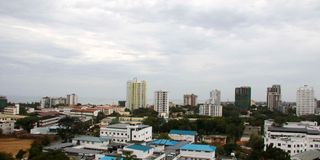
A view of the cloudy skyline in Mombasa

A view of the cloudy skyline in Mombasa on February 24, 2026. 

Photo credit: Kevin Odit | Nation Media Group

Owing to such variations in weather patterns, the Nation interviewed meteorological expert Ngao Leli, who is also the Lamu County Director of Meteorological Services, to shed light on the phenomenon that causes delayed rainfall in majority areas of the Coast region, mostly those neighbouring the Indian Ocean.

----

Q:

What phenomenon causes the variation in rainfall?

A:
This is all attributed to air masses originating from the Congo Forest in the west and blowing eastwards into Tanzania and Kenya. This particular Congo air mass, also called a westerly or north-westerly flow, is the primary driver of the heavy rain in the Kenyan highlands. Coastal regions like Mombasa mostly experience different, less intense weather, such as cloudy days or lighter showers during these periods.
Q:

How often does this occur?

A:
I don’t think there is a specific number of times or occurrences I can categorically pinpoint when the Congo air mass affects the Kenyan highlands and the Coast. What I know is that this scenario can occur at any time, in any season, month or year, and it affects regional weather. Climate models often struggle to predict the exact frequency of these events.
Q:

What’s the connection between coastal clouds and highland rains?

A:
The correlation between the two goes back to the effect of Congo air mass movement. The Congo air mass is highly moist, loaded with water vapour from trees in the Congo Basin rainforest. When the moist, westerly air mass travels east from Congo to Tanzania and then crosses into Kenya, it meets cooler, drier air masses, causing the air to rise, condense and form heavy rainfall, particularly in places like the western Rift Valley, Lake Victoria Basin and central highlands. Relief features such as mountains, hills and escarpments in the highlands force the moist air upward. Mombasa lacks the necessary topography and altitude that are crucial for turning this moisture into heavy rain.
Q:

Does it mean that coastal rainfall is unreliable or unpredictable?

A:
The main reason why Mombasa and parts of the Coast experience mostly cloudy days during rainy seasons is that, for much of the year, the region is dominated by easterly or south-easterly winds from the Indian Ocean. While the Coast can receive rain, the heavy convective activity driven by the interaction between the Congo air mass and the highlands often misses the Coast, resulting instead in high humidity, cloud cover and moderate temperatures.
Q:

At what point can the coastal areas receive heavier rainfall than the highlands?

A:
There are exceptions where the Coast can also experience very heavy rainfall. That happens when other systems, such as tropical storms, are present. The Congo air mass mechanism is typically focused on inland, western and central Kenya. Mombasa and much of the Coast often experience cloudiness without heavy rain due to lowland topography and the influence of dry north-eastern monsoon winds.
Q:

Which parts of the highlands are most likely to receive these rains?

A:
Heavy rains are occurring simultaneously in Nairobi, the Aberdares, the Mt Kenya region and western Kenya. Generally, the western parts of Kenya, central Kenya and the Rift Valley, which are rich in relief features like mountains, hills and escarpments, are likely to receive rainfall. The amount of rainfall at different places depends on the position of the station in relation to the rain-bearing winds. Highland areas such as Mt Kenya or the Mau Escarpment always force moisture-laden winds to rise, creating cool temperatures and heavy relief rainfall on the windward side.
Q:

You mentioned wind systems or monsoons that affect climatic patterns. What is their significance?

A:
Monsoons are crucial weather and climate determinants. For instance, the Coast region, including Mombasa, is dominated by the north-east monsoon from about November to March every year. This wind system is generally dry, resulting in cloudy but mostly dry weather. The south-east monsoon brings rain to the Coast, but the lower altitude limits the strong orographic lift seen in the highlands.
Q:

For the highlands, does distance from the ocean have any influence on their weather patterns?

A:
Definitely, yes. The distance a place is from the sea, whether far or near, has an impact. That’s why coastal areas have a more moderate climate, which prevents extreme cooling and limits very heavy rainfall, while inland highland areas experience greater temperature variations and more pronounced rainfall patterns.
Q:

What signs can help forecast the weather?

A:
People can rely on meteorological department offices for updates, but even without modern forecasting tools, there are other signs one can look for. Beyond standard dark clouds, people in the highlands can expect rain by watching for environmental changes such as increased humidity, sticky air, sudden temperature drops or a distinct earthy smell we refer to as geosmin. One can also observe changes in animal behaviour, like chickens huddling together instead of roosting, which can signal rain. In mountainous areas, water levels in rivers and streams can rise suddenly, even if it is not currently raining where you are. If clouds look like big cauliflowers, it signals that the rain will be very heavy.
Q:

Which other areas experience cloudy weather when it is raining heavily in the highlands?

A:
It is highly likely that if Mombasa is experiencing heavy rain and cloudy days, neighbouring coastal areas and the inland highlands in the region are also witnessing similar, if not heavier, rainfall patterns. Cloudy, rainy conditions in Mombasa are not isolated but part of a wider regional pattern affecting the entire Kenyan Coast, including Lamu, Kwale, Kilifi and parts of the south-eastern lowlands.
Q:

There are coastal counties like Taita Taveta and parts of Kwale that receive rainfall in tandem with the highlands. Why?

A:
Taita Taveta and Kwale receive more rain compared to Mombasa and the rest of the Coast counties, and this has a lot to do with orographic lifting, as I mentioned earlier. Inland hills like the Taita Hills and Dzombo Hills in Kwale force moist coastal air upwards to cool, condense and fall as rain. Mombasa, being flat and at low altitude, experiences convectional cooling that often results only in cloud cover or light drizzle. In addition, Taita Taveta and Kwale border Tanzania, meaning they are among the first areas in Kenya to receive the Congo air mass.
Q:

What can people living in the coastal regions do to adapt to the situation?

A:
People, especially farmers, should adopt climate-smart agriculture. For instance, with the current cloudy situation, it is not yet the ideal time to plant crops. But if you must plant, consider drought-tolerant and early-maturing crops like cassava, cashew, mango and cowpeas, and think about using drip irrigation to avoid disappointments. Significant rain at the Coast is not coming yet.

