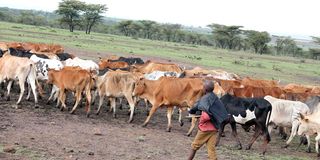
Kenya is banking on a new livestock traceability system to break into premium global markets and shield pastoralists from shocks that have long undermined the sector. The Animal Identification and Traceability System (ANITRAC), linked to the Kenya Integrated Agricultural Management Information System (KIAMIS), is being piloted in six counties - Kiambu, Narok, Siaya, Kitui, Taita Taveta, and Garissa.
Each animal receives a tamper proof Radio Frequency Identification (RFID) ear tag with a unique 15 digit digital identity. The chip stores ownership, health, and movement data, all linked to the national database. Transfers trigger SMS alerts to owners via KIAMIS, who must confirm transactions. At slaughterhouses, carcasses are barcoded, linking cuts of meat back to the animal’s record.
The Directorate of Veterinary Services (DVS) has decribed the system as “One tag. One identity. A smarter future for Kenya’s livestock sector.” The director of the directorate, Dr Allan Azegele, said the technology will strengthen disease surveillance, improve food safety, and build confidence in the livestock value chain.
“When you scan the barcode, you should see the animal was raised in Baringo, transferred to Narok, and slaughtered in Nairobi. That is the future we are building.”
The Animal Identification and Traceability Bill (2026) is expected to provide the legal framework for ANITRAC. It establishes a national database, mandates compulsory registration of animals, and introduces nominal transaction fees at transfer points such as slaughter or export.
“The bill also supports disease surveillance, allows animals to be used as collateral for credit and insurance, and aligns Kenya with international sanitary and phytosanitary (SPS) standards required by the EU, US, and Gulf markets. We intend to achieve compulsory registration. The farmer will not be charged, but there will be a nominal transaction fee at transfer points. This will guarantee sustainability,” Dr Azegele said.
Delegates pose for a group photo at the AU-IBAR forum for pastoral markets in Addis Ababa, Ethiopia, on July 13th 2026. PHOTO|POOL
Exporters say the absence of traceability has been their biggest barrier. Frank Moi, CEO of Chill Zone Logistics, stressed: “We can fatten the animals, vaccinate them, and meet halal standards. But if we cannot prove where the animal came from, when it was vaccinated, and how it was moved, buyers will not pay premium prices. Traceability is the missing link.” He added: “Why I cannot export meat to Europe, the US, or China is because we have no traceability system. It is not rocket science. We need to roll it out fast,” he said. “The market is growing at six to eight per cent per annum. Younger consumers are demanding healthier diets, asking more questions about traceability, and even shifting toward organic feeding. That mix is favorable to us, but it requires new business models,” he added.
The two were speaking at one the sidelines of the 1st African Pastoral Markets Forum in Adis Ababa, Ethiopia. The forum, hosted by the African Union InterAfrica Bureau for Animal Resources (AU- IBAR) also highlighted broader challenges. Pastoral markets across Africa face feed shortages, recurring animal diseases, poor infrastructure, and weak market information systems. In Kenya, reliance on rain fed fodder production leaves herds vulnerable to drought.
“Feed and fodder security is the foundation of everything. Without reliable feed, pastoralists cannot earn more, animals cannot gain weight faster, and Kenya cannot compete as a meat source. Importing 99 percent of our soya is unsustainable,” Frank added.
“Systemic failures in border logistics and resource management create high transaction costs for pastoralists. Improving only one part of the system is not enough. Markets perform best when production, trade, and policy improve together,” Senbeto Funte of the Regional Livestock Programme, noted.
“Namibia has implemented a two step system combining traditional branding with digital tagging, which has allowed it to access premium European markets,” said Calvin Ketshabetswe of the Botswana Investment and Trade Centre (BITC).
Botswana’s traceability system, cited at the forum, is considered one of the most advanced in Africa and has been key to sustaining its beef exports to the EU. Kenya’s ANITRAC is modeled in part on these experiences but is still at pilot stage.
Prof Ruth Kiraka of Strathmore University Business School, presenting Kenya’s Pastoral Markets Development Program, said: “Our vision is to build and scale self sustaining market led livestock systems that transform pastoralist livelihoods. Without structured markets and traceability, pastoralists will continue to lose value.”
Yet the urgency of reform was underscored by recent export shocks. In March, Kenya’s meat shipments to the Gulf collapsed during Ramadhan, leaving tonnes of product stranded and costing exporters millions of shillings each week. Freight costs tripled as conflict in the Middle East disrupted shipping routes and raised insurance premiums. The crisis revealed how over reliance on Gulf markets leaves Kenya exposed - and why traceability is essential if the country is to diversify into Europe, Asia, and the US.
“We don’t know for sure yet when we will fully roll out the system to the rest of the country but we will use the data we get from the six test counties to inform how we proceed,” Dr Azegele said. How the ANITRAC System works • Piloted in Kiambu, Narok, Siaya, Kitui, Taita Taveta, Garissa • RFID ear tags with unique 15 digit IDs • Tamper proof, weather resistant tags • Digital database integrated with KIAMIS • SMS alerts for transfers; owners must confirm • Carcasses barcoded at slaughterhouses for traceability Sources: Directorate of Veterinary Services (DVS Kenya); Kenya State Department for Livestock Animal Identification and Traceability Bill (2026) • Establishes national database • Compulsory registration of animals • Nominal transaction fees at transfer points • Supports disease surveillance and eradication • Enables animals as collateral for credit and insurance • Aligns Kenya with EU, US, and Gulf SPS standards Sources: Kenya Ministry of Agriculture and Livestock Development draft bill; AU IBAR Pastoral Markets Forum.Export Crisis 2026 • Shipments to Gulf collapsed during Ramadan • Tonnes of meat stranded in facilities • Weekly losses in the hundreds of millions of shillings • Freight costs tripled as conflict disrupted shipping routes .