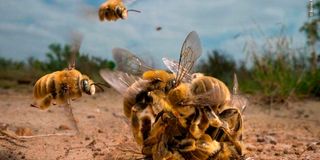
Insects, though small and often overlooked, are essential to life on Earth. They pollinate crops, sustain food chains, and break down dead matter, helping to keep ecosystems in balance. Yet these vital creatures now face a growing threat: rising global temperatures are pushing many species to the brink of survival.
A new study has found that nearly 70 percent of all insect species living in the tropics are already surviving at the edge of their heat tolerance, with little capacity to adapt further.
Kim Holzmann, a postdoctoral researcher at the University of Würzburg, and her team turned to mountains, nature’s own laboratories, where temperatures change rapidly over short distances. Their study spanned the coastal lowlands of Watamu in Kenya, the cool heights of Mount Kenya and the Taita Hills, and, across the oceans, from the Amazon basin to the Andes in Peru.
“By studying insects along these elevational gradients, we could observe how species adapted to different thermal environments without leaving the tropics,” Holzmann explained.
More than 2,300 insect species were collected, representing a wide range of groups including flies, bees, beetles, butterflies, and grasshoppers. The results revealed that across tropical lowlands, insects were living dangerously close to their maximum heat tolerance.
Unlike species in cooler regions, their capacity to adapt, what scientists refer to as ‘plasticity’, was significantly constrained.
“Insects in lowland areas already operate near their thermal ceiling,” Holzmann said.
By contrast, insects in mid- and high-elevation regions showed greater flexibility. Some could temporarily boost their heat tolerance by producing heat shock proteins, molecules that help stabilize cells under stress.
Using advanced modelling, the researchers examined the stability of proteins across different insect species. Proteins are fundamental to all biological processes, and their ability to function under heat stress largely determines an organism’s survival.
Insects with more heat-stable proteins, such as grasshoppers, were better equipped to withstand rising temperatures, while some fly species showed lower tolerance, reflecting less stable protein structures.
“Protein architecture places a fundamental constraint on how quickly species can adapt,” Holzmann noted.
In other words, as the globe gets warmer, some insect species face a very real risk of extinction—with serious consequences for our own survival.
Shifting to cooler places
In range shifts, insects are responding to climate change by moving to regions with more suitable temperatures.
“Insects can sometimes avoid heat by moving into cooler microhabitats,” Njoroge explained.
With global warming, the rising temperatures are accelerating development rates, meaning insects mature more quickly than before.
However, this often comes with biological trade-offs, including smaller body sizes and reduced reproductive output.
“The rise in warmer temperatures leads to faster development of insects, giving rise to smaller individuals that lay very few eggs,” Njoroge noted.
In an interview, Laban Njoroge, an entomologist at the National Museum of Kenya, explained the significance and impacts of insects in our ecosystems.
“Only one per cent of people globally understand the importance of insects in our ecosystems,” Njoroge said.
“The rest, 99 per cent, tend to view them as harmful.”
Insects play a vital role in agriculture, with about 75 per cent of global food crops relying on animals for pollination, the majority of which is carried out by insects.
Additionally, insects remain an important and affordable source of nutrition, especially where access to conventional protein is limited or expensive.
“Many communities feed on insects since it is a very cheap source of protein,” Njoroge said.
“Beef is expensive for most people, but insects provide a very cheap source of protein.”
A wide variety of arthropods are consumed, including termites, caterpillars, mopane worms, locusts and crickets. These are harvested in different regions, particularly in Western Kenya and along the coast, where insect consumption is deeply rooted in local diets.
“In the coastal area, the Mijikenda community consume the mopane which is locally known as ‘Maungu’,” Njoroge said.
Dried Mopane worms.
Photo credit: Shutterstock