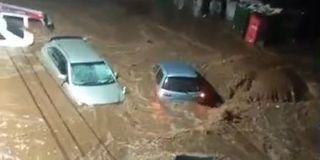
By the time floodwaters swallowed roads, homes and businesses in Nairobi earlier this year, the warnings had already been issued.
Meteorologists had predicted above-normal rainfall. Forecasts had pointed to possible flooding. Yet, when heavy rains hit parts of the Kenyan capital in March, scenes from submerged estates and stranded motorists resembled what one official later described as "a horror movie."
For many African countries, that contradiction has become painfully familiar. Climate warnings are becoming more accurate, but the continent remains dangerously unprepared for the disasters that follow.
It is that growing gap between climate information and real-world action that Ishaam Abader, director of the Regional Coordination Office at the World Meteorological Organization (WMO), says has become a central concern within the organisation.
Speaking to Climate Action, Abader warned that Africa still lacks the systems, infrastructure and capacity needed to confront increasingly extreme weather patterns.
"Africa continues to face extreme weather events from floods to droughts," he said. "I think there's a lot more that the continent can do to ensure that it is prepared."
His remarks come as African countries aexperience a surge in climate-related disasters threatening food security, infrastructure and livelihoods. From prolonged droughts in the Horn of Africa to devastating floods in Kenya, Nigeria, Libya and South Africa, climate shocks are becoming more frequent and more severe. Yet, despite contributing the least to global greenhouse gas emissions, the continent continues to bear some of the harshest consequences.
"We contribute the least to the climate crisis, yet Africa continues to pay one of the highest prices through devastating floods, droughts and food insecurity."
One of the core problems is the uneven state of weather and climate monitoring systems across the continent. While some countries have relatively advanced forecasting infrastructure, others struggle with basic observation equipment, weak data-processing systems and poor dissemination channels.
"Not all countries are on the same level," he said.
A country may have weather stations capable of collecting data but lack the computing power to analyse it quickly. Others may generate forecasts but fail to communicate warnings effectively to vulnerable communities. The result is a fragmented climate preparedness system across the continent.
That weakness is becoming more dangerous as extreme weather intensifies. Urban populations are growing rapidly, informal settlements continue expanding into high-risk areas, and pressure on ageing infrastructure is exposing millions to floods, heatwaves and drought.
In Kenya, the March floods exposed not only the destructive power of extreme rainfall but also deeper questions about urban planning and disaster response.
"We give the warnings, but what happened?" He asked. "What really happened that we ended up where we are? Is it planning? What is it? I think this conversation is ongoing."
Experts say this disconnect between science and decision-making is one of the biggest obstacles to climate resilience on the continent. Even where forecasts exist, warnings are often ignored, poorly communicated or disconnected from policy implementation.
To address those weaknesses, the WMO has been running programmes to improve Africa's climate observation infrastructure, including the Systematic Observing
"The goal is to strengthen climate forecasting, disaster preparedness and adaptation efforts across vulnerable regions," Abader said.
But forecasting improvements alone will not be enough. In many African cities, drainage systems remain inadequate, urban planning regulations are poorly enforced and emergency response structures are underfunded.
"Preparedness also depends on governance, planning, investment and public awareness," Muriuki said.
Agriculture, one of the sectors most exposed to climate shocks, is already feeling the pressure. Across East Africa, changing rainfall patterns are disrupting planting seasons and threatening food security. Abader believes climate outlook forums and early warning systems can help farmers and governments prepare.
"If you anticipate more than normal rainfall, or alternatively, drought, and you issue that warning in advance, there's an ability for the agricultural community to take adequate measures," he said. That could mean changing planting schedules, shifting crop varieties or improving water storage. Still, many small-scale farmers across Africa lack access to timely weather information, limiting their ability to adapt.
Beyond agriculture, a debate is now emerging around technology. Artificial intelligence and machine learning are rapidly transforming weather forecasting globally, raising questions about whether Africa can use digital innovation to overcome long-standing capacity gaps.
Abader believes it can. "We are encouraging the use of alternative technologies such as AI and machine learning," he said, arguing that for nations with limited monitoring infrastructure, AI may offer a faster and potentially cheaper path to better forecasting.
But analysts warn that without investment in local institutions, internet connectivity and technical expertise, digital forecasting tools may struggle to reach the communities most at risk. There is also concern about African countries' heavy dependence on foreign funding to strengthen their climate systems, raising questions about long-term sustainability.
Despite the challenges, Abader sees reasons for cautious optimism, pointing to growing recognition among governments and international institutions that adaptation, not just mitigation, must be prioritised.
"Mitigation is one aspect, but adaptation is also very, very important," he said. "That reality is becoming increasingly visible across the continent."