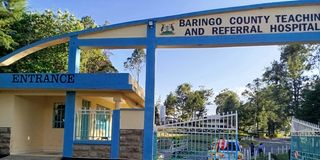
Around 4.50 pm last Monday, a couple arrived at the emergency entrance of Baringo County Referral Hospital in Kabarnet town.
The man carried a toddler who groaned in pain and appeared seriously unwell. Without pausing at the waiting bay, the couple hurried straight into the consultation room, where a handful of medical interns were juggling multiple patients.
A few minutes later, after stabilising the toddler, the interns delivered crushing news that the hospital’s laboratory was not operational, having been shut for over a week due to a strike by technicians.
The parents were instructed to carry out essential tests at private facilities in the town. Hurrying back to their vehicle, the toddler still groaned in pain.
Minutes later, the emergency entrance was again a scene of urgency. Another group arrived with a sick woman lying on a mattress in a Probox vehicle. The patient groaned in pain as relatives pleaded for help.
A nurse instructed them to wait for a stretcher, which was unavailable because the only working one was being used for a CT scan, while the backup stretcher was broken, missing a wheel.
The woman remained in the vehicle for more than 10 minutes before eventually being wheeled into the consultation room, where an overwhelmed intern was attending to other patients, and deficiencies in the system were starkly evident.
“Our laboratory is not operational at the moment. Patients are sent to private facilities for tests, except for emergencies such as blood cross-matches,” one intern explained.
At the hospital pharmacy, prescribed drugs were largely unavailable, save for paracetamol. Patients were being instructed to purchase essential medication elsewhere.
For Baringo residents, this chaos is neither surprising nor new. The county hospital has become a waiting room for disaster.
A site visit confirmed a serious service breakdown and a worsening health crisis. Patients were being wheeled in on makeshift mattresses, queues spilled outside the emergency doors and medical interns struggled to attend multiple cases with minimal supervision. Laboratories, theatres and specialty clinics remain largely non-functional. Families were being turned away and directed to private facilities, sometimes risking patients’ lives in the process.
The hospital has previously come under scrutiny for poor services and alleged negligence. Residents describe the situation as pathetic and persistent, accusing county health authorities of failing to address long-standing service delivery challenges.
Over the years, locals have repeatedly raised concerns about poor services, lack of essential drugs, broken equipment, understaffing, delayed care, and poor working conditions for health personnel.
Last September, a family from Kolowa in Tiaty accused the facility of negligence after their son, a Form Four student, died from an intestinal obstruction.
Ms Rosaline Lolgisoi, a resident of Endao in Marigat, recounted her ordeal two weeks ago while seeking care for her 15-year-old daughter. Referred from Marigat Sub-County Hospital, her daughter was admitted to the referral hospital on January 5 but could not undergo tests because the laboratory was closed.
Ms Lolgisoi, who is relying on the SHA medical scheme, had no funds for private testing and could only purchase some prescribed drugs with borrowed money.
“My daughter was treated without the tests because we couldn’t afford them. Even the pharmacy lacked essential medicines,” she said. She borrowed Sh2,000 to purchase drugs at a private pharmacy.
A section of the outpatient section at the Baringo County Referral Hospital in Kabarnet.
Photo credit: Florah Koech | Nation Media Group
“We are left wondering why a referral hospital can operate with a closed laboratory and an empty pharmacy. Emergency patients are at risk because clinical officers are on strike, leaving medical interns to run the facility,” Ms Lolgisoi added.
A spot check by the Daily Nation revealed the full extent of the crisis. Medical interns on duty were overwhelmed, struggling to cope with a growing stream of patients without supervision, as over 30 clinicians and specialists are currently on strike.
The hospital’s laboratory was deserted, conducting only emergency blood cross-matches. The theatre was handling only emergency surgeries, while other departments—including ENT, ophthalmology, reproductive health, and specialty clinics—remain closed and non-operational.
Philip Yator, Secretary-General of the Baringo County Kenya Union of Clinical Officers (Kuco), confirmed that more than 160 clinicians went on strike on December 15 over unresolved issues with promotions and re-designation under a signed agreement with the county government.
“The strike has halted services across all six sub-counties. Theatres are not working because anaesthetists are clinical officers on strike. Patients are being attended to by interns, which poses serious risks,” Mr Yator said.
He added that the union has sought legal enforcement of career progression guidelines, but the county government has yet to comply. “We went on strike before Kuco declared the national strike. We are advising our employer to implement the agreements so we can return to work.”
“The clinical officers are on strike. We have a staff shortage, but we are trying to offer emergency services. The laboratory is closed, but we are handling emergencies only,” he said.