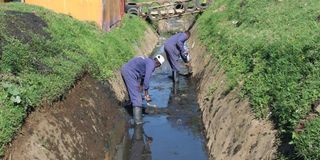
With a handkerchief covering her nose and mouth, a gunny bag slung on her back and shoulders, Ms Betty Lang'at, a fruit vendor, jumps over a manhole spewing raw sewage onto the road in Bomet town.
Her worn-out black rubber shoes step on spilled sludge as she steadies her steps to avoid slipping and falling. Pocketing her handkerchief with her face wincing, she uses the wet grass by the road to wipe her shoes clean before proceeding with her journey.
“In most parts of the town, the sewer lines are blocked or broken, leading to raw sewage being emptied into the spaces. The manholes are located with the waste flowing downstream,” Ms Lang'at told the Nation .
The waste snakes its way into the nearby storm water drainages, the roads, homesteads, business premises and is eventually washed down to the nearby River Nyangores.
Raw sewage at a burst manhole in Bomet town centre.
Photo credit: Vitalis Kimutai|Nation Media Group
It is an eyesore and a health hazard to the residents, who have had to endure the pungent smell for weeks, without intervention from the county or national government.
Stephen Mosonik and fellow shoe shiners stationed at Highway Petrol station at the town centre have had to endure the foul smell in the last two weeks, with no remedy provided by the Bomet County government.
“The sludge has caused a bad smell for the last two weeks that has led our daily customer base to seek services in other areas, thus depriving us of revenue,” Mr Mosonik said on behalf of other small-scale traders.
Mr Mosonik said small-scale traders have repeatedly raised the issue with the Bomet Water and Sanitation Company (Bomwasco), but no action has been taken.
“This has become unbearable and the inaction by the county government is unfortunate,” Mr Mosonik said on Monday, with demands from the local business community for action by the devolved unit.
The same situation is replicated in other parts of the town, especially near the Bomet University College (BUC), the county headquarters and the county commissioner’s residence.
The stench assaults residents in local hotels and eateries, making it unbearable for the customers who have been exposed to the risk of contracting diseases, including cholera, dysentery and typhoid.
“Pollution of Nyangores River is at an all-time high, yet this is the main source of water for the residents of Bomet town, who are now exposed to the risk of contracting water-borne diseases,” Mr John Lang'at, a resident of Chebirir in the outskirts of Bomet town said.
Mr Lang'at said pollution of the Nyangores River, which empties its water to Mara River, poses a health risk to people, aquatic life, livestock and wildlife downstream.
The Mara River, which runs through the Mara Game Reserve, is a key tributary of Lake Victoria, a regional water source and the largest freshwater lake, that empties its water into River Nile.
Bomet town has a sewage system with a 3.7-kilometer sewer line, initially designed for the core-urban population of 7,035 people.
It was constructed by Wamunyoro Construction Company Limited in 2014, at a contractual cost of Sh 134,799,107.
The system was extended by 4.8 kilometers in 2019, with the funding from the World Bank under the Kenya Urban Support Program (KUSP),which raised the population covered by the sewer line to 9,300.
Stephen Mosonik, a shoe shiner showing raw sewage flowing from a manhole into a stormwater drainage in Bomet town.
Photo credit: Vitalis Kimutai|Nation Media Group
The Bank gave a Sh 168 million grant to Bomet County,towards urban upgrade, which included – re-carpeting of roads, Bomet main market upgrade, construction of storm water drainage and extension of the sewer lines.
Bomet Municipality, according to the 2019 National Population Census had a population of 42,024, but the numbers are expected to have increased almost tenfold, due to the rural-urban migration dynamics.
The sewerage system operates at an average of 300 cubic metres daily, which is below its capacity of 700 cubic metres with a small percentage of the town residents covered ,due to the topography of the area.
The waste treatment plant is located next to the Bomet University College and is served with lines classified as – Godown, Gvn, Highway Bypass, KWFT and Prisons sewer lines.
Rapid growth in Bomet town has been realized in the last 15 years, following the advent of devolution, with the opening of Bomet University College with a population of around 7,000 students.
Recently, the university admitted 3,150 first-year students,a move that has piled up pressure on real estate developers, with high demand for housing units.
Mr Kipngetich Towett, the acting Managing Director of the Bomet Water and Sanitation Company (Bomwasco), said the firm was doing all it could to address the emerging issues, which have been complicated by heavy rainfall.
“By nature, sewer lines flow by gravity with valleys, hills and ridges being natural barriers. It is quite a challenge and capital intensive to onboard all households in a developing town like Bomet, to the sewer line,” Mr Kipng'etich said.
“Bomwasco has an exhauster serving Bomet town and adjacent trading centres, public and private institutions that is extended to the five sub-counties – Bomet East, Bomet Central, Konoin, Sotik and Chepalungu,” added the water firm boss.
Bomet town is also faced with an environmental challenge, following the lack of a proper solid waste disposal site.
The current dumpsite is located next to the 220 Affordable Housing Units, which are 97 percent complete and set to be opened soon by President William Ruto.
But currently,the Bomet County government is involved in a spat with the Kenya Prisons department, over the location of the dumpsite with each side laying claim to a designated site, which is also adjacent to the housing units.
An attempt to resolve the matter in the last seven years, has become a challenge with neither side agreeing to cede ground to end the stalemate.
A heap of waste has become an eyesore to the residents, with the waste washed to Nyangores River during rainy season, thus further polluting the water source, that is already choking from waste.
The Bomet Water and Sanitation Company also sources the water supplied to the residents from the river. A water treatment plant is set up next to the river.
Bomet town also faces an acute water shortage, which has persisted for the last one year with Bomwasco unable to pay Kenya Power for electricity supply with an outstanding bill of over Sh 20 million.