Hundreds of herders relocate in search of pasture, water as drought bites
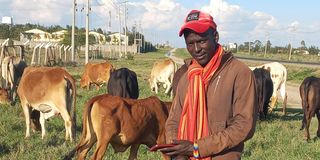
Raphael Teishi, a herder from Kajiado West sub-County, relocating his cattle to the neighbouring Machakos County in search of pasture on November 11, 2025.

Hundreds of herders in Kajiado County are relocating to neighbouring counties in search of pastures as the dry spell in the region persists.
In September 2025, the Kenya Meteorological Department (KMD) had warned that most parts of the country would experience below-average rainfall between September and December.
Last week, the National Drought Management Authority (NDMA) identified Kajiado County among the Arid and Semi-Arid Lands (Asal) counties drought hotspots. At least 64,300 are currently facing starvation.


In addition, NDMA noted that the current food insecure population across the Asal counties is estimated at 1.8 million people and is projected to rise to approximately 2.14 million by January 2026, owing to the anticipated below-average performance of the October to December short rains.
In most parts of the vast Kajiado County, including parts of Kajiado East, Central, South and West sub-counties, the pasture is diminished, leaving the ground bare, albeit with a few shrubs. Most parts of the parched rangelands are characterised by cracked earth, withering plants amid flowering Ipomea weed-anxious for non-forthcoming rains!
Several herders are said to have abandoned their homes and moved to other areas in search of pasture and water. Parts of Kajiado Central and West have been hard-hit by the simmering drought.
A devastated Ms Mary Saitoti from Olorngosua village in Kajiado Central told Nation the husband left their home a fortnight ago to Taita Taveta in search of pastures. MS Saitoti, like co-wives and neighbours, have been left to look after the children.
"Only women and children have been left in most homes. Men have relocated with animals. We have been left without food or enough milk to feed our families. We depend on well-wishers, “Said Ms Saitoti.
The same sentiments were echoed by Mr John Mutunkei, who said the herders have been restocking their herd in the last three years of plenty of pastures after the 2020-2022 dire drought.
During the drought period, at least One Million animals died,400,000 heads of cattle and 700,000 goats and sheep, of hunger and at least 400,000 households faced starvation, entirely depending on relief food, according to NDMA 2021 data. Then, a mature cow retailed for as little as Sh500, dampening the spirit of farmers.
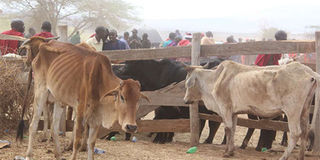
Emaciated cows wait for buyers at the Bisil cow market in Kajiado County. The persistent drought has forced pastoralists to sell their animals for as low as Sh 5oo. PHOTO | JOSEPH NGUNJIRI | NATION MEDIA GROUP
"We (herders) are now vulnerable after three years of plenty of pastures after the 2022 drought. It’s getting worse each day. Most of herders have relocated to other parts of counties and to Machakos, Makueni and Taita Taveta counties but the pasture is not enough. Soon,we will begin witnessing mass animal deaths, “Said Mutunkei, a herder.
In some parts of the county, cases of animals being supported to be on their feet has been reported. At Ilbisil livestock market, a mature healthy bull is selling between Sh150,000 and Sh180,000 while an emaciated mature animal is selling below Sh40,0000, a drop from a minimum of Sh100,000 six months ago. Goats and sheep prices remain minimal, at least for now.
Kajiado County Commissioner Michael Yator has called for the relocation of herders to consult the natives in the rangelands they target to avoid pasture- related conflicts.
"Let's our herders relocating their animals to peacefully engage their host locals to avoid pasture-related conflicts as the government moves in earnest to come up with a mechanism to cushion drought-hit families, “Said Mr Yator.
Kajiado Members of County Assembly (MCAs) are reaching out to the executive to come up with a raft of measures to cushion drought-hit families and their animals.
Ildamat MCA Joseph Mutunkei has urged Governor Lenku administration to factor in a drought kitty in an ongoing supplementary budget preparation.
"We fear for the worst with the ongoing drought. Let us move with speed to have a kitty to cushion drought hit families. It’s the responsibility of a government to protect its people and their animals, “Said MCA Mutunkei.
Kenyawa-Porka MCA Bernard Moloma wants the county government to reach out to Kenya Wildlife Service (KWS) to allow herders neighboring National parks to be allowed to graze in the parks during the dry season.
Kajiado pays homage to Amboseli National Park, Kyulu Hills National Park, part of Tsavo East and neighbours Nairobi National Park to the south.
"During the rainy seasons, wildlife roam in our private and communal lands. The co- existence ought to see herders allowed to graze in the parks during the drought periods, “Said Moloma.
Kajiado County boasts of an annual turnover of Sh3.2 billion. Thousands of heads of cattle are sold in its main markets of Ilbisil, Shompole, Kimana and Emali. However, the number of animals has shrunk in the last five years due to annual drought caused by climate change.
Follow our WhatsApp channel for breaking news updates and more stories like this.