Social media has become a daily source of entertainment, news, education and connection in the digital age. Yet inside many households, the same platforms that people use to cure boredom can quickly turn into battlegrounds of control and violence.
For millions, platforms such as Instagram appear harmless. But behind closed doors, the freedom they offer can provoke suspicion, jealousy and coercion in abusive relationships.
This was the reality for 24-year-old Ms Nuru Ibrahim. For her, joining Instagram was a simple step into the digital world. However, she did not know it would become the trigger for her death.
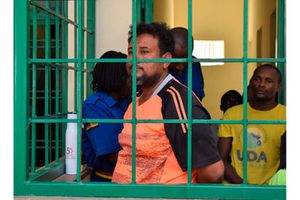
Murder suspect Murad Awadh Mbarak who is accused of killing his wife Nuru Ibrahim in June 2022, when he appeared before the High Courts in Mombasa on March 17, 2025.
Photo credit: Kevin Odit | Nation Media Group
Her husband, truck driver Murad Awadh Mbarak, used her online activity and a debt allegedly owed to him by her brother to threaten, intimidate and ultimately kill her. He has now been found guilty of murder in a case that exposes the deadly intersection of social media, financial pressure and domestic violence.
The murder took place on June 19, 2022 at Majengo Kanamai in Kilifi. The prosecution called 10 witnesses, including the couple’s children, relatives and neighbours, to explain what transpired before and after the killing that shocked the community.
Although no documentary proof of marriage was presented, Mbarak admitted they were married and had five surviving children, with one having died earlier.
Mbarak painted a picture of a loving and peaceful marriage, but witnesses familiar with the couple contradicted this. The deceased’s sister, Nasra Ibrahim, her uncle, Said Omar, and her cousin, Salama Mohammed, testified before Justice Wendy Micheni that the couple frequently quarrelled, often requiring family intervention.
The disputes mainly revolved around money. Ms Ibrahim had sold her jewellery to contribute to building their matrimonial home, though the property was registered solely in Mbarak’s name. The court also heard that he had lent money to the deceased’s brother, Ali, and although their father had partially repaid the loan before his death, Mbarak continued to demand the balance, despite being advised to wait for the conclusion of succession proceedings.
Witnesses further said that Mbarak was enraged by his wife’s decision to join Instagram, fearing it would expose her to public scrutiny or interactions with male followers.
Murder suspect Murad Awadh Mbarak who is accused of killing his wife Nuru Ibrahim in June 2022, when he appeared before the High Courts in Mombasa on March 17, 2025.
Photo credit: Kevin Odit | Nation Media Group
Because of these persistent conflicts, Ms Ibrahim expressed a desire to separate and divorce him. Her sister, uncle and cousin confirmed this to the court and added that she had asked for a refund of her contribution to the construction of the house so she could start a new life elsewhere.
Ms Nasra told the court she had spoken to her sister two days before the murder about these problems. She added that on May 1, the deceased had taken her handbag containing important documents, including allotment letters and the birth certificates of their six children, to her sister for safekeeping, along with some clothes.
“The accused had threatened to either kill or maim the deceased and to post her nude photographs on social media should she attempt to leave him,” she said.
Mr Omar testified that three days before the killing, Mbarak called him complaining that his wife had joined Instagram. Two days later, another dispute arose in the morning, and he intervened, urging them to reconcile.
“Later, around 3pm, Mbarak called again saying his wife wanted to go to the police to obtain a P3 form. I advised him to allow her to do so and promised to visit later,” he said.
However, that evening he received a call informing him that Ms Ibrahim had died. The court also heard that on June 17, the accused told a friend that the deceased wanted to separate and threatened that if she left him, he would post her nude photographs on social media to ensure no other man would want her.
The couple’s 11-year-old daughter gave a harrowing account of the events. She testified that she woke to her mother’s screams shouting, “You are killing me!”
She ran to the bedroom and found her father beating her mother with a broken piece of wood from a baby’s cot. Her mother was naked while her father wore a blue T-shirt and trousers.
Murder suspect Murad Awadh Mbarak who is accused of killing his wife Nuru Ibrahim in June 2022, when he appeared before the High Courts in Mombasa on March 17, 2025.
Photo credit: Kevin Odit | Nation Media Group
Neighbours, including Ms Rehema Salim, were also awakened by the screams. Ms Salim said that at around midnight on June 18, she heard cries of “I am being killed!” She rushed to the house and called out. Mbarak opened the curtain but refused to open the door, saying his wife had betrayed him.
“I saw the deceased bleeding from the eye and screaming while completely naked. We pleaded with the accused to open the door, but he refused,” she said.
When neighbours attempted to unlock the door using keys given by the daughter, Mbarak stabbed at their hands through the opening with a knife, forcing them to retreat. Police were eventually called, and he later surrendered.
A knife and broken wooden pieces were recovered as exhibits. Forensic analysis showed that both the knife and the accused’s clothes were stained with blood matching the deceased’s DNA profile.
The court found that Mbarak had a case to answer for the murder of his wife, who was only 24.
In his defence, he claimed an intruder had attacked them and inflicted the fatal stab wound. He also alleged that he had just returned from a long journey.
This was refuted by his employer, who testified that Mbarak had not been employed for some time and had only asked for work that day. Witnesses confirmed that no one else was in the house except the accused, the deceased and their children.
In a judgment delivered on November 14, Justice Micheni ruled that the eyewitness accounts, combined with forensic evidence linking Mbarak to the murder weapon and the deceased’s blood, proved beyond reasonable doubt that he inflicted the fatal injuries.
On malice aforethought, the judge noted that Mbarak had previously threatened to harm the deceased and vowed to “do something to her so that no other man would want her”.
“On the night of the murder, he locked the deceased in the house, broke a baby’s cot to obtain a weapon, assaulted her severely and eventually stabbed her. He refused to open the door even as she lay dying,” the court found.
The judge added that when the deceased asked for water, neighbours urged him not to give it as she was dying, yet he still gave it and stood by as she said her final prayers.
“His conduct in preventing help and attacking neighbours who attempted to intervene clearly demonstrates deliberate and calculated cruelty. The accused’s actions were deliberate, brutal and motivated by jealousy,” the judge said.
In the end, the court concluded that all elements of murder were therefore proven beyond reasonable doubt. He now awaits sentencing.