Despite his disappearance in the wilderness, a journal kept by Moses Kahindi during his time in Shakahola forest is now proving crucial in helping the prosecution understand events that unfolded before the tragedy became public in April 2023.
Kahindi, a member of the Good News International Church led by preacher Paul Mackenzie since 2008, was described by his sons, Jimmy Mganga and Samuel Mwavita, as a meticulous record keeper who documented every aspect of his life in the forest. His notes, contained in four books and several papers, have been handed over to the prosecution and police.
On Monday, the two appeared before Mombasa High Court Judge Diana Kavedza, confirming that the handwriting in the diaries was their father’s. They said he vanished after writing his final wishes in the forest.
Lady Justice Diana Kavedza Mochache at the High Court in Mombasa during the Shakahola case hearing.
Photo credit: Kevin Odit| Nation Media Group
“My father kept records of church activities from March 2015 to March 2023,” Mr Mganga testified during the hearing, in which Mackenzie and 30 followers are charged with murdering 191 children.
The diary traces when Kahindi and his family left their home in Sosobora Village within Malindi Sub-county, for Shakahola. The entries are neatly dated and subheaded.
Under the guidance of Senior Assistant Director of Public Prosecution Jami Yamina, the court was informed of some entries relevant to the case. The first is recorded at 10:30am on December 28, 2020, under the title Jangwani – Kuhamia Katika Jangwani (Migration to the Wilderness), marking the day they left their home.
“That was the day my father left everything for a new land described as peaceful,” said Mr Mganga. According to the notes, Jesus was to guide them to this new land of peace.
Prosecution Witness Jimmy Mwavita Mganga testifies before Lady Justice Diana Kavedza Mochache at the High Court in Mombasa.
Photo credit: Kevin Odit| Nation Media Group
The next section, Jangwani 2021 – Waliovuka Ng’ambo Ya Pili (Those Who Crossed to the Other Side), records the first deaths. On March 12, 2021, a woman named Julia died and was buried in the forest.
On July 6, 2021, another death occurred, that of Caro Kwamboka’s child. By December 11, 2021, more deaths had been recorded, followed by others in 2022, beginning with Solomon’s child on January 20, 2022.
Later entries, under 7/08/2022 – Masharti Jangwani (Wilderness Regulations), record rules introduced by Mackenzie. His team led by Evans Sirya visited Kahindi’s home to announce them.
Followers were forbidden from going to Malindi without permission, children were barred from leaving the forest, outsiders needed clearance from Mackenzie, and believers were encouraged to stay indoors awaiting Jesus.
“I know Evans Sirya, he was my father’s friend,” said Mr Mganga.
The diary shows that the last death of 2022 occurred on December 12, and many more followed in 2023, starting with a woman named Florence on January 15. Between March 3 and 11, 2023, seven children died. Overall, Kahindi recorded 38 deaths between March 2021 and March 2023 in his diary.
“My father was a careful record keeper. My mother gave my brother Samuel the diaries and our land title deeds in March, as instructed by my father,” said Mganga. He said this happened shortly before their father disappeared.
The diary also records violence in the forest, including an incident on February 19, 2023 when Kahindi assaulted his wife Joyce Kachi, injuring her hands.
A later entry on 9/03/2023 titled Kuomba Msamaha Jamii Yangu Jangwani (Seeking Forgiveness from My Family), records his public apology after attending the burial of four children.
He wrote, “I forgive my children, even those not present. Let them also be forgiven.”
Mr Mganga admitted he had quarrelled with his father after he withdrew his sister from school due to his beliefs.
“I reported him to the police. He was detained, and our relationship soured,” he said under cross-examination by Mackenzie’s lawyer Lawrence Obonyo.
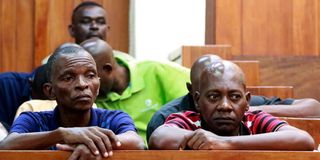
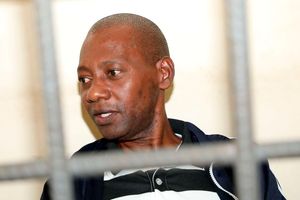
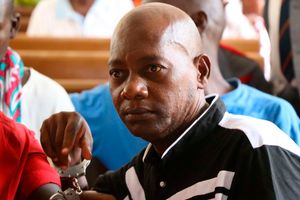
Pastor Paul Mackenzie with other accused persons who is charged with the murder of 191 Children in the Shakahola Massacre.
Photo credit: Kevin Odit| Nation Media Group
In the final entry dated March 11, 2023, titled Ufunuo Wake na Wosia (His Revelation and Will), Kahindi gave burial instructions and divided his property, stating that his body should not be sought after death but buried at Gethsemane.
“He told us not to look for his body and that he be buried at Gethsemane,” Mr Mwavita said, adding that he visited his mother that month and found her frail but unable to help.
The diary ends with the prayer, “Jesus help our hearts so that we may enter everlasting happiness. Amen”. This was written shortly before Kahindi vanished.
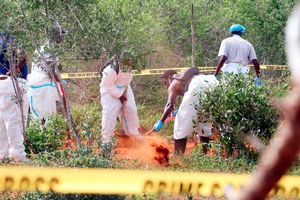
His sons say they do not know where he, their mother, and three siblings are. DNA samples have been submitted, but no results have been released to confirm if their remains are among those at the Malindi mortuary.
Another witness, Samuel Chome, a former church elder, said he attended the GNI church in Furunzi to learn preaching but left after hearing disturbing sermons.
“Mackenzie preached that if children hindered parents from going to heaven, they should be eliminated,” he said, referring to teachings in 2019 before the church’s closure.
Mr Chome testified that he later met Mackenzie’s followers in Chakama, where he runs a business, and saw them migrating to the forest before the ‘land of peace’ turned into a mass grave. He said Mackenzie's followers initially built mud-walled houses roofed with iron sheets but later switched to makuti thatch to avoid traceability.
“One follower told me iron sheets had serial numbers and could be tracked,” he said.
Mr Chome was later arrested but released after it was established he was not a follower. He became a state witness, having only interacted with Mackenzie’s followers in Chakama.
Meanwhile, Mackenzie has formally filed a petition challenging his alleged mistreatment at Shimo la Tewa prison, where he is being held after he was denied bail in various cases he is facing.
In his petition at the High Court in Mombasa, where he has sued the in charge at Shimo la Tewa prison, he claims that he has been subjected to mistreatment, including isolation, being served food with glass particles and threats to denial of sunlight. He wants a declaration that the treatment subjected to him violates his rights under the Constitution and also seeks an order restraining further mistreatment.
In the alternative, the suspect wants the court to order his immediate transfer to another prison. Through Lawrence Obonyo Legal Advocates, Mackenzie claims that the actions against him amount to torture, cruel, inhumane and degrading treatment.
“The respondent’s failure to act lawfully threatens the constitutional order and fosters a culture of impunity within public institutions. The petitioner’s life and dignity must not be sacrificed at the altar of institutional inertia,” argues Mackenzie.
He also seeks an order directing a formal report by the officer in charge Shimo la Tewa prison detailing the treatment, security arrangements and his welfare while in custody. Mackenzie is further seeking general and exemplary damages for violation of his constitutional rights and for malicious and reckless administrative action.
In the meantime, through an application, he wants pending hearing and determination of his petition, the court does issue an order restraining Shimo La Tewa Prison authorities from subjecting him to isolation, torture and inhuman treatment. Justice Jairus Ngaah directed this case to be mentioned on October 12.