At the dusty centre of Kwa Bi Nzaro, laughter drifts across the air as schoolchildren chase after a worn-out football on the playground of the local primary school.
They kick with abandon, their dreams pinned on becoming the next football legends. To them, this is just another ordinary day in the village, filled with innocence and ambition.
A homemade stretcher used to carry bodies of cult victims of Kwa Binzaro tragedy to the graves pictured on August 30, 2025.
Photo credit: Billy Ogada | Nation Media Group
Yet, just five kilometres away from their carefree game, beyond the scrubby bushes and into the shadows of Chakama Ranch, lies a world where joy has been replaced by dread, where hope was manipulated into horror.
Unknown to many locals, a portion of Shakahola Forest inside Chakama Ranch had been quietly transformed into a “holy wilderness” by a sect that drew members from across Kenya.
This was no simple congregation. It was a secretive and deadly movement that turned faith into a weapon, and starvation into “a path to salvation””. The group’s operations were hidden, its rituals chilling, and its leader, believed by investigators to be 30-year-old Sharlyne Anindo Temba, was arraigned in a Kilifi court alongside others last week.
Kwa Bi Nzaro cult prime suspect Sharlyne Anindo Temba at the Malindi Law Courts in Kilifi County on September 12, 2025.
Photo credit: Kevin Odit | Nation Media Group
The Nation’s own journey to Kwa Bi Nzaro began with resistance and obstacles. Our first attempt to reach Ms Temba’s homestead, the suspected headquarters of the cult, could not continue as planned owing to darkness and the danger of stumbling upon wild animals.
Days later, we gained access to the epicentre of what investigators now call “Kilifi’s new death trap,” a grim replica of the Shakahola tragedy of 2023.
During his last visit to the site, Inspector-General of Police Douglas Kanja revealed that at least 34 bodies and over 100 human remains had been exhumed from these grounds. Each exhumation peels back another layer of a grotesque story of belief gone astray.
Walking from Kwa Bi Nzaro centre without a guide, one could easily miss the hideout. To the untrained eye, it appears as just another clearing among the countless patches of wilderness that make up Chakama Ranch.
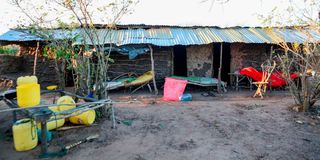
Yet, inside this fenced compound, five mud-walled structures held the weight of both indoctrination and death. Investigations reveal that Ms Temba acquired five acres of land here for Sh20,000, paying Sh10,000 upfront to a local elder, Karisa Gona.
A shallow grave at Kwa Bi Nzaro in Kilifi County on August 30, 2025.
Photo credit: Billy Ogada | Nation Media Group
At the gate, a crude barrier of twigs and branches opens onto a compound that seems ordinary, until one steps closer. Beside the entrance is a large pit, which police established as the source of the mud used to construct the huts.
One structure, known by investigators as the “holding bay”, contained three rooms, each representing a stage of descent.
The first room, closest to the gate, was the reception area. Newcomers to the cult began their indoctrination here, surrendering food, then water, their bodies slowly collapsing under the strain.
Morticians carry the remains of a person exhumed at Kwa Binzaro village within the vast Chakama Ranch in Kilifi County on August 28, 2025 as part of investigations into a suspected cult.
Photo credit: Brian Charo| Nation Media Group
Those who lasted 12 days of fasting without rebellion earned promotion and privileges. They could eat modestly, guard others and had proximity to leadership.
The second room housed those already weak, their bodies wasting away, bones protruding through their skin, eyes sunken, still clinging to the promise that suffering was a passage to eternal life.
The third room was a chamber for the dying, its floor covered with black PVC sheets. It was here that final breaths were taken.
When death came, it was methodical. Victims were stripped, wrapped in the PVC sheets, and their clothing discarded into a pit dug just behind the structure. The corpses were then ferried to another hut, the “mortuary”.
“This room, which we now believe to have been the mortuary, had ash on its floor. We suspect this was to aid in concealing the smell of dead bodies before they were buried,” an officer privy to the investigation and without authority to speak to the media said.
“It appears the priestess had to be present before any burial took place, and therefore, the need to store the dead in that room before they were interred as they awaited her next visit,” the officer added.
Beyond this grim cycle of starvation and death, life in the compound appeared deceptively simple. The kitchen, still strewn with yellow 20-litre jerrycans once used for cooking oil, scattered plates and a makeshift hearth of three stones, bore witness to the meals prepared for the guards and overseers.
Residential houses at Kaoyeni Village in Malindi, Kilifi County, where the Kwa Bi Nzaro prime suspect Sharlyne Anindo Temba (inset) lived.
Photo credit: Kevin Odit | Nation Media Group
A select few—tasked with enforcing order—ate and remained strong enough to control the weak. Their quarters, guarded and subdivided, were armed with pangas. Their duties were clear: prevent escape, bury the dead and quash dissent.
The guards’ brutality was matched by their vigilance. They patrolled the thorn-fenced perimeter, ensuring wild animals did not stray into the compound and that no desperate member slipped away to expose the sect’s secrets. Ironically, it was the successful escape of a follower in July that ultimately blew the lid off the group’s activities, drawing investigators into the thickets of the ranch and setting in motion the grisly unearthing now unfolding.
As one moves deeper into the ranch, the bushes thicken, thorny shrubs tearing at clothes and skin, elephant footprints pressed deep into the soil, their circular impressions evidence of the giants that migrate from Tsavo East National Park in search of water.
Hyena tracks, smaller and pointed, appear beside them—a haunting reminder that even predators roamed these paths, scavenging shallow graves when human cruelty left bodies poorly concealed.
“We are a bit lucky because the elephants have just crossed heading to Bi Nzaro in search of water. Hyenas often follow them because they know they will find water,” our chaperone explained.
Morticians carry the remains of a person exhumed at Kwa Bi Nzaro village within the vast Chakama Ranch in Kilifi County on August 28, 2025 as part of investigations into a suspected cult.
Photo credit: Brian Charo | Nation Media Group
White ribbons tied to branches mark the trails detectives carved through the wilderness, each one leading to a patch of earth where human remains were exhumed. Blue cardboards with neat inscriptions—B6, B9, B11—dot the landscape, each “B”representing a body pulled from the ground.
Some graves were heartbreakingly small, proof that children had not been spared the sect’s doctrine. In one, a woman was found with her child at her feet. In another, a body had been torn open by scavengers, its innards scattered across the soil.
The stench of decomposition lingered in many of these sites. Attendants at Malindi Mortuary later confirmed that, alongside bodies, detectives retrieved countless body parts in various stages of decay.
“Most of the bodies brought here were mostly skeletons of people. It appears some of these bodies could have been buried long before they were discovered,” an attendant told the Nation days later.
Carrying corpses through this unforgiving terrain was a task requiring stamina and knowledge of the land. Wooden stretchers, cushioned with grass wrapped in cotton sheets, were found in the holding bay. These crude tools were used to transport the dead at night, when the sect’s activity was least likely to draw attention. Each trip ended at a shallow grave, sealing the fate of those who once sought salvation.
The tragedy is not just in the numbers of the dead, but in the silence of those nearby, too. Shortly after the story broke, a local man who lived near Ms Temba’s compound vanished. His home, consisting of two mud huts, stands deserted.
“The person must have feared that he, too, will be arrested because he knew he would have been grilled on how he could have been living nearby and not known what was happening next door,” an officer privy to the investigations said.
A cordoned off area at Kwa Bi Nzaro where shallow graves were discovered.
Photo credit: Billy Ogada | Nation Media Group
At the edge of the site now stands the operations centre, where Red Cross staff and police coordinate exhumations. Retrieved bodies were first gathered here before being transported to Malindi Mortuary. White tents flap in the coastal breeze, temporary sanctuaries of order amid overwhelming chaos.
Like the cult in Shakahola before it, the Kwa Bi Nzaro one lured the faithful with promises of redemption but delivered only hunger, pain and graves. In 2023, Paul Mackenzie is believed to have convinced his followers that fasting would lead them to Christ, all while he himself lived comfortably. Hundreds died, buried in the same forest now hiding this new chapter of horror. With Kwa Bi Nzaro, history is repeating itself.
For the children kicking footballs in Bi Nzaro centre, the tragedy unfolding just a short walk away is almost unimaginable. Their laughter is the sound of life, untainted by manipulation. Yet the presence of shallow graves nearby is a grim reminder of how faith can be exploited, how the thirst for salvation can be twisted into a weapon, and how the quietest places can hide the darkest truths.
The story of Kwa Bi Nzaro is not yet complete, as investigators continue to piece together the role of the chief priestess, the extent of her following, and the exact number of lives cut short in her so-called holy wilderness. But what is clear is that in the thick forests of Chakama Ranch, hope was turned into horror, belief into bondage, and faith into a death sentence.
As elephants cross Kwa Bi Nzaro every evening, silently in search of water, and hyenas prowl for scraps through the vast wilderness, the whispers of those who walked here before—hungry, weakened, desperate—seem to hang in the air. Their stories are buried in the soil, unearthed one shallow grave at a time, each body a testament to the cost of blind devotion.
Kwa Bi Nzaro is no longer just a name on a map. It is a scar on the land, a cautionary tale etched into the history of Kilifi, and a chilling reminder of how easily salvation can be turned into suffering.